The father’s “hoodlum” delusion
EileenThe father’s “hoodlum” delusion is the persecutory fantasy that unseen enemies are watching, taunting, and infiltrating Eileen's father's life. It transforms shadows, police visits, and the sounds of a house into signs of a conspiracy centered on him. His daughter recognizes that the enemies are imaginary, but her attempts to contradict him do not loosen his conviction. The delusion is especially consequential because it joins his drinking, the loss of his independence, and the presence of his gun in their home, making private life feel governed by threats that Eileen's father invents and cannot put aside.
The imagined conspiracy
One scene begins with Eileen giving her father a warning letter from Officer Laffey. Eileen's father dismisses it as merely for appearances, then describes figures he calls hoodlums moving quickly through hiding places around the property. He says they watch and taunt him, and interprets his own snowballs thrown from a window as a way of showing that he knows what they are doing. The police warning, which might ordinarily indicate that officials are responding to a concern, is absorbed into his theory: their involvement, too, becomes part of the performance surrounding a supposedly hidden plot.
The threat soon crosses the boundary of the house. Eileen's father says the figures have entered through the basement, move through the rooms, and may be living inside the walls. He compares the sounds he attributes to them to rats and calls them black ghosts. He connects the supposed persecution to the mob and explains police presence as protection earned through his past service to the town. His account gives a single conspiratorial meaning to locations and institutions that would otherwise be separate: the house is penetrated, the mob is behind the danger, and the police are present because of it.
Drinking and the collapse of ordinary explanations
Eileen answers plainly that her father is drunk. He denies having been drunk for years and describes the beer he is holding as a way to calm his nerves. The exchange sets his stated explanation of his behavior against Eileen's assessment, while showing how the delusion and alcohol operate together in the household. In a later recollection, she describes him as tortured by the imagined hoodlums day and night and says that drinking is his recourse. His belief is not an isolated story he tells once: it supplies an ongoing account of why he drinks and why the world around him feels dangerous.
Eileen also describes the delusion as extending into her father's dreams. She tries to tell him that the threat exists only in his mind and that nobody is pursuing him. He scoffs and pats her head as if she were a child. Eileen understands that his cruel remarks come from a confused, intoxicated man, but that understanding does not erase their effect. Her account holds together two truths: her father is not accurately perceiving a real conspiracy, and his behavior still makes life at home frightening and hurtful for her.
Retirement and public behavior
After Eileen's father retires, the chief of police takes away his driver's license following dangerous incidents: he drives the wrong way on a freeway and later parks in a public cemetery. With driving no longer available to him, he stays home more often, but the imagined investigations continue on foot. He goes out during blackouts, knocks on neighbors' doors to conduct searches he has invented, draws his gun at shadows, and lies in gutters or in the road. These actions show how the supposed campaign against him moves beyond private speech and shapes his conduct in public.
The police sometimes bring him home quietly and then scold Eileen for allowing the situation to get out of hand. Their response offers a stark contrast with his theory that they are guarding him from the mob: in practice, they return him to the house and place responsibility on his daughter. One extended absence makes that responsibility concrete. After a six-day drinking bout, Eileen receives a call from a hospital two counties away and drives there to collect him. Afterwards, she gathers his shoes and locks them in her car's trunk to limit his ability to leave on foot. She keeps the key around her neck. The practical precaution makes her father's loss of independence part of her daily routine, even as the delusion remains his own.
Family memory and the gun
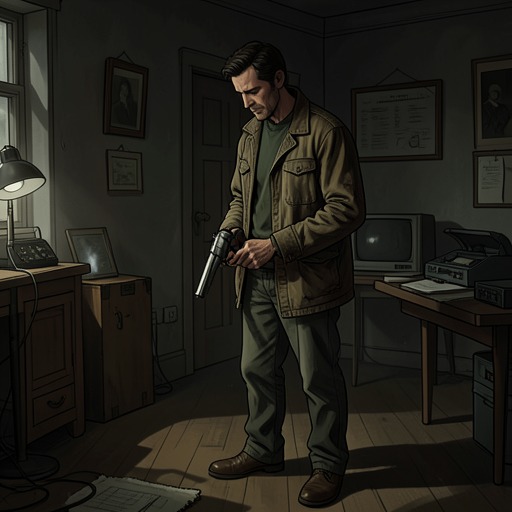
The imagined enemies recur in the language Eileen remembers from her childhood. Her father waves his gun while calling the figures the devil's spawn, linking his supernatural and conspiratorial fears to an object that had already been part of family life for years. When Eileen was growing up, he cleaned the gun at the kitchen table and explained its mechanics as a warning about the danger of touching it or distracting him. She recalls being frightened by it, though she says it was simply part of the household scenery. In adulthood, its presence takes on sharper significance alongside her father's later gestures toward shadows.
The delusion also gives Eileen's father a heroic identity that conflicts with Eileen's view of his actual life. He imagines himself as a vigilante battling evil and believes his work against the mob could require witness protection. Eileen counters that there was no mob in X-ville and that his police work had amounted to little more than routine traffic stops. Her recollection exposes the gap between his grand account of himself and the ordinary facts she supplies, without making his disorientation harmless. The repeated figures in hiding, in the house, and in dreams make the delusion a persistent structure of his experience; for Eileen, they accompany the drinking, fear, and obligations that define life with him.