The ideal of being a “real lady”
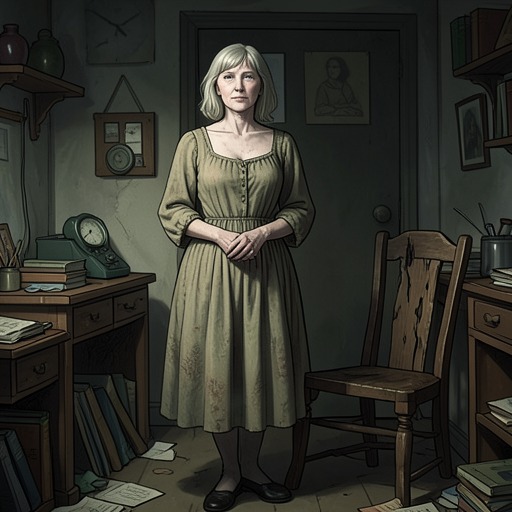
EileenThe ideal of being a “real lady” is the standard of femininity and respectability through which Eileen imagines remaking herself. It first appears as a bodily ideal—thin, shapely, and beautiful—then expands into a program of proper conduct, from eating regular meals and dressing well to keeping house and dating. Eileen’s retrospective account makes the ideal consequential but unstable: she longs for its promise of transformation even as she imagines a future beyond the life it prescribes.
Origins in bodily shame
Eileen remembers disliking photographs of herself and describes a childhood body measured against standards she could not meet. She was a pudgy, pale girl who struggled in physical education; her mother bought clothes a size too small in the hope that Eileen would change to fit them. As she grew older, she remained short and became slight. By the time she left X-ville, she had become so thin that she likened herself to a scarecrow, a condition she says she preferred even while recognizing that something was wrong.
The ideal promised that this body could be corrected through adulthood. Eileen imagined growing six inches and becoming shapely and beautiful, and vowed to eat and dress better when she was grown. The aspiration joined self-improvement to a fantasy of physical transformation: becoming a proper woman seemed to mean not merely behaving differently, but finally inhabiting a body she could approve of.
Rebecca and the imagined future
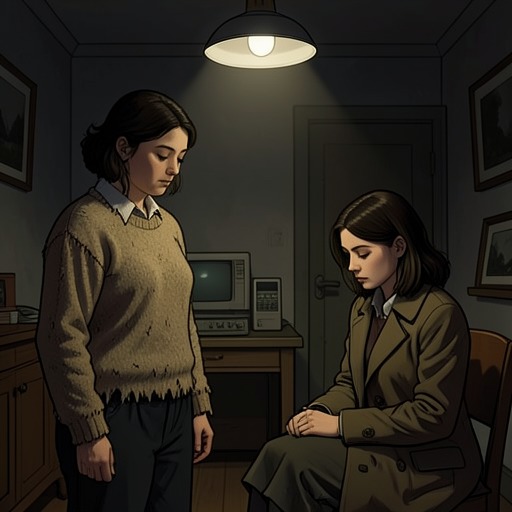
Eileen measures herself against an imagined image of Rebecca: narrow hips, long, elegant thighs like those of fashion models, and a healthy glow. Rebecca becomes more than a model of appearance in Eileen’s thoughts; Eileen hopes she might guide her in where to go, how to dress, what to do, and how to live. The wish gives the ideal a personal dimension. Eileen does not only want to conform to an abstract standard; she hopes Rebecca can show her how to enter a life that feels otherwise inaccessible.
That future is not wholly defined by conventional respectability. Before meeting Rebecca, Eileen imagined moving into a shabby apartment or a women’s boardinghouse, where ordinary freedoms—reading newspapers, eating a spotted banana, walking in a park, or sitting in a room like a normal person—would be precious. Alongside that modest vision sits a more grandiose ambition: she wants to do something important and imagines looking down on the world from a skyscraper, able to crush anyone who crossed her. The two fantasies reveal the range of what transformation means to her, from basic privacy and ordinary ease to power over those who have hurt or disregarded her.
Respectability as a corrective script
In imagining the Christmas she might have wanted without Rebecca, Eileen lists the rules she might have imposed on herself to avoid having to go alone: eat three meals a day, sit still like a good girl, keep a diary, attend church, pray, wear clean clothes, have nice girlfriends, date boys, go steady, and do laundry. She also imagines a conventional family scene, complete with a lavish meal, a loving mother, a gentle grandfather, a dog, and a fire. This is a counterfactual account, not a description of the Christmas she actually experienced or a settled plan she carried out.
The list makes the ideal less a single appearance than a discipline of everyday conduct. Its repeated promises—be good, be orderly, be clean, belong to a family, follow familiar courtship customs—offer a model of safety and social acceptance. Yet Eileen presents this imagined conformity as something she might have clung to because she feared forging a path alone. Respectability promises protection by making her legible as a proper girl, but it also asks her to regulate her appetite, movement, sexuality, and daily routines.
Limits and afterlife
Eileen’s later perspective does not portray escape as an instant cure or as the fulfillment of every earlier fantasy. She says that leaving X-ville allowed her to start over, but did not solve all her problems. Her account of the life she eventually built emphasizes comfort, care for others, emotional openness, and gratitude for another day. It does not present those qualities as proof that she has become the flawless, beautiful woman she once imagined; instead, it locates change in a life made over time, outside the simple promise that proper habits or appearance would transform everything.
The ideal therefore remains double-edged in Eileen’s story. It gives shape to her longing for a future and supplies a concrete vocabulary for self-reform, but its standards are entangled with childhood humiliation and fear of isolation. In retrospect, the possibility of beginning again matters more than perfect compliance: the prescribed role may have offered Eileen an imagined route to belonging, while the life she describes ultimately depends on having found another way to live.