Straightedge
ElementsStraightedge is the controlled drawing instrument through which Euclidean construction turns an abstract geometric requirement into a visible operation. Its importance lies not in measurement or ornament but in the disciplined production of straight lines: within the system presented here, a construction is performed with the straightedge and Compass, and its validity is established by demonstration.
Definition and Geometric Status
The work identifies the straightedge and Compass as "the only instruments" permitted in Euclid, or plane Geometry. This restriction is the purpose of the postulates: the instrument is not merely a convenient classroom accessory but part of the conditions under which a legitimate construction may be made. The straightedge supplies the means for drawing a straight line between designated points, while the accompanying geometric system determines what may be concluded from that act.
The restriction also separates Euclidean construction from ordinary practical drawing. The text defines a proposition as a result obtained through reasoning and distinguishes between problems, which propose that something be done, and theorems, which assert the truth of a principle. A problem may require a line to be drawn under given conditions, a circle to be described, or a figure to be constructed; its solution must show how the requested operation can be performed with the straightedge and Compass. The demonstration then proves that the indicated process actually reaches the required end.
Operations in Construction
The earliest postulate grants that a straight line may be drawn from any one point to any other point. This statement gives the straightedge its foundational operation and places the tool within a formal sequence: points are given, a straight line is drawn between them, and later conclusions depend on the construction having been made according to the postulated rule.
The straightedge is also implicated whenever a line is produced. To produce a line is to extend or prolong it, increasing its length; the added portion is called its produced part, or production. The same instrument therefore supports both the initial connection of points and the continued formation of the lines used to define angles, parallel straight lines, and plane figures.
The proposition sequence makes this operational role concrete. Book I opens with a problem requiring construction on a given finite straight line, and later propositions call for drawing a straight line perpendicular to a given indefinite straight line from a given point. In these procedures the straightedge does not, by itself, guarantee the desired relation. It draws the lines that the construction requires; the accompanying circles, intersections, definitions, postulates, axioms, and demonstrations establish that the resulting figure has the asserted property.
Relation to the Euclidean System
The straightedge operates inside a framework whose basic objects and principles are deliberately separated. Definitions state what entities such as points, lines, and angles are; postulates grant allowable constructions; axioms state general truths taken to be self-evident; and demonstrations derive the conclusions of propositions from these foundations. The straightedge belongs chiefly to the constructive side of this structure, but its marks become geometrical knowledge only when the reasoning proves what they accomplish.
This distinction is reinforced by the account of superposition, the process by which one magnitude may be conceived as placed upon another so that corresponding parts exactly coincide. Such a principle belongs to the reasoning by which equality and other relations are established, whereas the straightedge supplies the drawn lines that make the configuration available to inspection. The tool thus stands at the boundary between operation and proof: it creates the diagram, while the demonstration converts the diagram's arrangement into a warranted conclusion.
Visual Teaching and Intellectual Discipline
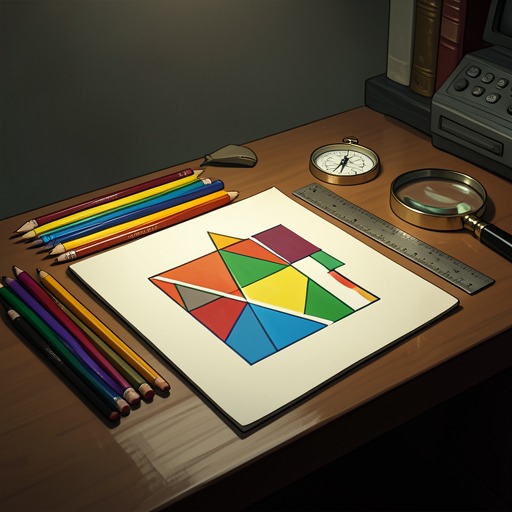
The straightedge is especially significant in a book whose introduction argues for visual instruction. The work says that colour and illustration are not introduced merely for entertainment, but to assist the mind in its search for truth, facilitate instruction, and diffuse permanent knowledge. Because the straightedge produces the central linear forms of the diagram, it participates in this larger pedagogy: the learner sees relationships embodied in lines before following the reasoning that establishes them.
That visual emphasis is not presented as a rejection of proof. The introduction criticizes instruction that hides reality beneath ostentatious formalities, endless repetitions, and perplexing demonstrations, yet it still treats geometry as a discipline that develops inquiry, elevates the mind, and strengthens reasoning. The straightedge therefore represents a balance between visibility and rigor. It makes the construction legible to the eye without replacing the logical work required to show that the construction is correct.
Significance
Within the book's educational argument, the straightedge is a small but decisive instrument of access. Geometry is presented as foundational to arithmetic, land-surveying, mensuration, engineering, navigation, mechanics, hydrostatics, pneumatics, optics, and physical astronomy. A tool that permits elementary lines and more elaborate constructions to be made under common rules helps connect the visual beginnings of the subject with the wider practical vocations dependent on its propositions.
Its strict limitation is therefore productive rather than restrictive. By allowing only the straightedge and Compass, the system concentrates attention on what can be constructed from simple operations and justified through definitions, postulates, axioms, and demonstration. In the coloured and visually oriented presentation of the Elements, the straightedge is both a practical means of making the figure and a symbol of the book's larger method: teach through what the eye can grasp, but make every geometric result answer to reason.