Compass
ElementsThe Compass is a foundational construction instrument in Euclid’s geometry. Its decisive significance lies in the way it joins physical operation to deductive proof: together with the Straightedge, it defines the permitted practical means of plain Geometry, while the propositions show that operations performed with those means can yield established geometrical relations.
Definition and Geometrical Status
The instrument enters the system through the third of Euclid's postulates, which grants that a circle may be described with any centre at any distance from that centre. The postulate does not merely mention a drawing device; it establishes the geometrical legitimacy of transferring a chosen distance around a centre to form a circle. The Compass therefore operates at the boundary between an ideal mathematical object and the controlled act by which that object is represented.
The book distinguishes this instrument from the figures and magnitudes considered in the geometry itself. A circle, its centre, and its radius belong to the conceptual vocabulary of plane figures, while the Compass supplies the permitted means for describing the circle. The resulting construction is not treated as an empirical measurement but as a step whose validity can be incorporated into a proof.
Place in the Euclidean Method
The Compass is explicitly paired with the Straightedge as one of the only instruments permitted in Euclid, or plain Geometry. The restriction is presented as the purpose of the postulates: geometry begins by stating which elementary operations may be assumed, rather than allowing unrestricted mechanical assistance. This limitation gives the instrument methodological importance. It makes construction reproducible and keeps the proof tied to a small, defined set of operations.
Within the book's classification of propositions, a problem proposes that something be done, such as drawing a line, describing a circle, or constructing a figure under given conditions. Its solution must show how the required object can be made with the Straightedge and Compass; its demonstration must then prove that the indicated process really attains the required end. The Compass thus belongs not only to the practical vocabulary of drawing but also to the logical architecture that separates construction from demonstration.
Construction, Superposition, and Proof
The instrument's operations are understood within a wider system that includes definitions, postulates, axioms, and superposition. Superposition is the conception of placing one magnitude upon another so that every part coincides exactly. In this setting, a distance established by the Compass can participate in comparisons and coincidences without being reduced to an informal visual estimate. The drawn circle becomes a stable basis for constructing or testing relationships among lines, angles, and figures.
The book's opening propositions immediately place construction at the centre of the work: Book I begins with a problem whose heading calls for action on a given finite Straight line, and later propositions include drawing a perpendicular to a given indefinite Straight line from a given point. Although the surviving headings do not reproduce every Compass movement, they locate the instrument within the practical sequence through which Euclidean figures are made. The instrument's importance is consequently cumulative: each permitted construction prepares the conditions under which a later theorem can be demonstrated.
Material Tool and Educational System
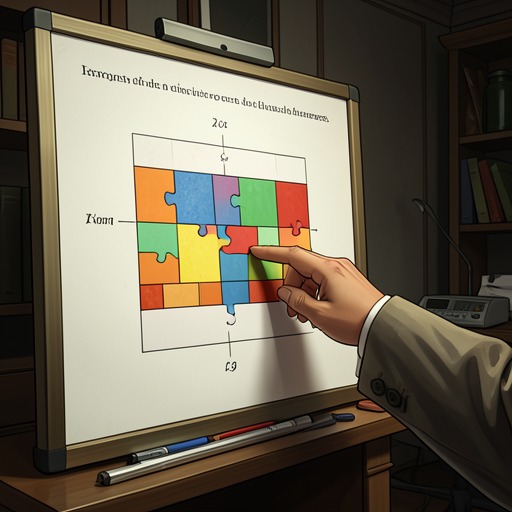
The Compass also supports the book's larger account of geometry as an intelligible, teachable practice. The work argues that diagrams make relations more immediate when visual parts can be identified by their forms and colours, while insisting that colour merely names a line or part and has nothing to do with its mathematical magnitude. This distinction parallels the status of the Compass: the physical mark is useful for access to the idea, but the proof concerns the geometrical relation rather than the material appearance of the mark.
The broader pedagogical claim is that geometry should impress reason, fact, and proof on the understanding rather than train students to commit demonstrations to memory. Coloured diagrams are presented as especially effective because sight and hearing can be addressed simultaneously in oral teaching. Tangible diagrams are also described as a medium through which geometry and other linear arts and sciences can be taught to blind learners, while the visual system is said to suit the needs of deaf and non-speaking learners. In this educational programme, the Compass is one component of a disciplined constructive language: it helps make abstract relations graspable, but those relations remain accountable to definition and demonstration.
Significance
The Compass embodies the characteristic economy of Euclidean Geometry. A small and sharply restricted instrument is granted a precise operation; that operation produces circles and transfers distances; and the resulting constructions become premises within proofs derived from the system's accepted foundations. Its significance is therefore not ornamental or merely technical. It represents the book's conviction that mathematical knowledge can be built from simple, public acts whose consequences are secured by reasoning rather than by authority, memory, or the persuasive appearance of a diagram.