Southeast Washington, D.C.
ErasureSoutheast Washington, D.C. is presented as a neighborhood of concealed hardship only blocks from the National Mall and Capitol Hill. It is where Lisa Ellison chooses to practice medicine, and where her clinic becomes the setting for both her daily care of patients and the violence that ends her life. The neighborhood’s significance lies in that collision: the capital’s public monuments are near, but so are homes boarded against intrusion and a community whose needs demand sustained local care.
Setting and Conditions
Thelonious Ellison describes a city adept at hiding poverty, then measures that concealment against conditions in Southeast Washington. Near the National Mall and Capitol Hill, where tourists gather, residents cover windows with towels to keep out rain and nail boards across doors at night. The contrast is not between distant worlds but between places separated by only a few blocks.
Lisa lives above Adams-Morgan but practices in Southeast, which she regards as the place where people live. Her decision locates her professional life in the neighborhood rather than among the city’s more visible institutions. The narrator considers her tougher than he could be, making the choice a measure of her resolve as well as a description of where she works.
The Clinic and Its Patients
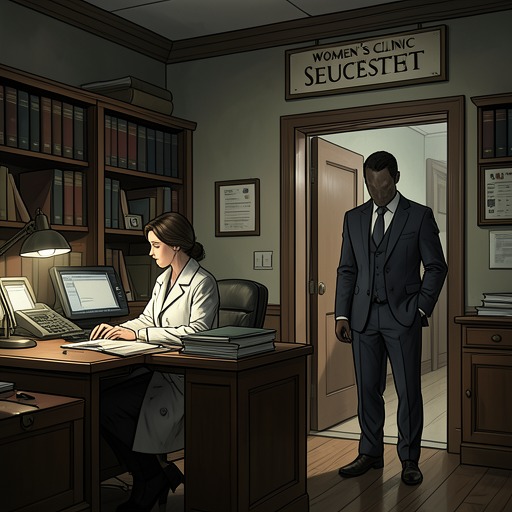
Thelonious’s arrival at the clinic is marked by the immediate attention of ten women, whose faces turn toward him as he enters. At the reception desk, he identifies himself as Lisa’s brother. The receptionist recognizes him as the writer in the family, embraces him, and calls down the hall for Eleanor. The brief exchange makes the clinic feel like a working community, not simply a medical address: visitors are noticed, relationships are known, and patients and staff share the space.
In a later imagined scene, Lisa treats a little girl whose name she dislikes. She looks in the child’s ears, jokes with her, and asks whether purple is her favorite color because the child’s throat is that color. The girl laughs; Lisa speaks sternly to her mother and writes a prescription for antibiotics. After walking them toward the front, Lisa checks and initials a chart handed to her by the receptionist. The small gestures—examining, joking, prescribing, signing—show the ordinary sequence of care that gives the clinic its purpose.
Violence and Loss
That imagined routine breaks abruptly. The little girl tugs at Lisa’s skirt; Lisa answers with a raised-eyebrow glance, and then the scene gives way to broken glass, screams, and chairs scraping across the floor. Thelonious cannot make out the words forming on his sister’s mouth before she is gone. The narrative’s inability to recover those words leaves the moment of violence as a rupture in the remembered work of the clinic.
The account later confirms that Lisa was pronounced dead at the scene. The clinic is therefore not only the place where she serves patients but the setting bound to her killing. The remembered details of treatment remain sharply particular, while the violence that interrupts them resists clear verbal description.
Financial Aftermath and Significance
Lisa’s death also leaves the clinic’s survival uncertain. Young doctors carry substantial debts from medical school, establishing a practice, and buying equipment. Lisa relied on grants and part-time hospital work to support the clinic. Although she had taken out an insurance policy, much of its value went toward paying her bills; the family had limited savings, and the former office of Thelonious’s father drained money as well.
Until Lisa’s share can be sold, one-third of the Women’s Clinic Southeast belongs to Thelonious. The two physicians who worked with her are as young as she was, fear they may be the next targets, and do not want to deepen their commitment by buying him out. Their hesitation makes the consequences of the killing extend beyond the loss of one doctor: the clinic’s future and its capacity to continue serving Southeast Washington are left precarious. The neighborhood thus connects the novel’s intimate grief to the unequal material conditions surrounding care—visible in both the clinic’s debt and the nearby poverty the city otherwise hides.