Women’s Clinic Southeast
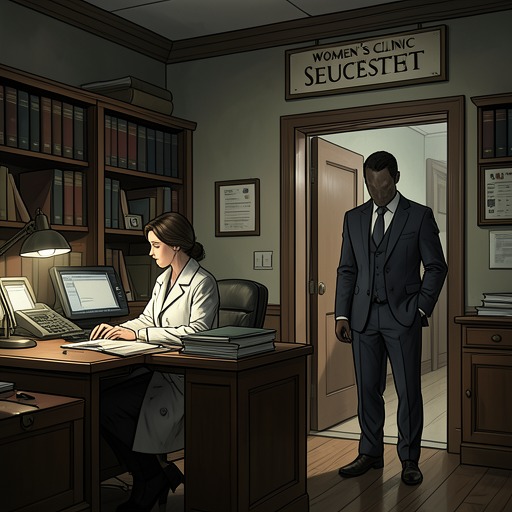
ErasureWomen’s Clinic Southeast is Lisa Ellison’s medical practice in Southeast Washington, D.C., where routine care unfolds under the pressure of public hostility and limited resources. The clinic is both a place where Lisa treats patients and a vulnerable institution exposed to protest, fear, and financial uncertainty. Through Thelonious Ellison’s visits and recollections, it is presented not as an abstract political symbol but as a workplace embedded in a neighborhood and sustained by the labor of its staff.
Setting and Place
The clinic stands in a part of Washington that Thelonious describes as close to the city’s tourist center yet marked by poverty that the capital conceals. Within a few blocks of the Mall and Capitol Hill, residents cover windows against the rain and secure doors with boards at night. The contrast makes the clinic’s location significant: it serves people in a district whose hardship is near the city’s most visible civic landmarks, but largely kept out of view.
Lisa lives above Adams-Morgan, but chooses to practice in Southeast, where, in her brother’s understanding, the people who need care live. Thelonious regards her as tougher than himself. That judgment establishes a contrast between the siblings: he can accompany her and worry about her safety, but the clinic and its work belong to her daily life, not his. The location is therefore more than a backdrop to family events. It identifies the community Lisa serves and the routine she maintains despite the risks around the practice.
Medical Work and Daily Life
Thelonious’s imagined scene of Lisa at work gives the clinic a domestic, practical scale. He pictures her examining a little girl, making a joke that prompts the child to laugh, and speaking sternly to the child’s mother before writing a prescription for antibiotics. Lisa then walks the mother and child to the front of the clinic. A frightened teenager waits in a chair; the receptionist gives Lisa a chart, and Lisa checks and initials entries with a pen kept in her jacket pocket.
The sequence consists of small acts of attention: examination, conversation, prescribing, reviewing a chart, and guiding patients through the corridor. The child tugs at Lisa’s skirt, and the imagined sounds of the clinic abruptly give way to disturbance. Because Thelonious is imagining Lisa’s work rather than simply reporting an ordinary appointment, the scene brings her care into contact with the violence that threatens the clinic. Its interruption makes the practice’s vulnerability felt without erasing what happens there on an ordinary day: patients are seen, records are completed, and care continues.
Protest and Exposure to Danger
The clinic’s work is accompanied by recurring demonstrations. Lisa tells her brother that Anti-Abortion Protesters gather outside every day, and that they frighten her. On one afternoon, Thelonious drives her to work and drops her at the entrance. When protesters recognize Lisa and shout accusations, he gets out of the car and walks with her through the line to the door. He sees a protester holding a large poster and shaking a fist at him. For a moment, he thinks one man may be someone who had watched them earlier at a restaurant, but the possible recognition passes without confirmation.
The escort changes Thelonious’s understanding of what Lisa faces. Walking beside her, he realizes that she goes through the protesters alone every day and that his arrival does not make him the protective brother she needs. Lisa accepts his company graciously, then tells him she will see him later. Her response neither turns the encounter into a rescue nor denies the danger: she continues into the clinic and returns to her work. The scene places the pressure on the threshold itself, where patients and staff must pass between the public demonstrations and the practice’s door.
Financial Strain and Aftermath
The clinic’s vulnerability is also financial. Thelonious learns that young physicians carry substantial debt from medical school, starting a practice, and purchasing equipment. Lisa relies on grants and works part-time at a hospital to help support the clinic. Although she has taken out an insurance policy on herself, much of its value is committed to her bills. The practice therefore depends on several forms of support rather than on a secure surplus.
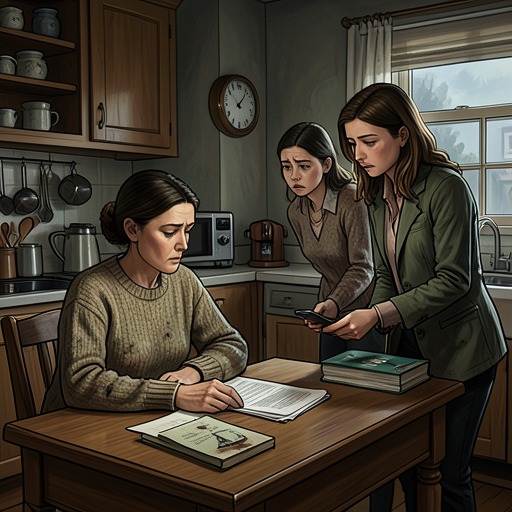
After Lisa’s death, Thelonious inherits a one-third share of Women’s Clinic Southeast. The two physicians who had worked there with Lisa are themselves young and frightened that they could become targets. They are unwilling to deepen their commitment to the practice by buying him out; one says the venture has always been uncertain and that the time may have come to cut losses and leave. The inheritance thus gives Thelonious a stake in an institution he did not run, while the remaining doctors confront the risks of continuing it. The clinic’s place in the story gathers together Lisa’s daily work, the public hostility she endured, and the material consequences of her death: the practice persists as a business and a workplace, but the person who held its work together is gone.