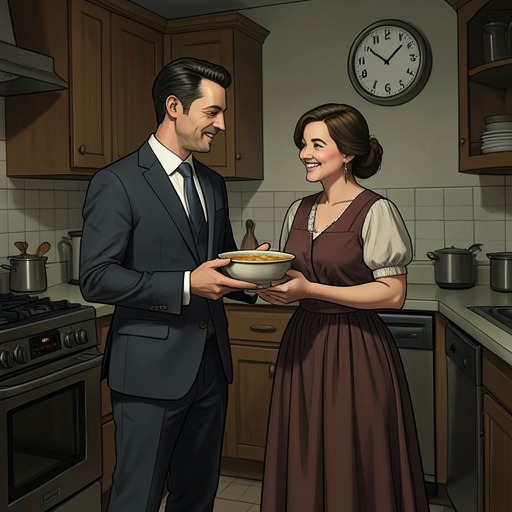
Frau Fabian
FabianFrau Fabian, Jakob Fabian’s mother, is a practical, tender presence whose care is expressed less through grand declarations than through work: she tidies his room, repairs his clothes, brings food for his journey, and offers him a place to return to. Her visits briefly make Berlin feel like home, while her presence at the family shop becomes the setting in which Jakob’s grief over Stephan Labude finally breaks through.
Identity and Character
Frau Fabian is closely associated with domestic labor and the family’s modest soap business. Her care takes concrete forms: she notices the dust in Jakob’s room and a broken coat loop, straightens his jacket, and makes plans around his meals and comfort. The narrative presents her diligence as both nervous and orderly, a combination that fills the room with the reassuring familiarity of home.
Her concern is not abstract. She worries that a suitcase could be stolen if left unattended, and Jakob becomes the more watchful of the two, keeping an eye on the luggage rack. The exchange makes their affection reciprocal: she is protective, but he is also alert to her vulnerability and anxious to take care of her.
A Visit That Makes Berlin Feel Like Home
During her visit, Frau Fabian and Jakob go to the cinema together. The film is an extravagant, shallow farce, but what matters to him is that she laughs; her pleasure is enough to make him laugh too. Walking home, she reflects that if she had been as healthy earlier in life, he might have had an easier childhood. Jakob answers that things were not so bad and that the past is over, gently refusing to turn their shared history into a reproach.
Their domestic closeness continues after they return. They disagree over whether she should sleep in the bed or on the sofa, and Jakob wins the argument. Before leaving to visit his friend next door, he explains that a young woman lives there and that he is close to her, then kisses his mother goodbye. The scene places his adult life beside their old intimacy without suggesting that one cancels the other.
Care in Everyday Details
The next morning, Frau Fabian wakes Jakob by warning that he will be late for the office. He drinks his coffee standing up and prepares to leave; she stays behind to put the room in order. As she works, the familiar bustle transforms the room: it seems suddenly like home. Jakob tells her not to sit idle even for five minutes, a teasing instruction that recognizes the energy with which she has already taken charge of the space.
Their talk turns to the childhood memories that make their bond particular. Jakob recalls scratching the bedstead with a pin and then taking her by the hand to show her the supposed masterpiece. He also remembers giving her sewing supplies for her birthday: black and white thread, needles, and fasteners. She remembers the gifts vividly, correcting and completing his recollection, then smooths his jacket and observes that his suit needs pressing. Memory and present care meet in the same gesture: she remembers the child while tending to the grown man.
Farewell and the Offer of Home
At the station, Frau Fabian reports that she has sewn the coat loop back on and restored the room to a more presentable state, despite the offense taken by Frau Hohlfeld. She has also been busy enough to make clear how fully she inhabits the role of caretaker. Jakob brings food from a station buffet—a ham roll, biscuits, and two oranges—and she calls him reckless, a small protest that accompanies her acceptance of his generosity.
He slips a twenty-mark note into her handbag without telling her. Her own hopes are modest and domestic: she asks when he will come home again, promises to cook his favorite dishes, and imagines a visit to Aunt Martha’s garden. She mentions that there is little business at the shop. Jakob promises to visit as soon as he can; as the train takes her away, she urges him to stay healthy and to come home if things do not move forward in Berlin. Her invitation makes home not merely a remembered place but a practical alternative to an uncertain city life.
The Return and Labude’s Death
Later, Jakob returns to the town where he was born and approaches the family soap shop. The streets and buildings remain familiar, but the people are strangers to him. In the shop window, a notice advertises reduced prices on household soaps. Inside, Frau Fabian serves two women: she sets down washing powder, cuts a bar of hard soap, then weighs and wraps soft soap from a barrel. The ordinary sequence of work continues as Jakob arrives.
He opens the door, and the bell rings. His mother looks up and lets her hands fall in alarm. Jakob tells her, in a trembling voice, that Labude has shot himself; then he begins to cry. He moves into the back room, sits in the armchair by the window, looks out into the courtyard, and lowers his head onto the sill. The son who had earlier tried to keep the past behind him now collapses into grief in the place of his childhood, with his mother again at the center of the scene. Her role is not to explain or resolve the loss: her presence and the family home receive the emotion he can no longer contain.