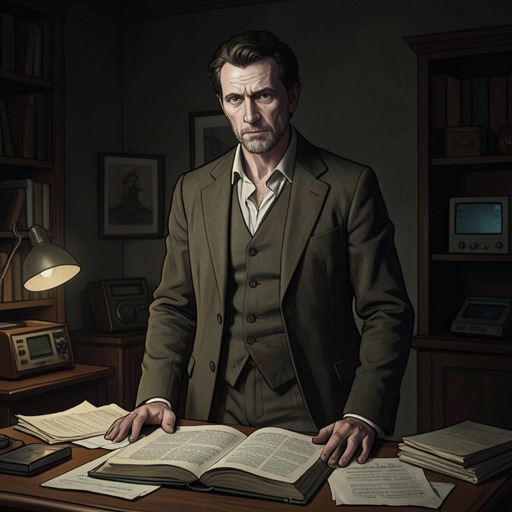
Justizrat Labude
FabianJustizrat Labude is Stephan Labude’s father, a legal adviser whose response to his son’s suicide exposes a painful divide between the language of composure and the claims of grief. He initially insists that Stephan acted knowingly and that the living need not weep, yet he soon investigates the rejection of his son’s dissertation, discovers grounds to doubt the professor’s account, and confronts him directly. His movement from guarded resignation to accusation gives the aftermath of Stephan’s death its central moral conflict: whether the cause of the suicide will be acknowledged or explained away.
Identity and First Response
When Justizrat Labude arrives at the house, he has a newspaper in hand. A woman tries to leave the car with him, but he pushes her back into her seat, and the car drives away with her face pressed to the window. The text does not identify her or explain the incident, leaving this hurried separation at the edge of the main scene. The old servant follows the father indoors with his arms raised as if ready to support him. Justizrat Labude grips the banister as he climbs, but he does not collapse. Fabian steps into the corridor rather than witness a father seeing his dead son; behind the closed bedroom door, he and the servant wait for some cry of grief. None comes, and the silence cannot be interpreted.
Once summoned to the study, Justizrat Labude sits with his head in his hand, then stands to greet his son’s friend with an artificial smile. He describes himself as poorly equipped for tragic experience: the little sympathy allowed by his egoism, he says, has acquired an inauthentic sheen through years of legal pleading and procedural routine. The courtroom, in his account, has made feeling look polished without making it genuine. He turns toward Stephan’s body as if to apologize to the dead man, but he also insists that self-reproach is useless. He had not been a father who lived for his son; he was, instead, an older man in love with life, and Stephan’s death has not destroyed life’s meaning for him.
Grief, Responsibility, and the Dead Son
His first explanation of the suicide is starkly self-contained. Pointing toward the body, Justizrat Labude says that Stephan knew what he was doing and that, if his son judged it the wisest course, others need not cry. The statement sounds like a defense against grief, but it does not settle whether the father believes it or is trying to master what cannot be changed. Fabian observes that such sober speech might itself suggest self-reproach. Justizrat Labude rejects that inference: the visible cause of Stephan’s suicide, he says, lies outside their sphere.
Asked whether Stephan left letters, Fabian conceals the farewell letter and says that a short note gave the explanation: the Geheimrat had rejected Stephan’s Habilitationsschrift as inadequate. That omission leaves Justizrat Labude to respond to the account Fabian chooses to disclose, rather than to the fuller evidence in Fabian’s possession. He has not read the dissertation and admits that he has never had time. When Fabian calls it one of the best and most original works of literary history he knows, he brings a copy from the bookshelf and places it on the desk. The manuscript turns the question of responsibility from abstract consolation toward a specific judgment that can be examined.
Testing the Rejection
Justizrat Labude does not stop at Fabian’s praise. He leafs through the manuscript, calls for the telephone book, finds a number, and phones the Geheimrat’s household despite the late hour. Learning that the professor is away in Weimar for a meeting of the Shakespeare Society, he says he will visit him at the institute the next day. He asks whether the dissertation has already been read; after listening for a long time, he hangs up and reports a detail that changes the meaning of the rejection. The Geheimrat had recently called the work exceptionally interesting over dinner and said he was eager to see its conclusion.
The professor’s apparent praise makes the rejection difficult to reconcile with the quality of the dissertation, and Justizrat Labude’s question about it prompts Fabian to spring up in anger: can work be praised and then rejected? The father answers with a bitter observation that work judged bad is, at any rate, more often accepted. He then asks to be left alone with Stephan and says he will read the manuscript. The contrast is consequential: the man who had confessed that he had never made time for his son’s work now undertakes to read the five-year project after his son’s death.
A portrait of Lessing hangs on the wall. Justizrat Labude points to it as the place where the cause of death is hanging, takes it down, and smashes it against the desk without visible agitation. The gesture gives physical form to anger that his earlier speech had kept at a distance. He cuts his right hand on the broken frame, orders the servant to sweep up the debris and bring sticking plaster, and remains with his son and the manuscript. The portrait’s destruction does not itself prove the professor’s motive or settle the case; it marks the father’s refusal to leave the rejection as an untouched institutional verdict.
Confrontation and Aftermath
The next day, Fabian finds Justizrat Labude and his wife waiting at the institute before the Geheimrat has returned. She looks very old and weeps as she greets Fabian, saying that they had not cared for Stephan. Fabian tells her there is no point in reproaching themselves. Justizrat Labude asks whether Stephan was not old enough, then recounts that he read the dissertation during the night. Though he says he cannot judge whether its foundations are sound, he recognizes that its conclusions are clever and incisive. Fabian goes further, calling the work masterly and affirming that its foundations are also sound. The father’s overnight reading is thus more than a gesture of mourning: it gives him grounds to challenge the professional judgment that had been reported as the immediate cause of Stephan’s death.
Stephan’s mother urges the two men to leave, asking why they would take away the cause for which her son died now that he is dead. Her plea registers a different danger: that correcting the record might also strip the death of the explanation around which the family’s grief has gathered. When the Geheimrat arrives and says he has no idea what they mean, Justizrat Labude leans forward and states directly that his son shot himself because the professor rejected the work. The Geheimrat wipes his forehead, stares at the people around him as though they might be mad, and whispers that it is impossible. Justizrat Labude answers that it is possible and orders him to take his coat, come with them, and see the body on the sofa, which is as dead as anyone can be.
Stephan’s mother says that they are killing him a second time. Her words make the confrontation more than a dispute about scholarly evaluation: the family’s demand for acknowledgment risks reopening the injury of the death itself. Justizrat Labude nevertheless presses the professor to face both the dead son and the rejected work. His arc does not resolve into uncomplicated remorse or a recovered intimacy; he had admitted his distance from Stephan, and the evidence supplied does not show what the professor ultimately says or does. What it does show is a change in the father’s conduct: from explaining why others need not weep to insisting that the circumstances of his son’s death cannot be dismissed as impossible.
Narrative Significance
Justizrat Labude’s composure is repeatedly unsettled by acts and details that exceed his own account of himself. He calls his sympathy inauthentic, yet takes the time to seek the truth of a rejection, reads the work he had neglected, and risks the decorum of an academic meeting by accusing the professor in person. He says life retains its meaning after Stephan’s death, but destroys the portrait associated with the alleged cause and cuts his hand doing so. Rather than treating these contradictions as proof of a single hidden motive, the narrative makes them visible as tensions between legal routine, paternal failure, and the demand to answer for a dead person.
The father’s legal habits shape the way he confronts grief: he tests a claim, follows the discrepancy between praise and rejection, and demands that the person implicated face the evidence. Yet the procedure cannot restore Stephan or give the bereaved parents an uncomplicated account of their responsibility. Fabian knows more than he initially tells; the mother fears losing the cause that has become attached to her son’s death; and the Geheimrat’s denial leaves the accusation unresolved in the scene. Justizrat Labude’s significance lies in this collision between explanation and mourning. His investigation gives the dead man’s intellectual work a hearing at last, while the broken portrait and the mother’s warning show the cost of trying to make a death legible after it has already occurred.