Professor Kollrepp
FabianProfessor Kollrepp is an elderly inventor who sees his celebrated machines as weapons against workers: they multiply production while eliminating jobs and livelihoods. Having abandoned his wealth and family after confronting the human consequences of industrial progress, he wanders Berlin with plans for a still more powerful machine in his pocket. Fabian offers him shelter and friendship, but Kollrepp is taken back to a sanatorium; in Fabian’s dream, he returns to demonstrate a vast apparatus that swallows him. His story makes technological progress at once a material force, a moral burden, and a nightmare that even its inventor cannot escape.
Identity and Background
Kollrepp introduces himself as an inventor and an honorary member of five scientific academies. He claims that technology owes him significant advances: his textile machinery enabled the industry to produce five times as much cloth per day as before, and his inventions made money for many people, including himself. The achievement is inseparable from its cost. As factories grew more productive, the number of employed workers fell; Kollrepp comes to understand that his peaceful machines functioned like cannons, putting whole armies of workers out of action and shattering hundreds of thousands of people’s claims to a livelihood.
His change of conscience follows an encounter with the consequences of industrial conflict. While in Manchester, he saw police charge against locked-out workers and strike their heads with sabres; a little girl was trampled by a horse. Kollrepp says he was responsible. On returning, he began giving his money away and declared that he wanted nothing more to do with machines. His family placed him under guardianship, objecting to his actions and his renunciation of invention. He left them and became a missing person, while they continued living in his house on Lake Starnberg.
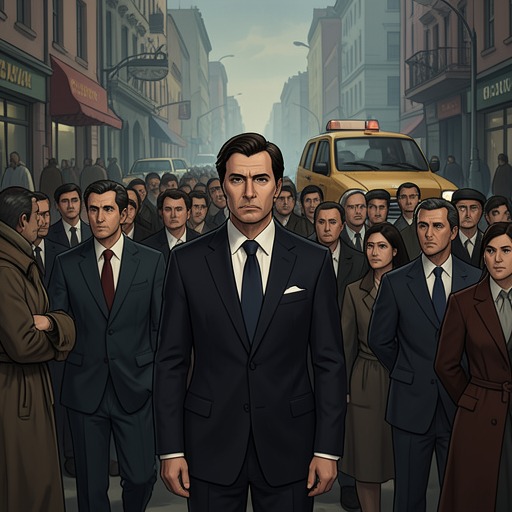
Kollrepp’s private life has not simply vanished with his former status. A week before he speaks to Fabian, he reads in a newspaper that his daughter has given birth, making him a grandfather. He is now moving through Berlin like a tramp, far from the home and wealth he once possessed. His account holds together the transformation from prosperous inventor to impoverished wanderer without presenting either condition as a cure for the damage his work has helped cause.
Machines, Work, and Responsibility
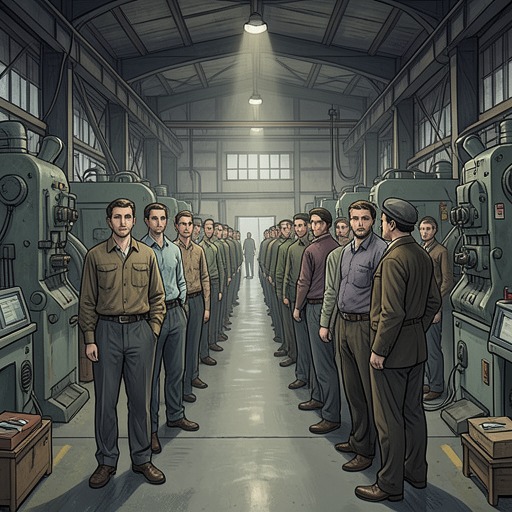
Kollrepp’s account connects a specific invention to a broader economic contradiction: output rises while employment contracts. He describes his machines as instruments that increase the fixed capital and productivity of businesses but reduce the number of workers they hire. The image of machinery as artillery gives this economic change a human target. Industrial equipment does not merely make more cloth; in his retrospect, it disables “armies” of workers and destroys their right to subsistence.
That account resonates with the economic crisis described elsewhere in the novel. Malmy argues that technology multiplies production even as it decimates the workforce, while the mass public’s purchasing power withers. He points to grain and coffee burned in America because prices might otherwise fall, and to French winegrowers lamenting an excessively good harvest while other people have nothing to eat. Kollrepp’s personal confession gives this mismatch a concrete biographical dimension: he helped increase production and then witnessed the violence and deprivation accompanying the labor system built around it.
Yet recognition has not given Kollrepp a practical way to undo the consequences. He says he considered going to Russia to offer his services, but cannot cross the border without a passport and expects that revealing his name would stop him from leaving. In his breast pocket he carries sketches and calculations for a loom installation that would surpass every existing textile machine, worth millions. He would rather starve than use it for profit. The contradiction is sharp: the inventor who has repudiated machinery continues to carry the means of a potentially greater technical advance, and his refusal to put it to work is both a moral stand and a precarious condition of life.
A Wanderer in Berlin
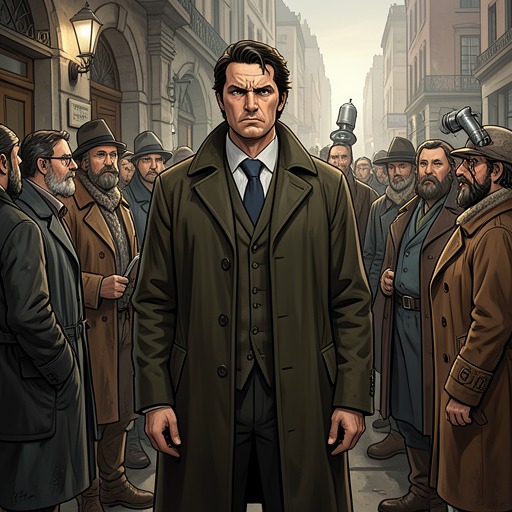
Kollrepp’s daily survival depends on concealment, improvisation, and the small courtesies owed to an old man. He changes his address every day and sometimes spends the night in stairwells, entering a building shortly before its gate closes and naming a resident from the address book if a porter asks his business. He plans to climb to an attic and sit on the stairs, hoping that its door will be open. The assumed respect for old age, he remarks, has reached even the porters; it can buy him temporary shelter, though discovery often follows the next morning.
His other refuges have been temporary too. During winter he taught physics at a private school, but his lessons became an educational campaign against the wonders of technology, displeasing both pupils and director. He then spent three months warming himself in post offices. Now that it is warm, he sits for hours in railway stations watching people depart, arrive, or remain behind. The stations offer no permanent home, but they give him company in motion: he says he finds it entertaining to watch and is glad to be alive.
When Kollrepp tells Fabian he expects to sleep at Yorckstraße 93, Fabian writes down his own address and offers him the sofa if a porter throws him out early. The offer gives the inventor a modest alternative to his precarious stairwell routine. Kollrepp worries about imposing on Fabian’s landlady; Fabian shrugs off the concern. Their exchange establishes a bond built not on grand rescue but on practical hospitality: an address, a sofa, and permission to return.
Kollrepp treats his reversal of fortune with an equanimity that contrasts with the urgency of his political and technical reflections. He says he began poor, became rich, and is poor again, as though the sequence makes little difference. The sunshine on his terrace in Leoni and the sunshine over Kreuzberg matter equally to him. But the ease of this comparison should not obscure his circumstances: he is a homeless man with a persistent cough, dependent on improvised shelter and carrying valuable plans he refuses to sell.
Shelter, Family, and Removal
Fabian’s offer becomes more than a hypothetical kindness when Kollrepp arrives at his room and Fabian introduces him to his mother as an old friend and, for convenience, an uncle. The sofa is unavailable that day, but Fabian invites him back the next. Kollrepp responds by pressing an envelope into Fabian’s hand. He says it contains his machine and warns that people are after him: his family, he believes, wants to have him committed again and obtain his notes for profit. The sketches he had described as millions’ worth are now entrusted to Fabian’s keeping.
Kollrepp does not speak of the prospect of commitment as an unmitigated terror. He says there is nothing objectionable about the institution: its park is beautiful, its director is tolerable and plays chess well, and he has escaped once when he grew tired of the place. He insists that he is not mad, but too sensible for his relatives. The humor and self-possession of this account make his removal harder to read as either simple rescue or simple persecution; the available facts show both a family seeking control and an old man who treats confinement as a familiar, temporary condition.
Two men arrive with authorization to take him away. Kollrepp recognizes the sanitary councillor and Winkler, says he knew the previous day that they were following him, and goes with them without a struggle. Before leaving, he opens a cupboard, looks inside, closes it, and takes Fabian’s hand to thank him. He tells Fabian’s mother that she has a good son. The doctor and attendant follow him out; from the window, Fabian and his mother see the chauffeur help Kollrepp into an overcoat and his cape put away. Fabian has safeguarded the papers, but cannot prevent the inventor’s return to the institution.
Dream and Narrative Significance
Kollrepp returns in Fabian’s dream after his removal. Fabian walks through an endless, empty street bordered by immense buildings without doors or windows, exhausted, hungry, and thirsty, still trying to reach its end. Kollrepp appears behind him in his faded cape, badly rolled umbrella, and gray, stiff hat. When Fabian says he thought the inventor was in the madhouse, Kollrepp answers that this is the place and knocks against a building with the tip of his umbrella. A gate opens where there had been none. The scene carries the earlier dispute over sanity into a dream landscape in which the institution and the world around it are difficult to distinguish.
The dream’s machinery turns Kollrepp’s remorse into grotesque spectacle. He leads Fabian through a blue-lit passage to an apparatus as large as Cologne Cathedral, where half-naked workers shovel hundreds of thousands of small children into a blazing cauldron. The machine produces a hundred thousand a day, Kollrepp explains, even though he has shortened the working day and introduced a five-day week. The juxtaposition makes the promise of efficiency collide with a horrifying image of human beings treated as raw material. When a coupling fails, Kollrepp pokes at an opening with his umbrella; the umbrella disappears, then his cape pulls him into the machine. He vanishes, swallowed by the device.
Fabian cries out that an accident has happened, but a child falls from the cauldron only to be scooped up and thrown back into the fire. He rides the conveyor through the yard, waiting for his friend to return, but Kollrepp does not. Instead, another Fabian, dressed in the inventor’s cape, hat, and umbrella, emerges from a tipping container. This double merges with the real Fabian; Fabian takes back the umbrella and adjusts the cape, becoming once more the only copy of himself. The dream’s mechanical transformations do not offer a literal sequel to Kollrepp’s removal. They make his machine a device for multiplying, consuming, and reproducing identities, and draw Fabian into the inventor’s vision of a system from which no observer remains wholly outside.
Later, while speaking inwardly to the dead Labude, Fabian remembers Kollrepp as a man who loved life and recalls the image of him standing in a cupboard with his hat on and umbrella in hand, as if afraid it might rain inside. That affectionate detail returns the dream’s strange machinery to the vulnerable, comic figure Fabian had sheltered. Kollrepp’s narrative role rests in this contrast: he is at once the inventor who helped enlarge industrial production, the witness who recognizes its human price, the wanderer who refuses to sell his plans, and the dream figure whom his own machine consumes.