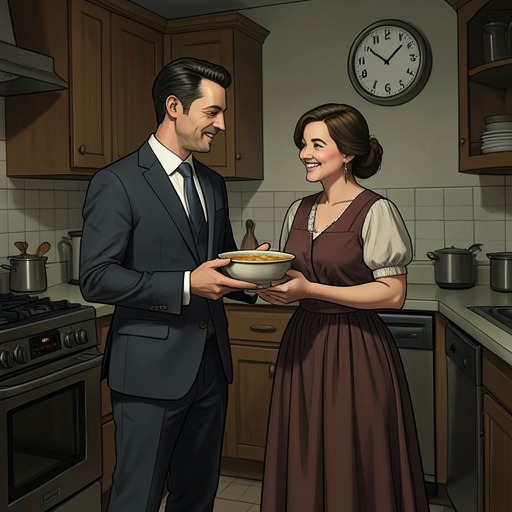
Eva Kendler
FabianEva Kendler is a woman from Jakob Fabian’s past whose unexpected reappearance makes time and lost possibility briefly visible. When Fabian meets her again after at least ten years, she is a married mother of two; the encounter recalls an earlier intimacy and contrasts the responsibilities she has acquired with the life she once might have imagined for herself.
Identity and Background
The novel gives little biographical information about Eva before their reunion. Fabian recognizes her on the street only with difficulty: she has grown considerably heavier, and he wonders that he recognizes her at all. She, by contrast, knows him immediately, calls him Jakob, blushes, and tells her daughters to greet their uncle. Her greeting is affectionate and familiar, though the children’s presence makes the distance between their present lives unmistakable.
Their shared history reaches back to when Eva was seventeen and her parents were away. Fabian tells his mother that he stayed away from home for two days and describes the encounter as an instruction in sex that he conducted with conscientious, almost solemn seriousness. His mother remembers being worried at the time. The contrast between his brisk, self-conscious account and her concern leaves the earlier episode partly in the past’s shadow: it is recalled as a formative escapade, but the reunion does not establish how Eva understood it or what followed immediately afterward.
Reunion and Family Life
Fabian asks how Eva has been and when she married. She explains that her husband is a senior physician at the Carolahaus, but that his position does not allow them to live extravagantly or establish an independent practice. He may accompany Professor Wandsbeck to Japan; if the move proves worthwhile, she may go too with the children. Her account presents marriage through practical limits and a possible relocation, rather than through any description of romance.
The two girls stand beside her, resembling their mother more than one another. Eva smooths their sailor collars as she speaks, a small, concrete gesture of care that accompanies her reflection on the life she now leads. She says that before one has properly had a life of one’s own, one is already responsible for one’s children. This year, she adds, the family will not even go to the seaside. Her remarks make responsibility both an emotional condition and a constraint on ordinary pleasures.
The Past and Its Meaning
Eva quietly tells Fabian that things were more beautiful then, recalling the time when her parents had travelled and she was seventeen. The remark does not amount to a detailed account of what she regrets; its force lies in the distance between that remembered youth and the present, where family duties and financial limitations shape her choices. Fabian answers that the situation is terrible, but the exchange remains brief. They say goodbye without pursuing the past or making plans.
After Eva leaves, the two girls tucked close to their mother as they move away, Fabian stays where he is for a while. The narration makes the encounter’s meaning explicit through the image of the past rounding a street corner, now unfamiliar and scarcely recognizable, with two children in tow. Eva’s greeting that Fabian has not changed turns the image back on him: while her life has visibly altered, he is made to confront how little the years seem to have changed his own appearance—and how radically they have changed the world he shares with her.
Narrative Role
Eva’s brief return links Fabian’s youthful past to an adult present he has not witnessed. Her daughters, her husband’s uncertain professional prospects, and the possibility of Japan establish a whole domestic life in a few details, without opening that life beyond the chance meeting. The scene’s restraint matters: the novel does not resolve the pair’s old relationship, but places their different recollections and circumstances beside each other, then lets them part.
The encounter also gives the past a physical form. It is not recovered as a complete story or renewed as intimacy; it appears on an ordinary street, recognizable only after a moment, and walks away with Eva’s children. Fabian’s subsequent retelling to his mother brings the youthful episode back into view, while her recollection of her own anxiety prevents his version from standing as the only memory of it. Eva therefore serves less as a renewed romantic possibility than as a measure of elapsed time, altered responsibilities, and the lives that continue beyond Fabian’s point of view.