Kommunisten
FabianThe Communists are presented as a working-class political force whose claims arise from exploitation and whose street-level conflicts unfold amid Berlin’s wider political crisis. The novel gives that force a face in a wounded worker, but refuses to make poverty or political affiliation a guarantee of moral wisdom: the worker’s demand for justice is real, while his hostility toward opponents and readiness for violence remain part of the same unsettled political world.
A factional street conflict
The Communists enter the episode near the Märkisches Museum through a shooting that follows an argument in a tavern. According to the wounded worker, a National Socialist had drawn a swastika on the table; the worker objected, exchanged words with him, and struck him. The innkeeper threw them both out. When the other man followed and cursed the International, the worker turned around and was shot. The account makes the political provocation concrete, but also records the worker’s own violence before the gunfire: the confrontation has already become personal before either man is wounded.
Labude and Fabian come upon the aftermath amid shots and shouting. Labude takes a revolver from the wounded Communist, examines the wound in his calf, and attempts a makeshift bandage with a handkerchief. The injured man’s explanation locates the shooting in a chain of gestures and retaliations rather than in an organized battle. Yet the setting and the political symbols—swastika on one side, the International invoked on the other—make clear how quickly everyday antagonism can become armed conflict.
The wounded worker and Fabian’s argument
Fabian and Labude transport the Communist and his National Socialist opponent together in a car bound for the nearest hospital. Their injuries do not suspend their enmity: the two men answer one another with accusations, including “Volksverräter!” and “Arbeiterverräter!” When the National Socialist reaches for a weapon, Labude restrains his wrist and Fabian removes the revolver. Their intervention prevents the argument from escalating into another shooting, though the wounded men continue to regard each other as enemies.
Fabian addresses both factions, condemning efforts to preserve intolerable conditions through dictatorship and insisting that reciprocal gunfire will accomplish nothing. He identifies the Communist’s party as fighting the exploitation of the proletariat, and acknowledges that a worker’s pursuit of his rights is a duty. He also calls himself the worker’s friend because they share an enemy and because he values justice. But his solidarity is not an endorsement of the party as a moral authority: he warns that the ideals of humanity will remain neglected even if the workers gain power, and that poverty alone does not make anyone good or wise. The scene distinguishes the legitimacy of the Communist’s social grievance from the assumption that political victory automatically resolves injustice.
Class politics and social crisis
The worker’s charge of exploitation belongs to a wider economic diagnosis voiced elsewhere in the novel by Malmy, a newspaper editor. He describes a state that subsidizes unprofitable large estates and heavy industry while manufacturers sell abroad at a loss and charge domestic buyers above world prices. Raw materials remain expensive, wages are pressed down, taxes diminish mass purchasing power, and capital leaves the country. His account presents working-class grievance not as an isolated dispute but as part of an economic order in which public policy and private production combine to impoverish the many.
Malmy links that order to technological unemployment: machinery multiplies production while reducing the workforce, and the resulting loss of wages further weakens demand. He points to grain and coffee burned in America and French vintners lamenting an abundant harvest, while others go hungry. The pattern illuminates the worker’s language about exploitation: scarcity and deprivation coexist with surplus, and the Communist’s demand for workers’ rights responds to a system whose productive capacity does not secure their livelihood.
The inventor Fabian encounters makes the labor argument personal. The old man says his machines enabled the textile industry to produce five times as much cloth each day as before, enriching employers and himself, even as the number of employed workers fell. In Manchester he witnessed police riding against locked-out workers and a little girl being trampled by a horse; he came to believe that his inventions had helped make such suffering possible. His family placed him under guardianship after he began giving away money and rejecting further involvement with machines. The episode gives industrial progress a double edge: productivity rises, but its benefits are uneven, and the displaced bear consequences the inventor can no longer ignore.
The human cost of unemployment
The novel places the Communist’s demand for workers’ rights within a citywide landscape of unemployment that includes white-collar and professional workers as well as industrial laborers. After Fabian is sent from one employment office to another, he encounters a mixed group at the Alexanderplatz branch: doctors, lawyers, engineers, agricultural experts, and music teachers, all dependent on crisis relief. One man calculates that his weekly support of 24.50 marks leaves just 38 pfennigs per person per day; because his wife cannot even send bread to their children’s school, he says he may soon resort to burglary. A neighboring young man, who has already spent a year in prison, answers that even stealing takes practice. Their exchange makes economic desperation neither an abstraction nor a condition confined to one class: relief is meager, and the threat of destitution reaches households that once depended on skilled work.
A city caught between armed factions and the street
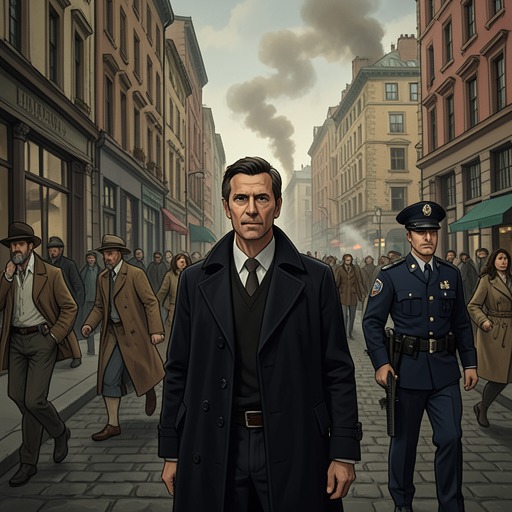
The episode at Wedding extends the novel’s account of political antagonism beyond the isolated tavern shooting. As workers approach along Reinickendorfer Straße, police form a barrier, with mounted officers waiting behind it. The marching workers’ songs grow louder, then give way to angry shouting as the police advance in a line, leaving a meter between each man. The confrontation gathers force before it can be seen: sound first signals the imminent collision, and cries confirm that the two sides have met.
Police strike the crowd; horses move into the space ahead, a shot rings out, and windows shatter. Stones fly, a police sergeant is stabbed, and officers raise their batons and charge at a run. Reinforcements arrive in three trucks. Workers flee to the edges of the square and nearby streets, where they stop and gather again, while Fabian pushes through the crowd and leaves. A few streets away, the noise has receded enough for the surroundings to seem orderly. The contrast makes the violence feel both immediate and disturbingly easy to overlook: the street can appear calm almost as soon as a clash has been driven out of sight.
The Communists are not depicted as standing outside this cycle of force. In the museum-area episode, the wounded worker reports that he objected when a National Socialist marked a tavern table with a swastika, traded words with him, and struck him before the innkeeper expelled them both. The opponent followed, cursed the International, and shot when the worker turned around. His story identifies a political provocation and a shooting, but also the worker’s own participation in the escalation. In the car, the two wounded men continue their mutual denunciations; Fabian and Labude have to stop the National Socialist from reaching for a revolver, and Fabian takes the weapon.
Fabian’s response distinguishes a worker’s claim to justice from the promise that a party can deliver a just society simply by taking power. He acknowledges that workers have a right and a duty to claim their rights, and says that he regards the worker as an ally against a shared enemy. At the same time, he warns that ideals of humanity may remain neglected under a new ruling class, and that being poor does not by itself make someone wise or good. The scene leaves the Communist’s grievance intact while refusing to equate class position with moral innocence. Read beside the Wedding confrontation, it shows how demands rooted in real inequality can enter a political world where enemies answer one another in the language of betrayal and force.
The novel’s preface frames its exaggerated city portrait as satire and warning rather than neutral documentary description. Against that declared purpose, the Communist’s brief appearance has a sharply limited but consequential role: he makes exploitation visible in a personal dispute, while the street clashes show how rapidly political hostility can become bodily danger. The account neither erases the material basis of working-class anger nor suggests that factional combat resolves it.