Nationalsozialisten
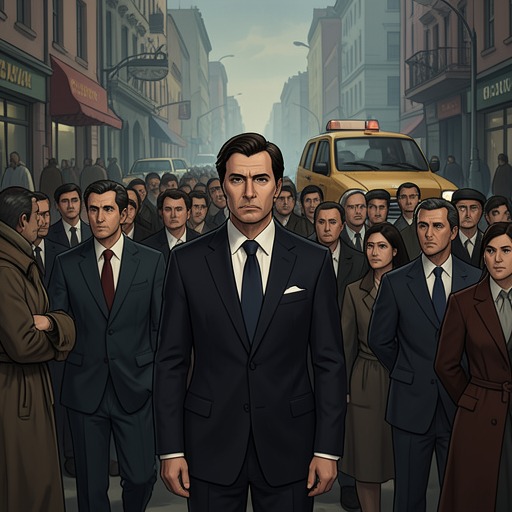
FabianThe Nationalsozialisten are presented as a political force whose antagonism toward workers becomes street violence. Their presence is not confined to party slogans: in a clash near the Märkisches Museum, a Nationalsozialist is wounded by gunfire, and the novel later places workers and police on the brink of confrontation at Wedding. Together these scenes show political division turning into bodily danger amid the wider social crisis.
Street Violence and Political Antagonism
Near the Märkisches Museum, a wounded worker explains how the shooting began: in a tavern, a man had drawn a swastika on the tablecloth; an argument followed, the worker struck him, and after the landlord threw them out, the other man pursued him and fired. The account makes the violence political without making it a planned battle: an emblem and a quarrel lead to a shot in the street. Labude treats the worker’s wound while Fabian goes for a taxi, and the friends eventually transport the injured worker and the Nationalsozialist together to a hospital.
In the car, their shared injuries do not soften their enmity. The Nationalsozialist calls the worker a traitor to the nation; the worker answers that he is a traitor to workers. The exchange reduces each man to an enemy category and carries the tavern dispute into the journey for medical care. When the Nationalsozialist reaches for a revolver, Labude restrains his wrist and Fabian takes the weapon. Fabian then argues that political conflict cannot be resolved by shooting one another, while criticizing both factions for knowing what they oppose more clearly than what they stand for.
Political Violence as a Social Symptom
The novel places this street encounter within a larger atmosphere of economic strain and political paralysis. In a late-night conversation about short-term loans, the editor Malmy describes a fragile system in which large withdrawals could bring down banks, cities, corporations, and the state. He then traces the pressures beneath that instability: the state supports large landed estates and heavy industry; manufacturers sell abroad at a loss while charging domestic prices above the world level; the cost of raw materials weighs on production, wages are pressed down, and taxes further diminish mass purchasing power. Capital, meanwhile, flees across national borders. His account presents political extremism against the background of material arrangements that preserve concentrated interests while deepening hardship.
Malmy extends the diagnosis from finance to work and consumption. Technology multiplies production while reducing the labor force, even as mass purchasing power collapses. He points to grain and coffee burned in America to prevent prices from falling, and French winegrowers complaining that their harvests are too abundant, while others have nothing to eat. The grotesque mismatch—surplus production beside hunger—turns economic disorder into an indictment of a society unable to distribute what it produces. In this setting, the Nationalsozialisten appear not as an isolated source of violence but as part of a wider crisis in which hardship, political agitation, and evasive public explanations coexist.
The book also gives that crisis an institutional and human scale. Fabian’s search for unemployment assistance sends him from one office to another: after waiting two hours, he learns that he has applied at the wrong place, and later finds lines of carefully dressed unemployed clerks presenting stamped cards for official certification. At another branch, a small man calculates that his family’s support amounts to 24.50 marks, or 38 pfennigs per person per day, and says that his children cannot take even a piece of bread to school. These encounters make the economic pressures concrete: unemployment is not only a statistic in Malmy’s diagnosis but an administrative routine and an immediate threat to subsistence.
A former inventor gives technological displacement a personal history. His machines enabled the textile industry to produce five times as much cloth each day, but the increase in productivity also reduced the number of employed workers. Remembering police riding against locked-out workers in Manchester, and a little girl trampled by a horse, he concludes that his inventions helped destroy hundreds of thousands of livelihoods. His family placed him under guardianship after he began giving money away and rejected further work with machines; he left home and has been missing for six months, living as a vagrant in Berlin. The episode links the progress Malmy describes to injured lives, while resisting the comforting separation of technical achievement from its social consequences.
The street scenes and these accounts converge on a warning: economic arrangements that produce insecurity do not remain abstract. At the Märkisches Museum, political accusation becomes gunfire; at Wedding, class conflict meets the force of the police. The Nationalsozialisten belong to this charged public world, where grievances and ideological labels sharpen antagonism, while the injured bodies and hungry households reveal what such a world costs.
The Wedding Confrontation
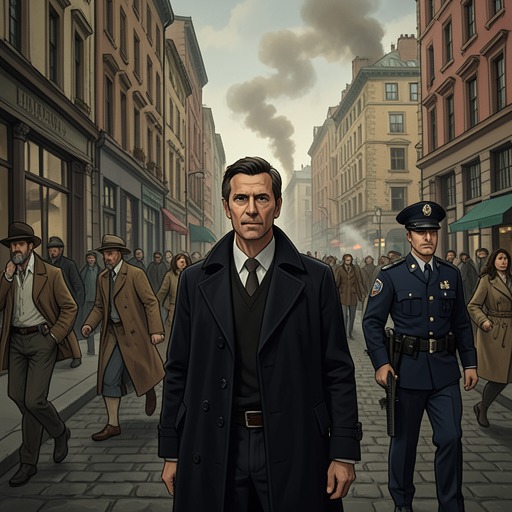
The later confrontation at Wedding broadens the novel’s portrait of political violence from a tavern quarrel and street shooting into an encounter between massed workers and the police. At Weddingplatz, police block Reinickendorfer Straße as workers approach in a crowd. Mounted officers wait behind the cordon; the police line advances step by step, while the workers’ songs grow louder and give way to angry shouts. The narrative registers the impending collision first through sound and movement: before Fabian can see what is happening, the noise makes the coming clash unmistakable.
The confrontation escalates rapidly. Cries confirm that the two sides have met, and police strike the workers; mounted officers charge into the space ahead. A gunshot rings out, windows shatter, stones fly, and a police sergeant is stabbed. The police raise their batons and run forward, reinforced by officers arriving on three trucks. Workers flee, then regroup at the edges of the square and along its access streets. Fabian pushes through the crowd and continues on, while the noise recedes; only three streets away, the scene already seems to have returned to peace and order. That abrupt transition makes the public appearance of calm part of the episode’s irony: the violence has not resolved the conflict, but it can quickly disappear from view.
Historical Warning and the Limits of the Political Portrait
The novel’s foreword frames its satire as a warning about the Germany and Europe approaching an abyss. Its author identifies mass unemployment, the psychological depression that follows economic crisis, the desire for intoxication, and the activity of reckless political parties as signs of the coming storm. Equally dangerous is the quiet before it: a widespread paralysis of the heart that leaves people unwilling to resist. Against that background, the Nationalsozialisten belong to a political landscape in which agitation and violence exploit a deeper social crisis, while those who attempt to oppose the drift are pushed aside.
The foreword also clarifies how the novel presents that landscape. It calls the book neither a documentary album nor a simple record of what happened, but a satire that exaggerates urban conditions through caricature. The Nationalsozialisten appear within that deliberately distorted mirror: the tavern quarrel, the wounded men carried together to hospital, and the armed confrontation at Wedding are particular scenes, but their sharp contrasts expose a broader political condition. The novel’s warning does not depend on treating any one clash as a complete account of history; it makes the visible absurdity and danger of antagonism serve as an alarm.
That alarm is sharpened by the foreword’s account of the book’s original title, Der Gang vor die Hunde, which its first publisher would not accept, along with some of its harsher chapters. The title announced the work’s purpose: to force a hearing and reflection before Germany and Europe reached the abyss. In the author’s formulation, the moralist holds up a distorting mirror, and even when it seems useless, continues at his post. The novel’s portrayal of the Nationalsozialisten thus contributes to a larger act of moral intervention: it shows political violence not as an isolated spectacle but as one of the storm signs of a society moving toward catastrophe.