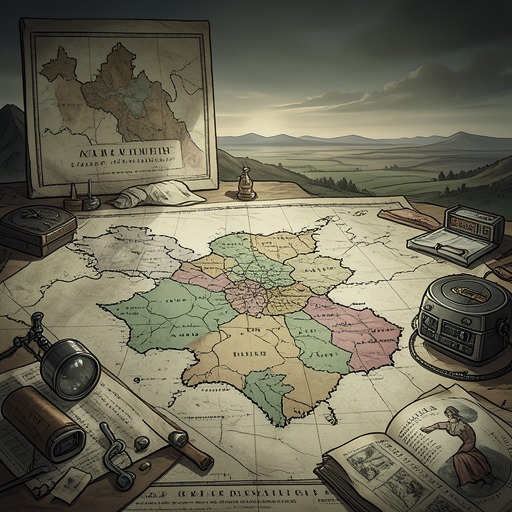
Anti-German guerrilla war in the Urals
FatherlandThe anti-German guerrilla war in the Urals is the unresolved conflict that shadows the Reich’s proclaimed victories and helps define its political order. Fought by Soviet-backed guerrillas against German power east of the Urals, it continues for two decades after Germany’s settlements with Britain and the United States. In the novel, the war is at once a military struggle, a routine feature of official broadcasts, and a source of growing dissent inside Germany.
Origins and duration
The conflict follows the German defeat of Soviet conventional forces and the subsequent wartime settlements with Britain and the United States. The novel describes the guerrilla struggle as continuing on the fringes of the expanded German Empire after the 1946 peace with the United States, a nuclear stalemate that diplomats call the Cold War. Rather than ending with the Reich’s battlefield victories, armed resistance persists east of the Urals.
By 1964, the fighting has been grinding on for twenty years. Its distant fronts and difficult-to-pronounce place names—Oktyabrskoye, Polunochoye, and Alapayevsk—recur in news of offensives and losses. The named battlefields make the conflict part of everyday information, while its remote geography helps keep its human and political costs at a distance from the Reich’s center.
The war in official news
German media describe the fighting through the language of victory. A headline announces that spring thaw has brought fresh fighting on the Siberian Front and that German troops have smashed guerrilla groups. The same report says that five leaders were executed in Rovno, capital of the Reichskommissariat Ukraine, after organizing an attack on a family of German settlers. The presentation casts German forces as restorers of order and resistance as terrorism.
The broadcasts also place the Urals conflict within a repeated cycle of state messaging: deaths of leaders, military victories, appeals for sacrifice and revenge, and updates from the eastern front. When the news announces an important statement, people in the room glance anxiously at the screens. Their reactions—strained humor, resignation, apprehension—contrast with the confident language of the reports. The war is not merely a distant item in the news; its continuation is felt by people with brothers, sons, and husbands serving in the East.
Domestic dissent and social consequences
The insurgency also forms part of the setting for a younger generation’s resistance to the state. Xavier March has encountered increasing numbers of young men who rebel against their parents, question the regime, listen to American radio, and circulate forbidden books. Their protests are chiefly directed against the war, which they regard as an apparently endless struggle against American-backed Soviet guerrillas east of the Urals.
This opposition links private acts of cultural dissent to the Reich’s inability to bring the conflict to an end. The clandestine circulation of writers such as George Orwell and Graham Greene accompanies the rejection of official accounts, while protest against the war challenges the state’s demand for sacrifice. The insurgency therefore reaches into domestic life even when its fighting remains far from the capital.
Narrative significance
The war exposes the limits of the Reich’s victorious self-image. Its propaganda can describe individual operations as successes, but the recurring reports of fresh fighting and the long span of the conflict disclose a struggle without a decisive conclusion. The difference between headline and duration is central: the state announces that resistance has been crushed, yet the war remains a familiar, continuing presence.
By connecting the eastern insurgency to the Cold War, to anxious families, and to the protests of young people, the novel presents military power as unable to secure lasting political quiet. The Urals front is both a distant theater and a measure of the regime’s domestic instability: the conflict persists abroad, while its costs and official justifications steadily shape life at home.