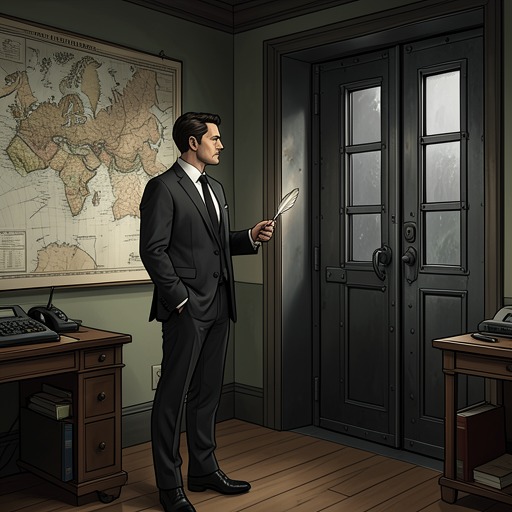
Martin Luther inspects Auschwitz
FatherlandMartin Luther’s inspection of Auschwitz on July 15, 1943, is presented in the novel through an eleven-page handwritten report that Xavier March reads while investigating the records left by Luther and other officials. The report transforms an abstract paper trail into an account of the machinery behind the deportations: the arrival of a train, the separation of its passengers, the killing of those sent away from the work camp, and the systematic recovery of their belongings and remains. Its importance lies not only in what Luther saw, but in the bureaucratic form that records it: a government official’s dated observations reveal how administrative organization, euphemism, and material accounting joined in mass murder.
The Inspection and Its Administrative Setting
Luther identifies himself as an under state secretary in the Reich Ministry for Foreign Affairs. He writes that, after almost a year of repeated requests, he has finally received permission to make a full inspection of Auschwitz-Birkenau on behalf of the ministry. The report begins with his journey from Berlin to Krakau and an overnight stay at Wawel Castle with Governor-General Hans Frank, State Secretary Josef Bühler, and their staff. At dawn he is to travel to the camp and meet its commandant, Rudolf Höss.
The account emphasizes that the camp belongs to an administrative system extending beyond the site itself. Höss explains that Auschwitz falls under the SS Economic Administration Main Office, while camps in the Lublin district are controlled by Odilo Globocnik. Unable to conduct the tour personally, Höss assigns Luther to a young officer, Weidemann, and directs him to show the visitor everything and answer his questions. The report thus records the inspection as both an official visit and a guided passage through a system whose responsibilities are divided among agencies and officers.
Luther’s observations of the grounds establish the scale and organization of the place before the train arrives. He describes a railway siding about 1.5 kilometers long, fencing supported by concrete pylons, and wooden watchtowers with machine-gun positions. Beyond the trees stands a red-brick chimney emitting smoke. The setting is not presented as an isolated killing site: rail access, guarded boundaries, and camp sectors make it part of a coordinated operation.
Arrival and Separation of the Deportees
At 7:40 a.m., SS troops, some accompanied by dogs, and prisoners assigned to assist them gather near the tracks. A train arrives, and Weidemann identifies it as a transport of Jews from France. Luther estimates that it contains about sixty freight cars. The doors are opened, and the passengers are ordered to leave with hand baggage while leaving heavier luggage behind. Men climb down first and help women, children, and elderly passengers; some passengers are thirsty and exhausted, while dead and gravely ill people remain in the cars after a journey of four nights.
The guards divide those able to walk into columns. Men considered fit for work are directed toward the work camp; the rest are marched in another direction. The separation of families is part of the process, not an incidental disturbance: people call and gesture to one another as the groups are sent apart. Luther follows the column directed away from the work area. By 8:30, Weidemann estimates that it numbers nearly 2,000, including babies, children, older people, adolescents, and the sick. They are led along a cinder path, through a courtyard, and down twelve steps into a large underground chamber labelled in several languages as a bathing and disinfection room.
The signs and instructions give the room an ordinary, reassuring appearance. Benches and numbered pegs are provided, and the people are told to undress and remember their numbers so they can retrieve their clothes. Some hesitate but comply after the order is repeated. Camp prisoners move among them, helping those who need assistance. The report shows deception operating through familiar institutional language and the promise of later recovery: the deportees are instructed to remember a peg number even though they will not return for their clothing.
The Killing Process and the Treatment of Bodies
At 9:05, the naked crowd is directed through oak doors into a second chamber. Luther describes it as bare except for four thick columns, each with a metal grille at its base. When the doors close, Weidemann leads him outside. A small van bearing Red Cross markings arrives on the grass above the installation. An SS officer and a doctor, wearing gas masks, carry metal canisters to four concrete pipes and pour in a granular substance. They then remove their masks and smoke.
At 9:09, Weidemann takes Luther back downstairs. The report records muffled sounds from inside the chamber. A small glass panel in the door offers a direct view; Luther looks through it, sees a hand against the opening, and turns away. The sequence makes clear what the official label and orderly instructions have concealed. The machinery of killing is connected to the staged appearance of medical and sanitary procedure, while the report itself moves between measured timestamps and evidence that resists euphemism.
During the waiting period, Weidemann takes Luther to a section called Canada, about a kilometer north of the gas chamber. The fenced yard contains vast quantities of property taken from deportees: luggage, blankets, prams, wheelchairs, artificial limbs, and everyday personal items. Weidemann gives figures prepared for the Reichsführer-SS: 132,000 men’s shirts, 155,000 women’s coats, 15,000 boys’ jackets, 9,000 girls’ dresses, and 135,000 handkerchiefs. The report also records 3,000 kilograms of women’s hair. Weidemann insists that Luther take a well-made doctor’s bag as a souvenir. The gesture places an individual object beside the inventories, exposing the conversion of victims’ possessions into counted goods and keepsakes.
At 9:31, the inspection returns to the underground installation after an exhaust system has cleared the gas. Luther records that the bodies are removed by a Jewish prisoner detachment, which hoses down the room and uses straps to move them to elevators. The account notes that gas can remain near floor level for as long as two hours. At 10:02, Luther reaches the incineration room: fifteen ovens are operating, and bodies are conveyed from the elevators to the furnaces. Barbers cut hair, which is collected in sacks; jewelry is placed in a metal box; and a dental team removes gold. Luther is given a tin of gold to assess its weight. The report traces the victims’ treatment beyond killing to the recovery of hair, valuables, and dental gold.
Weidemann tells Luther that the camp has four gas-chamber and crematorium installations, each with a stated capacity of 2,000 bodies a day, for a total of 8,000. He says the operation relies on Jewish prisoners, who are replaced every two or three months, and describes it as self-supporting and self-sealing. The account also identifies the smoke and flames visible from troop trains on the eastern railway as a security problem. In this formulation, the system’s operational efficiency and concealment are treated as administrative concerns, even as the report documents the mass killing that produces them.
The Report Among the Evidence
March reads Luther’s notes as part of a larger investigation, comparing their dates with other documents. Luther’s visit took place on July 15, 1943. Two days later, Bühler forwarded a map showing the locations of six camps to Friedrich Kritzinger at the Reich Chancellery; the dates also correspond with entries in Bühler’s pocket diary. The sequence connects a foreign-ministry inspection to the circulation of camp locations among senior officials and gives March a way to place documents and individuals within the same chronology.
The visit also gains significance from the Wannsee records that March has examined. The conference minutes, dated January 20, 1942, refer to approximately eleven million Jews and describe deportation eastward through bureaucratic terms such as labor utilization and natural reduction. A rough draft preserves material that the final version suppresses: a discussion of shooting, gas trucks at Kulmhof, and experiments using Zyklon B at Auschwitz. Heydrich’s handwritten objection appears beside the draft account, while the final minutes reduce the subject to a single phrase. Luther’s later report supplies the concrete stages that the polished conference record obscures: transport, separation, killing, and the processing of bodies and property.
Other documents in March’s investigation expose the division between what officials put on paper and what they kept unwritten. Göring’s directive of July 31, 1941, charges Heydrich with preparing the organizational, technical, and material measures for a complete solution of the Jewish question in German-controlled Europe. In a separate affidavit, Stuckart records that Heydrich described an order from Hitler but refused to put it in writing, citing political considerations. Read beside those records, Luther’s dated observations show a policy articulated through formal authority and implemented through specialized agencies, facilities, transport, and accounting.
A further circular, dated August 6, 1942, orders that human hair cut in concentration camps be used for industrial felt and thread. It specifies that women’s hair is to be made into socks for submarine crews and felt stockings for the railways, sets a minimum length for male hair, and requires monthly reports. The circular’s instructions echo the inventories Luther encountered at Canada and the hair collection he observed in the crematorium. Together, the records show that the camp’s bureaucracy did not stop at classifying and transporting people: it also measured, stored, and redirected what was taken from them.
Significance in the Investigation
Luther’s report is a decisive piece of evidence because it joins a firsthand inspection to the documentary trail March is reconstructing. Its dates and details corroborate the movement of information among officials, while its account of the camp gives material meaning to the minutes, directives, maps, and inventories. The narrative’s form matters: a report organized by time, route, and administrative observation repeatedly encounters what official language tries to smooth over, from the pretence of a bathing room to the counted contents of Canada.
The inspection also makes the relation between knowledge and complicity difficult to evade. Luther’s position gives him access to the camp, its officials, and its operations; the surviving report records that he saw the arrival and separation of a transport, the chamber, and the processing of bodies. The evidence establishes what the visit disclosed and how Luther documented it, without by itself resolving every question about his later conduct. For March, however, the report helps turn a collection of scattered records into a coherent account of an organized killing system—and shows how its violence was made to pass through the ordinary forms of correspondence, procedure, and statistics.