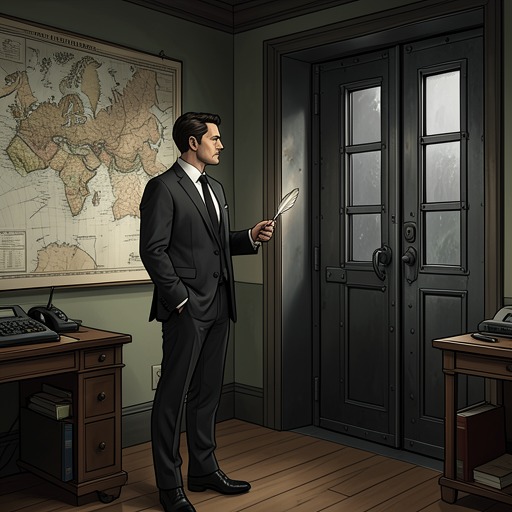
Martin Luther fakes his death to escape
FatherlandMartin Luther fakes his death to escape by arranging for another man to be identified as himself, leaving the authorities to believe he is dead while he tries to gain time. The substitution succeeds as an official misidentification, but its consequences turn the regime’s insistence on institutional infallibility into part of the cover-up—and leave Luther’s own death to be recorded as that of a stranger.
The Deception
Xavier March reconstructs the plan as a deliberate identity substitution. Luther needed someone to take his place and persuade the Gestapo that he was dead. March believes Luther killed a man of roughly his own age and build, dressed him in his clothes, and left him with his wallet, passport, and watch before placing him beneath a freight train. He reasons that Luther was gambling that by nine o’clock the next morning the Berlin police would have stopped looking for him.
The scheme depended on recognizable personal effects as well as resemblance: the dead man carried the objects that would make officials identify him as Luther. March’s account presents the apparent death not as an accidental disappearance but as an attempt to manufacture an official conclusion and buy time to carry out a wider plan.
The False Identification
The man substituted for Luther was Alfred Stark. March later finds Stark’s belongings in a small storeroom at the morgue, among tagged bundles of clothing and other property left by the dead. The tag identifies the bundle as belonging to Stark and gives the date as April 18, 1964. The discovery confirms that the body treated as Luther’s was in fact Stark’s.
The authorities do not correct the error. March concludes that Odilo Globocnik will not admit the Gestapo made a mistake: its supposed infallibility must be maintained. Stark’s body therefore continues to be treated as Luther’s, while Luther’s body is sent to a pauper’s grave under Stark’s name. The false identification outlives the deception that created it, becoming an administrative fiction preserved by the institution responsible for investigating the death.
Luther’s Death and the Aftermath
The morgue’s records reveal the final reversal. Luther has not escaped; he has died, and his body has been handled without honor under the identity of a poor stranger. March regards the outcome as a bleak form of poetic justice, but his immediate concern is not Luther’s fate. He wants to know how, between midnight and nine that morning, Globus discovered that Luther was still alive.
The episode thus separates Luther’s intended escape from its result. His plan briefly rests on the hope that the police will accept a substitute body as his own, yet the surviving evidence shows that the identity exchange cannot be disentangled from the authorities’ decision to protect their reputation rather than correct the record. The deception changes who is officially dead, but it does not preserve Luther’s life.