National Socialism
FatherlandNational Socialism is the political order that shapes the novel’s alternative Germany, extending from police jurisdictions and family law into propaganda, occupation, and the organized exploitation of people and property. Its decisive force lies in the way state violence and everyday routine coexist: an ordinary report of a body, a scheduled family visit, or a compulsory workplace announcement can take place within a system whose institutions also conceal mass persecution and murder.
State Power and Police Structure
The regime’s reach is visible in the hierarchy of security agencies. At the everyday level, the Orpo handles routine public policing and emergencies, including the recovery of bodies from lakes. The Sipo, which includes the Gestapo and the SD, is concerned with threats to the state, such as terrorism, subversion, and counterespionage. Between these bodies sits the Kripo, responsible for ordinary criminal investigations, including murder. The divisions are practical, but they also mark the boundaries between routine law enforcement and the regime’s political security apparatus.
The Kripo’s Werderscher Markt headquarters embodies this order in its architecture and daily procedures. SS sentries guard the entrance; visitors show identification and sign in; a board displays a terrorist-alert scale whose status remains at red. Before Führertag, the office workload increases, while portraits of Adolf Hitler and Reinhard Heydrich preside over the lobby. The scene makes institutional authority both bureaucratic and ceremonial: investigation proceeds amid files, clerks, and security controls, under the images of the leaders who command the state.
That bureaucracy also shapes what the police call crime. March anticipates a case involving a German woman and a Polish laborer being treated as a sexual offense under the 1935 Race Defilement Act. The law makes private relationships objects of racial regulation, and the expected punishment falls unequally on the people caught within its categories. In this system, ordinary criminal procedure does not stand apart from ideology; it can enforce the regime’s racial definitions in the language of law.
Ideology in Everyday Life
The novel repeatedly places political control inside familiar routines. March’s visits to his son Pili follow an unspoken pattern established after his divorce: a brief pickup at Klara’s home, arranged to avoid awkward encounters, under the terms of the Reich Marriages Act. Their time together is limited, but Pili’s new Pimpf uniform and enthusiasm about his initiation test bring the regime’s youth organization into the private encounter. At ten, he has entered the junior group; at fourteen, its members pass into the Hitler Youth. The progression makes ideological formation part of a child’s ordinary growing up.
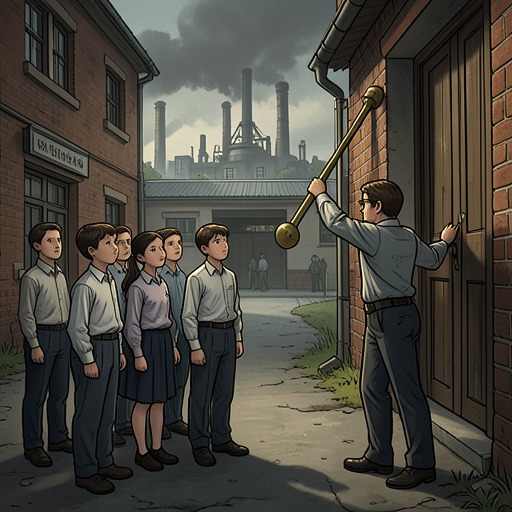
The regime similarly appropriates the calendar. Children receive a week away from school for Hitler’s birthday rather than Easter, and the holiday begins on schedule even in drizzle. In Wedding, factory whistles sound early, banners fill the streets, and local SA bands accompany public celebration. Yet graffiti threatens those who fail to enjoy themselves, while brownshirts try to remove it. The contrast exposes the coercion beneath the festivities: participation is presented as spontaneous national feeling, but the public display leaves little space for dissent.
Workplace communication follows the same logic. At the Kripo, staff must assemble in the canteen for a government announcement at a prescribed time. The Propaganda Ministry’s method turns news into a communal event, limits the opportunity for private skepticism, and uses an early finish to associate the state with a small daily convenience. Screens display the Reich’s map while Beethoven plays. Propaganda thus works through scheduling and shared habits as well as slogans: the state organizes not only what employees hear but where, when, and with whom they hear it.
The reach of the system becomes most chilling when the narrative sets it against an ordinary scene. A body recovered from the Havel is initially part of a familiar police workload; such cases occur regularly and may result from accident, suicide, or murder. The significance of the moment emerges through the contrast between that routine and the world-changing consequences that follow. National Socialism’s violence is not always announced as an exceptional event. The structures that normalize daily life also help make extraordinary crimes difficult to recognize.
Occupation, Extraction, and Administrative Violence
In occupied Poland, National Socialist rule combines resettlement propaganda with exploitation and appropriation. Newspapers and television invite Germans to settle in the General Government with promises of free farms and guaranteed income. The reported conditions behind those advertisements are far harsher: poor soil, exhausting labor, and settlement in towns where fear of partisan attacks shapes daily movement. The promotional image and the lived circumstances belong to the same policy, but tell radically different stories about what occupation means.
At Krakau, the scale of looting is reflected in both private luxury and official records. Halder describes Hans Frank’s administration at Wawel Castle and the wealth associated with it; the conversation links Josef Buhler’s position in the General Government to his Schwanenwerder home. Later, an inventory compiled by Polish museum authorities provides figures for the removal of cultural property from Warsaw alone: 2,700 paintings from the European school, 10,700 paintings by Polish artists, and 1,400 sculptures. These numbers make plunder legible as more than isolated theft: it is a transfer of cultural wealth on a vast scale.
The account of that transfer shows how official access and a lawful appearance can conceal private appropriation. Buhler, as a state secretary, could arrange the shipment of objects under escort to Wilhelm Stuckart at the Interior Ministry. Stuckart then arranged storage or the smuggling of works out of the Reich in exchange for portable assets such as cash, jewels, and gold. Some looted sculptures were being excavated from a garden. The chain connects occupied territory, state offices, transport, storage, and conversion into private or concealed wealth; administrative form does not interrupt the crime but enables it.
The same logic of turning human lives into managed resources reaches its most extreme form in the records Martin Luther brought back from Auschwitz. His notes describe an area called Canada, where belongings taken from deportees were gathered, and list large quantities of clothing and personal property sent onward to the Reich. The inventory includes 132,000 men’s shirts, 155,000 women’s coats, and 3,000 kilograms of women’s hair, alongside children’s clothes, handkerchiefs, and other goods. A doctor’s case is treated as a souvenir. The objects retain the evidence of individual lives, even as the administrative record reduces them to categories, quantities, and usable property.
Luther’s account also records the killing and disposal process at the camp, including the use of gas chambers, the removal of victims’ hair and valuables, and the handling of bodies for incineration. In this sequence, the paperwork and the machinery of murder are parts of the same system. The figures do not soften the violence; they show how it was organized, measured, and made useful to the state. The novel’s attention to these records opposes the smooth public language of resettlement and order with evidence of what that language concealed.
Money, Disappearance, and Public Memory
The regime’s authority reaches beyond Germany through the movement and protection of wealth. After the outbreak of war, demand for Swiss accounts rises as people seek to move property out of Germany. Banks devise numbered deposit arrangements involving a box, a number, a key, and a letter of authorization; multiple keys and letters can be issued, allowing property to pass without direct bank involvement in each transaction. The mechanism helps explain how concealed wealth can survive political upheaval and change hands while remaining detached from the people and circumstances from which it came.
National Socialism also shapes what can be remembered publicly. Charlotte recalls searching for her mother’s former theater and artist friends in Berlin, many of whom had been Jewish or homosexual. They were gone, and the places where they had lived were occupied by others. When she asks whether residents must have known, she describes people watching television, drinking tea, and listening to music, while nothing remained to make the absent people visible. The scene brings the novel’s central contrast into domestic scale: ordinary life continues, but its apparent normality rests beside the disappearance of whole communities and the erasure of evidence of their former presence.
Across the novel, National Socialism is therefore represented not as a doctrine separate from daily life but as a system that organizes it. It assigns police jurisdictions, shapes family visits and childhood milestones, stages public feeling, advertises settlement, and routes property from occupied populations through offices and private accounts. Its most consequential achievement is the appearance of continuity between ordinary administration and extraordinary violence. The investigations matter because they recover what that continuity is designed to obscure: the human cost behind classifications, inventories, official explanations, and the quiet routines of the state.