Historical truth and denial
FatherlandHistorical truth and denial in the novel are not abstract questions of interpretation: they determine whether victims can be remembered and whether crimes can be proved. The regime’s official history presents its victories as national destiny, while its machinery suppresses witnesses and evidence; against that power, March’s investigation depends on documents, testimony, and finally a fragment of scorched brick. The novel’s ending leaves him with physical proof, but not certainty that proof will persuade anyone.
Official History and Public Memory
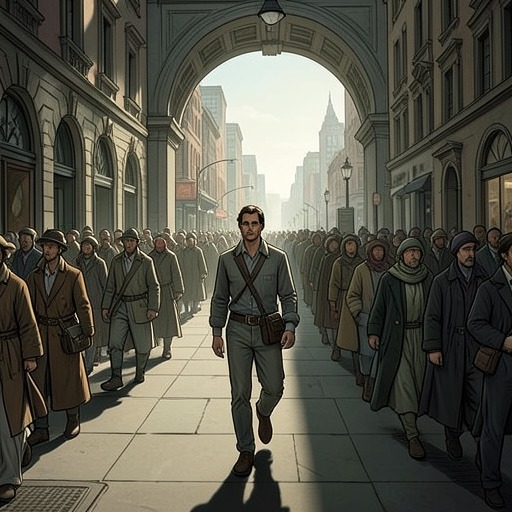
March’s memories of state broadcasts reveal how the regime turns political events into a continuous story of triumph. He recalls being summoned from class in 1938 to hear that German troops had entered Vienna and Austria had returned to the Fatherland. The headmaster, a First World War veteran, wept before boys too young to understand the announcement. In 1939, at seventeen, March heard Hitler’s declaration that he would not take off his uniform until victory or death. His mother wept; March looked at his father’s naval photograph and welcomed the prospect of war as a chance to fulfill what he imagined his father had wanted.
Later broadcasts recast military and diplomatic outcomes as evidence of Hitler’s genius. The defeat of Soviet conventional forces in 1943 was attributed to strategic brilliance; the 1944 armistice with Britain to counterintelligence, after U-boats received a new cipher system and Britain was starved into submission; and peace with the United States in 1946 to scientific superiority, after a German V-3 rocket exploded over New York in response to America’s atomic attack on Japan. The sequence makes the regime’s version of history feel cumulative and self-confirming: every turn, including the end of a war, is presented as another vindication of leadership.
The broadcasts continue after the fighting becomes a distant, recurring conflict on the Urals Front. Deaths, victories, calls for sacrifice, and revenge are folded into the same public narrative. Around March, listeners show forced humor, resignation, and apprehension; many have brothers, sons, or husbands in the East, and they keep looking toward the screens. The gap between official celebration and private anxiety shows how state memory does not erase lived experience, even when it dictates the language in which events may be understood.
Documents, Law, and Concealment
The novel places official narratives beside records that expose the violence they obscure. March encounters a battered, leather-bound copy of A Commentary on the German Racial Laws, with passages underlined in red and marked with exclamation points. Its explanations of the Nuremberg Laws and its marriage charts show persecution organized through legal categories and administrative language. The book’s bureaucratic form matters: the regime’s crimes are not detached from paperwork but enacted and normalized through it.
A sworn account signed by Wilhelm Stuckart and dated June 4, 1942, records a different kind of document-making. Stuckart says that Reinhard Heydrich described powers granted by Hermann Göring on July 31, 1941, to implement an unwritten Führer Order. When Stuckart proposed putting the order in writing, Heydrich refused on political grounds and directed him to take reservations to Hitler personally. The account preserves a record of a conversation whose central instruction was deliberately not to be formally recorded. Its existence gives March a route into the history the regime sought to keep deniable, while its status as a sworn statement also makes the writer’s position and purpose part of the evidence that must be considered.
The importance of records becomes especially stark when March learns that thirteen of the fourteen men who attended the conference at Heydrich’s invitation are dead, while the fourteenth, Martin Luther, is missing. The count turns the absence of witnesses into a pattern rather than an accident. A cartoon pinned to a police noticeboard advises children not to open a parcel without knowing what it contains. March reads the image as a maxim for policemen, extending it to the danger of asking questions without knowing their answers. The joke exposes the habits of caution that a terror system cultivates: information itself becomes something to fear.
Evidence Against Denial
The novel makes the threat to historical truth explicit through a passage quoted from Primo Levi’s The Drowned and the Saved. The quoted SS officer predicts that the victims will not survive to bear witness; even if some do, the world will doubt them, call their accounts unbelievable, and accept the perpetrators’ denials. He describes the destruction of evidence and the dictation of the history of the camps as parts of the same undertaking. In the novel, this passage gives a name to the obstacle March faces: evidence may exist, yet power can attack the people who carry it and the credibility of what remains.
That danger is not merely theoretical. A garage worker who found notes when March’s car was brought in passed them directly to Karl Krebs; Krebs believes that only this low-ranking worker knows he has them and that Globocnik does not yet know. The papers’ survival depends on a narrow, vulnerable chain of custody. A small detail about who found the notes and who received them becomes inseparable from their evidentiary value: documents can reveal the truth, but their survival also exposes those who know about them.
The Fragment and the Uncertain Ending
Near the end, March tells Max Jaeger that nothing remains at the site associated with Globocnik—not even a brick—and that nobody will believe the account. He adds that part of himself cannot believe it either, identifying this as his worst moment. The admission complicates any simple opposition between truth and lies: state denial has reached beyond public debate and begun to corrode the investigator’s own confidence.
Then March finds a fragment almost buried at the base of a sapling. The brick is pitted with yellow lichen, scorched by explosives, and crumbling at the corners; as he scrapes it, red dust gathers beneath his fingernail. He sees other pieces in the grass—first several, then dozens and hundreds. The detail reverses his despair without resolving the larger problem. The brick exists, and more fragments lie nearby, but the discovery cannot restore the dead or guarantee that a hostile society will accept what the evidence means.
The author’s note further distinguishes the novel’s altered history from the documented record. It states that many characters’ names belong to real people and that their biographies are accurate up to 1942, while their later fates differ; it also identifies several documents quoted in the novel as authentic and explains that other documents were created on a factual basis. This framing places invented events alongside acknowledged records without collapsing one into the other. The novel’s concern is not only whether a past can be reconstructed, but how documents, testimony, physical traces, and public belief compete to establish what counts as history.