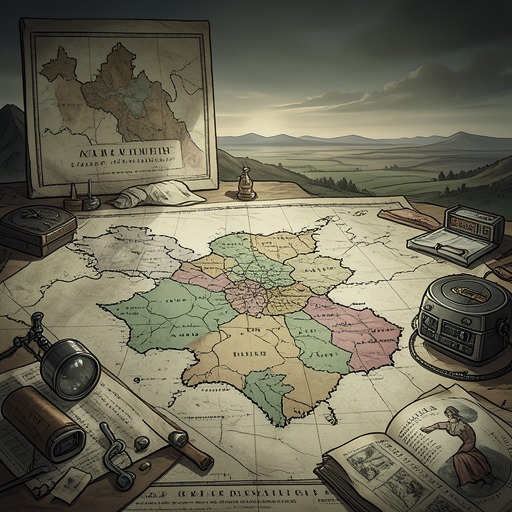
Eastern conquest and Nazi expansionism
FatherlandEastern conquest and Nazi expansionism are represented as both a military project and a landscape built to outlast its human costs. On March’s journey east, granite memorials and winter-proof highways make conquest visible as an enduring national monument, even as the empty roads and accumulating dead expose the violence beneath that claim to permanence.
Memorials to the East
A Totenburg, or Citadel of the Dead, stands on a bare hilltop near the road: four fifty-meter granite towers arranged in a square around a bronze obelisk. As March and Jaeger pass, weak sunlight flashes from the bronze like a mirror. The image briefly catches the eye, but the structure’s scale and exposed setting give it the character of an imposed monument, marking the conquered East with a memorial to German sacrifice.
The tomb is not an isolated landmark. March sees dozens of such tumuli between the road and the Urals, dedicated to Germans who have died, are dying, or will die in the conquest. That compressed sequence of past, present, and future makes the campaign seem perpetual: the memorials honor casualties already suffered while anticipating more. Their apparent imperishability contrasts with the vulnerable human lives absorbed into the project.
Roads Built for Expansion
The eastern landscape also bears the imprint of infrastructure. Beyond Silesia and across the steppes, the Autobahnen run along ridges so winter snow will not block them. Yet the highways are deserted, ceaselessly swept by the wind. Their engineering promises continuity of movement, while their emptiness gives that promise an unsettling afterlife: a route built for an expanding power persists as a desolate line across the terrain.
The scene then returns to the immediate journey. March and Jaeger drive another twenty kilometers, passing the factory chimneys of Kattowitz, before March tells Jaeger to leave the autobahn. The turn off the great road grounds the monumental vision in a specific movement through an industrial landscape; eastward expansion is not merely an abstract ambition but an environment of roads, factories, and commemorative structures.
Significance in the Journey
The passage places the Totenburg beside the autobahn as two expressions of the same project. One monumentalizes the dead; the other is designed to keep routes open through winter and across vast distances. Together they present conquest as something organized to endure, supported by infrastructure and sanctified by memorials, while the empty highway and the anticipated succession of casualties undermine any uncomplicated image of triumph.
The setting also sharpens the contrast with March’s earlier thought of Globus: nothing remains there, not even a brick, and he fears that no one will believe what happened. Against that absence, the granite towers and bronze obelisk appear designed to make one version of history last. Their polished monumentality cannot, however, erase the cost the passage names: the dead, the dying, and those still to die for the conquest of the East.