National Socialism and the Führer cult
FatherlandNational Socialism and the Führer cult in the novel are not confined to official doctrine or Hitler’s public image: they organize work, family life, youth formation, civic celebrations, and the language through which mass murder is administered and hidden. The governing idea is that a political order can become so habitual that alternatives are difficult to imagine; the narrative tests that claim against the evidence of people erased from memory and violence rendered as routine procedure.
Ideology in Everyday Life
The regime’s power appears most durable where it seems least exceptional. A body recovered from the Havel is described as a routine occurrence, one among the accidents, suicides, and murders that recur in the city. That normality is set against the irreversible change the discovery will bring. The contrast establishes a central pattern: ordinary life continues around violence, and its familiarity can make the extraordinary seem unremarkable.
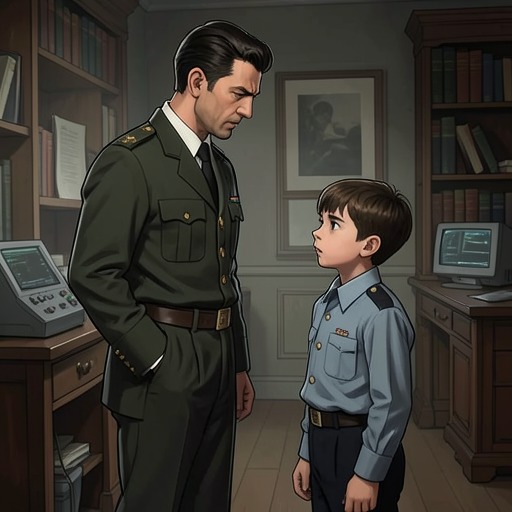
The same logic enters family life through law and custom. After his divorce, March sees Pili according to a schedule governed by the Reich Marriages Act; their brief meetings have settled into an unspoken ritual designed to avoid awkward encounters. On the visit described in the novel, Pili arrives in his Pimpf uniform, and lunch turns to the youth organization’s initiation and route marches. Membership begins at ten and leads at fourteen into the Hitler Youth. The scene makes ideological formation part of a child’s social calendar and a father’s limited time with his son, rather than an abstract political lesson.
At work, the state also choreographs how citizens receive news. A compulsory gathering at Werderscher-Markt brings officers, clerks, typists, and drivers together to hear a government statement. The announcement is timed for the end of the working day, broadcast communally, and paired with music and television screens. The arrangement leaves little room for private skepticism, while the prospect of leaving work early subtly associates the regime with a pleasant feeling. Propaganda is thus presented not simply as a message but as the organization of attention, company, and time.
The Leader as Public Image
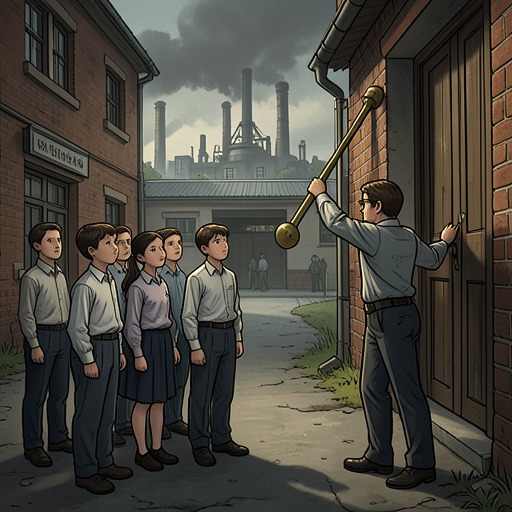
The cult of the Führer makes political loyalty visible across the city. In the days before Hitler’s birthday, official photographs appear in shop windows, framed with seasonal decorations; the approaching celebration brings an increasing display of swastika banners. On the birthday holiday, factory whistles sound early, banners hang from apartment buildings, and SA bands accompany street festivities. The crowds and civic arrangements turn loyalty into a shared public performance.
The weather itself is drawn into this political vocabulary: sunshine is called “Führer weather,” while rain has no Party name. The distinction reveals the asymmetry of the cult. Favorable conditions are credited to the leader, but ordinary discomfort has no official explanation or place in the celebratory story. Even in drizzle, the holiday proceeds by decree, and people set about celebrating with what the narration calls National Socialist determination. A piece of graffiti in Wedding—“ANYONE FOUND NOT ENJOYING THEMSELVES WILL BE SHOT.”—makes the coercive underside of compulsory festivity legible, even as brownshirts try to remove it.
The leader’s image also accompanies the movement through spaces of daily commerce and travel. As March and Jaeger are driven toward the Great Hall, they pass shop windows displaying Hitler’s portrait, decorated in anticipation of his birthday. The scene places the monumental destination within a city already saturated by smaller repetitions of the same image: the cult is both architectural spectacle and routine decoration.
Erasure and the Limits of Official Memory
The ideology’s hold on public life is matched by an imposed absence in private memory. Maguire recalls looking for her mother’s former friends—artists and theater people, some of whom may have been Jewish or homosexual—only to find that they had not merely disappeared. It was as if they had never existed. In the homes where those friends had lived, older residents offer no recognition; they watch television, drink tea, and listen to music. The stillness of these ordinary activities sharpens the force of the silence surrounding the missing people.
This erasure gives the novel’s account of National Socialism a second dimension. The state’s authority rests not only on public ceremonies and official portraits, but also on the disappearance of people from the stories a society can tell about itself. The apparent blankness of those who occupy former homes contrasts with the material record March later encounters: a regime can suppress remembrance in daily conversation, but its paperwork may preserve what its public language tries to obscure.
Bureaucratic Language and Organized Violence
The Wannsee minutes expose how the regime’s administrative vocabulary turns mass killing into a matter of conference business. The document identifies the January 20, 1942, meeting in Berlin and estimates that around eleven million Jews are included in the so-called Final Solution. Its language of direction, labor utilization, and “natural reduction” disguises the fate implied by the policy. March recognizes “appropriate” and “appropriately” as evasive words that allow officials to avoid saying plainly what their decisions entail.
Draft minutes make the machinery behind that evasion more explicit. They record Heydrich’s discussion of the shortcomings of shooting and his invitation to Lange to report on methods used in the occupied territories. Lange’s account compares shootings near Riga, gas trucks at Kulmhof, and experiments at Auschwitz using Zyklon B. Heydrich’s handwritten “No!” appears beside the passage, and the final version reduces the discussion to a brief phrase. The contrast between draft and approved record shows concealment working inside the bureaucracy itself: a document can preserve evidence of deliberation while its final form suppresses the detail.
Luther’s account of a camp visit gives the policy a physical and administrative sequence. At Auschwitz, a railway siding, guarded enclosures, and an arriving transport lead into a process that separates those designated for labor from the rest. The account records nearly two thousand people in a column, a building labeled “Baths and Disinfecting Room,” and the movement from that deceptive sign into the killing installation. The facilities, guards, prisoners assigned to assist, and the onward handling of belongings reveal a system organized through space, labor, and procedure rather than a single isolated act.
The same account describes the camp’s disposal and recovery operations, including the use of elevators, furnaces, and workers assigned to process human remains and possessions. Its figures for the installations’ stated capacity make mass killing legible as administrative throughput. The novel’s restraint in juxtaposing such details with official procedures emphasizes the system’s industrial organization without making its language neutral: the paperwork and logistics are themselves evidence of what the regime has done.
A circular on human hair extends that logic beyond the killing process. It orders that hair cut in concentration camps be used for industrial felt and thread, specifying uses for women’s hair and a minimum length for men’s hair. The quantities are to be separated, stored, and reported monthly. This is the same administrative voice that governs appointments and statistics, now applied to the remains of prisoners. Its orderly instructions expose how the regime turns people into classified labor, material, and entries in a report.
The Novel’s Central Contrast
The Führer cult promises a coherent, celebratory national life, but the narrative repeatedly sets that promise against what the state excludes from view: the dead treated as routine, the missing erased from neighborhood memory, and the victims of genocide reduced in official documents to euphemisms and administrative categories. Public ceremony and private habit make the order feel natural; the records, read against their omissions, disclose the violence that sustains it.
The result is an account of ideology as both spectacle and practice. Hitler’s portraits, youth uniforms, compulsory broadcasts, and birthday festivities provide visible signs of allegiance, while laws, schedules, euphemisms, and reports make that allegiance part of ordinary procedure. The title’s pairing of National Socialism with the Führer cult therefore points beyond devotion to a leader: it identifies an entire social order that tries to control not only what people do, but what they can remember and imagine.