“My mother, the harlot”
Faust“My mother, the harlot” is Margaret’s broken song in the dungeon, where family deaths recur as a childlike, disjointed refrain. Heard by Faust as he approaches to free her, it makes her mental disarray audible and prepares the scene’s final contrast between Mephistopheles’ verdict that she is judged and the voice from above declaring her saved.
Setting and Dramatic Moment
The song is heard inside the dungeon while Faust stands outside an iron door with keys and a lamp. He has come to release Margaret, but pauses before the lock, admitting that he dreads seeing her again. The sound of singing comes from within as he grasps the lock: the private song precedes their encounter and tells the audience what his entrance will find.
The scene makes the threshold consequential. Faust hears Margaret before she knows that her lover is nearby; as he unlocks the door, he observes that she does not dream he is listening. The song is therefore both her isolated utterance and the first sign of contact between the imprisoned woman and the would-be rescuer.
The Song’s Images and Form
Margaret’s refrain gathers family deaths into a sequence: she names her mother and father, then her little sister, whose bones were laid in the woods. The verses do not offer a composed explanation of what happened. Instead, the sudden movement from accusations about her parents to the sister’s burial, and then to the image of a beautiful woodland bird flying away, gives the song its fractured, childlike form.
That final bird image changes the song’s direction without resolving its grief. The repeated call to fly away turns escape into a refrain, while the burial in the woods keeps the loss present within it. The song’s plain, nursery-like structure thus holds together anguish and a longing for release without making Margaret’s confinement disappear.
Earlier Signs of Distress
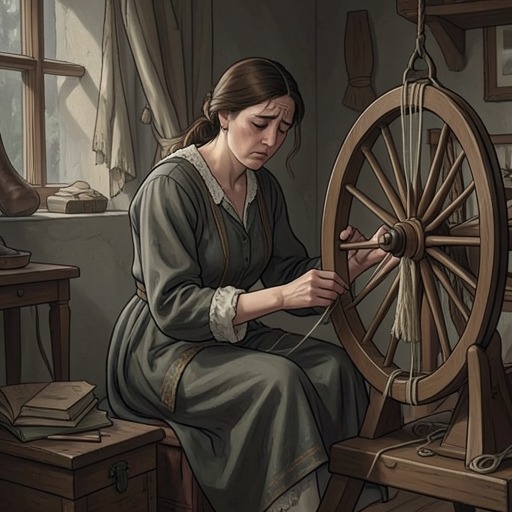
The song belongs to a wider pattern of distress in Margaret’s appearances. Alone at her spinning wheel, she had already sung that her peace was gone and her heart was sore, unable ever to find it again. In the cathedral, the Evil Spirit confronted her with the deaths of her mother and a child, the blood on her threshold, and the life stirring beneath her heart; Margaret answered that she wished to be free of the thoughts pulling her in opposing directions.
In the dungeon, those accusations return not as a speech to an adversary but as a song assembled from family losses. The song’s repetition makes the past audible at the moment Faust arrives, linking her earlier anguish to the consequences that now surround her. It also places the audience in the position of hearing her suffering before the rescue attempt can become a conversation.
Judgment and Salvation
The song does not itself pronounce a judgment or describe Margaret’s fate. Its place in the final dungeon scene instead sharpens the stakes of the decision that follows: Margaret gives herself to God, and Mephistopheles announces that she is judged. A voice from above immediately answers that she is saved.
The ending distinguishes the demonic declaration from the transcendent one. Heard between Margaret’s song of family loss and her appeal to God, the voice from above grants the scene a resolution that Faust’s arrival alone cannot provide. The song remains a sign of her disorder and suffering, while the final judgment establishes that her story does not end with imprisonment or condemnation.