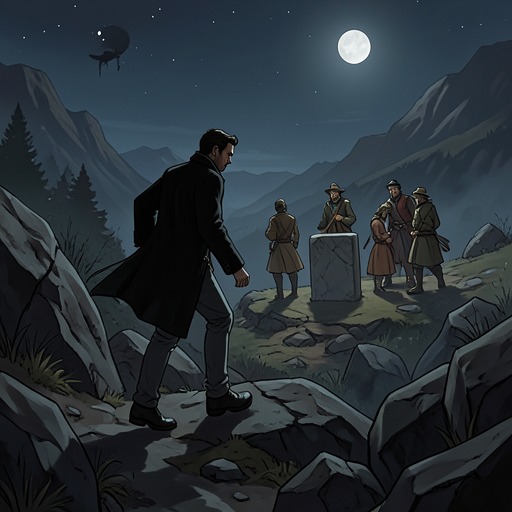
Spirits
FaustThe Spirits in Faust form no single, stable species so much as a supernatural company whose powers and appearances shift with the scene. They can be instruments of divine purpose, voices that hold a threshold against Mephistopheles, or performers who lull Faust with images of sensuous delight. Their range makes them essential to the play’s unsettled supernatural world: they do not merely decorate the action, but help stage its contests over striving, temptation, and moral perception.
Identity and Place in the Supernatural Order
The Lord places the Spirits within a moral order that can accommodate opposition without treating it as an absolute threat. He permits Mephistopheles to set snares for Faust, while asserting that a good person may retain an instinct for the true way even through obscure aspiration. In this account, the human being’s active nature can flag and crave repose; the Devil’s role is to provoke and excite that nature. Mephistopheles is thus allowed to work as a disruptive companion, but the Lord presents this disturbance as part of a larger providential framework, not as proof that evil has finally prevailed.
The Lord’s address also distinguishes the denying spirits from the “God’s sons in love and duty,” whose relation to creative power is described through bonds of love and enduring thought. The contrast locates supernatural beings along a spectrum of allegiance and function: some are associated with denial and disturbance, while others belong to divine duty and creative order. The play does not turn that distinction into a simple catalogue of species; instead, it lets spirits appear in varied forms and tasks, leaving their significance to emerge from the dramatic circumstances in which they act.
Thresholds, Ritual, and the Familiar Disguise
When Faust’s poodle grows into a monstrous presence in the study, Spirits speak from the corridor, warning one another not to follow the creature inside. They compare the trapped Mephistopheles to a fox in a snare and describe him as an old hell-lynx trembling back and forth, unable to work himself free. Their speech makes the doorway a contested boundary: Faust has summoned a power he does not yet understand, while the Spirits outside recognize the danger and keep their distance. Their warning also lends the scene a communal supernatural perspective, briefly showing the encounter from beyond Faust’s own bewilderment.
Faust answers the threat by invoking the four elemental figures: Salamander, Undine, Sylph, and Gnome. His formula treats knowledge of the elements—their sense, properties, and power—as necessary to command Spirits. The ritual is an assertion of mastery through classification, but it does not settle the encounter by itself. The scene has already shown that a creature can cross from the familiar poodle’s shape into a form Faust recognizes as monstrous, and the ritual therefore stands amid uncertainty about what sort of being has entered the room and how it can be controlled.
The later revelation of Mephistopheles’ familiar likeness gives this shapeshifting a cruelly intimate dimension. Faust recalls that the creature had often run before him at night, rolled at the feet of an unsuspecting wanderer, and clung to a fallen person’s shoulders. He demands that the monstrous figure be changed back into its favorite dog-shape so that he can trample the outlaw beneath his feet. The remembered dog is not an unrelated detail: it binds a domestic, apparently familiar appearance to Mephistopheles’ predatory role, and Faust’s appeal for transformation shows how rage tries to turn recognition into an instrument of punishment.
Enchantment and Performance
In another scene, Mephistopheles announces that the Spirits will offer Faust more sensory pleasure in an hour than the monotony of a year. Their promised performance appeals to smell, taste, and touch as well as sight and hearing, presenting enchantment as an assault on the senses rather than a mere verbal illusion. The Spirits sing of dark arches giving way to lovely weather and a blue sky; starlight, hovering figures, and flowing garments open into images of secluded lovers, vine-covered bowers, and grapes spilling into rivers of wine. Their vision expands outward through crystalline waters, emerald shores, and winged beings flying toward islands and the distant star of rapture and love.
The song’s movement carries the listener from shelter and intimacy to an ever-widening world of motion. Lovers are hidden in bowers, but the winged creatures do not remain there: they drink, fly, circle islands, climb highlands, and hurry toward a distant promise. Beauty is rendered as restless ascent, a fitting form for the play’s persistent tension between the desire to settle into pleasure and the impulse to move beyond it. Yet the scene is explicitly a performance arranged by Mephistopheles. The Spirits’ imagery gives sensuous attraction extraordinary force, while their supernatural song serves the Devil’s immediate purpose of putting Faust to sleep.
Once Faust sleeps, Mephistopheles dismisses the Spirits as fays and acknowledges his debt to their performance. He says that the dream-images have wrapped Faust in sweet falsehood, but does not mistake that success for a completed victory: Faust is not yet the man who will catch and hold the Fiend. The scene therefore makes the Spirits’ art potent but limited. Their enchantment can prepare a vulnerable state and shape desire, while Mephistopheles still has to use a rat to gnaw at the threshold’s magic and open the way for his own escape.
Spectacle, Judgment, and the Play’s Moral Tensions
The play’s later masque supplies another register of spiritual appearance. Oberon calls for the Spirits to show themselves, while announcing that the fairy king and queen are newly plighted; Puck follows with a swift, whirling dance and a call for a hundred others to share the pleasure. Elsewhere in the spectacle, a Spirit just coming into form is described through a spider’s foot, a toad’s paunch, and little wings. The audience is told that it will be a small creature, but also a little poem. Such images refuse a clean division between graceful enchantment and grotesque matter: the supernatural can arrive as a dance, a promise of fairy celebration, or an unfinished creature assembled from unsettling parts.
The masque also dramatizes disagreement over what supernatural evidence means. The Realist is vexed by the confusion around him and says he stands, for the first time, on insecure ground. The Supernaturalist takes delight in the spectacle, accepting the Devils’ presence as grounds for inferring better spirits as well. Spirits thus belong not only to the action but to a dispute about how the action should be understood. Their appearance can unsettle confidence in ordinary explanation, yet it does not compel every observer to draw the same conclusion.
That interpretive uncertainty becomes morally sharper when Faust confronts Mephistopheles over the suffering of the condemned woman. Faust calls for the Infinite Spirit to transform the reptile back into the dog-shape in which Mephistopheles once appeared, and recoils from the thought that more than one person has sunk into such misery. He says that this single person’s suffering pierces him, while Mephistopheles calmly grins at the fate of thousands. The demand for transformation cannot undo the suffering Faust sees; instead, the familiar canine disguise returns as the image through which he expresses his wish to abase the Devil. Mephistopheles answers by accusing Faust of entering into fellowship with them and then recoiling from its consequences. In that exchange, the supernatural world’s shifting forms lead back to human responsibility: spectacle and disguise may shape perception, but they do not dissolve the question of what Faust has chosen to do.