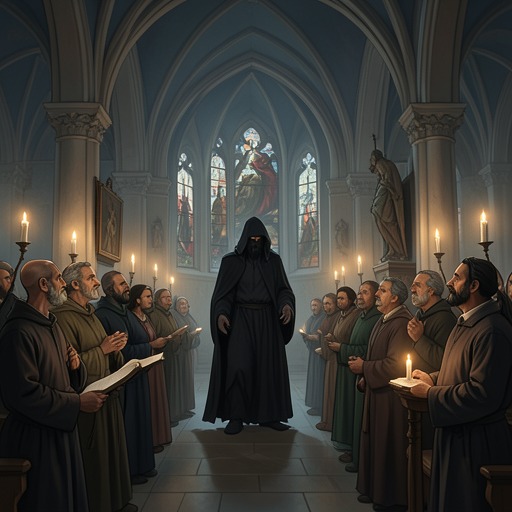
Angels
FaustAngels in Faust are a collective heavenly presence whose appearances frame the tragedy with two connected claims: creation moves within an order beyond human comprehension, and spiritual judgment can conclude in salvation. They first praise the enduring rhythms of the cosmos; later, their Easter choruses turn resurrection into consolation and a promise of renewed life, while the final heavenly voice confirms Margaret’s salvation.
Identity and Dramatic Presence
The Angels belong to the heavenly host introduced alongside the Lord and Mephistopheles. The Three Archangels come forward to speak in praise of creation, with Raphael, Gabriel, and Michael each voicing a distinct aspect of the world’s movement. The Angels also appear as collective choruses, first answering the account of Christ’s burial and then proclaiming his resurrection. At the end, their heavenly presence is condensed into a voice from above that answers the verdict spoken by Mephistopheles.
Their dramatic function is collective rather than personal: they do not pursue an individual plot or engage in dialogue with the human characters. Instead, their ordered voices provide a counterpoint to human suffering and to Mephistopheles’ efforts to draw Faust and Margaret into despair. The recurring movement from plural chorus to a single voice gives their interventions both ceremonial scale and decisive authority.
Praise of the Created World
In their first appearance, the Three Archangels describe a universe in perpetual motion. Raphael praises the sun’s ancient course among its brother-spheres, a path that ends with a thunderous step; the Angels draw power from its radiant face, though the measure of that power cannot be known. Creation remains splendid as it was at its beginning, even when its works exceed understanding.
Gabriel widens the picture from the heavens to the earth. Day and night alternate in immense contrast, while ocean tides break against the rocks and the celestial spheres race onward. Michael adds storms that surge between sea and land, a chain of action charged with wrath and energy, and devastation flashing before thunder. Yet amid this upheaval, the Angels praise the gentle movement of the Lord’s day. Their account does not deny conflict or destruction in nature; it places those forces within a larger order whose purpose is not fully comprehensible to them.
The collective chorus returns to that limit of knowledge. The Angels acknowledge that the works remain beyond their comprehension, yet they draw strength from them and declare them as splendid as at creation’s first hour. Their praise therefore joins wonder with humility: cosmic order is affirmed, but it is not reduced to something the speakers claim to explain.
Easter Choruses and Resurrection
The Angels’ later choruses appear within the Easter sequence. After Faust voices his sense of being an image of the Godhead and turns toward the consoling song associated with the night of death, a chorus of women recalls preparing and laying Christ in linen, only to find that he is no longer there. The Angels answer with a compact proclamation: Christ has ascended, and the woes and trials that tested him have ended in glory.
The disciples’ chorus emphasizes the difference between Christ’s victory and human longing: they ask whether he has burst from the grave, but lament that they remain native to earthly sorrow and miss their Master. The Angels respond by declaring that Christ has risen from corruption’s womb and urging the faithful to break from gloom. Their account describes how the Master is made near through praise, pleading, loving need, brotherly care, preaching, and blessing. Resurrection is presented not only as a completed triumph but as a presence continued through communal acts of faith and care.
Judgment and Margaret’s Salvation
At the drama’s close, Margaret refuses Faust’s attempt to take her from the dungeon and gives herself to God. Mephistopheles declares that she is judged; a voice from above immediately answers that she is saved. Although the stage direction does not identify the speaker by name, the voice belongs to the heavenly order established by the Angels’ earlier interventions, and its pronouncement overturns Mephistopheles’ claim to the last word.
This ending gives the Angels’ role its final consequence. Their earlier choruses set suffering beside resurrection and insist that despair is not the only possible conclusion; the closing voice applies that spiritual possibility to Margaret. The contrast is sharp: Mephistopheles announces judgment as condemnation, while the heavenly response distinguishes judgment from damnation. The Angels thus frame the work’s movement from cosmic praise, through Easter consolation, to Margaret’s salvation without making her suffering disappear or treating the conclusion as a worldly escape.