Harrison State College
FirestarterHarrison State College is the academic setting where the Lot Six experiment first places Andy McGee and Victoria Tomlinson in the same room. Its Psychology Department offers Andy a small but timely payment; its lecture hall and Jason Gearneigh Hall then become the spaces in which a classified experiment begins and the two participants’ connection takes shape. The college is more than a backdrop: it links Andy’s financial need to the experiment and gives the story’s intimate turning point an institutional setting.
Campus and Academic Setting
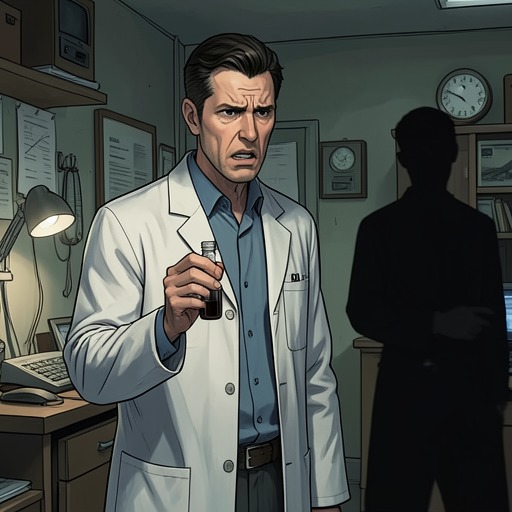
The early scenes locate the experiment within Harrison’s academic buildings. Dr. Wanless introduces the study in a nearly deserted lecture hall in the combined Psychology and Sociology building. He tells twelve young participants that they will receive injections, some containing water and others water mixed with a small amount of Lot Six, described as a classified hypnotic and mild hallucinogen. The double-blind arrangement means neither the participants nor the researchers will initially know who has received the compound, and the volunteers are to remain under close supervision for forty-eight hours.
The college setting gives the project an ordinary administrative surface: forms, graduate assistants, scheduled appointments, and a department-issued check. Yet the secrecy around Lot Six is already conspicuous. Participants ask about its composition, but Wanless evades the questions. The experiment thus enters the story not as an openly understood scientific undertaking, but as a campus study whose terms are only partly disclosed to the people taking part.
Andy’s Route into the Experiment
For Andy, participation arises from immediate financial pressure. In May of his senior year, he is graduating fortieth in a class of 506 and third in the English program. He has arranged a graduate assistantship and scholarship-loan package for the fall, enough to support groceries and continued study, but those resources do not solve the gap before the semester begins. The best summer work he has found is a night-shift job as an Arco gas attendant.
Quincey Tremont, Andy’s psychology-major roommate, knows his circumstances and brings him the possibility of earning two hundred dollars quickly. The experiment therefore intersects with Andy’s academic life at a vulnerable practical moment: he is a successful student with a future plan, but needs money now. Harrison State College is both the institution offering the study and the place where the opportunity reaches him through a fellow student.
Before the injections, the participants complete a questionnaire of twenty-five yes-or-no questions, including whether they have received psychiatric counseling, experienced psychic phenomena, or used hallucinogenic drugs. Andy marks no for drug use, despite privately reflecting on how common such use seems in 1969. This moment situates the study within the period and shows Andy moving through its screening process with private reservations rather than open challenge.
Room 70 and the Study’s Immediate Effects
The volunteers are assembled upstairs in Room 70 of Jason Gearneigh Hall, where twelve cots have been brought in from the college infirmary. The physical arrangements make the research feel both temporary and controlled: the participants lie on institutional bedding while graduate assistants administer the intravenous lines and take notes. Wanless moves among the cots, speaking to each participant with a small, reassuring smile, but Andy remains unconvinced by the appeal to modern science. He associates scientific progress with destructive technologies as well as medical benefits, so the study’s professional assurances do not settle his unease.
When Andy gradually comes out of a doze, several cots are empty and about five participants remain in the room. A graduate assistant is questioning one of them and writing on a clipboard; the quiet exchange suggests that observation continues as the volunteers recover. Andy, by contrast, feels physically well and unusually alert. His attention turns to Victoria Tomlinson, asleep on the neighboring cot, and he recognizes that he has fallen in love with her. The experiment’s immediate personal consequence is therefore distinct from its scientific purpose: within the supervised room, Andy’s sense of his relationship to Victoria changes decisively.
Return to the Hall
Five days later, Victoria does not want to revisit the experiment. She has received and banked her two-hundred-dollar check from the Psychology Department and would prefer to forget the circumstances in which she earned it. Andy nevertheless persuades her to return to Jason Gearneigh Hall, although she goes unwillingly. Their visit comes at the change of classes, with Harrison Chapel’s bells sounding in the May air and other people around them.
Andy reassures her that nothing can happen in broad daylight among dozens of people, but he cannot clearly identify, even to himself, what he fears. That hesitation gives the campus a changed meaning. The hall first hosted an experiment whose effects and significance were uncertain; returning to it now brings the pair back toward that unresolved experience. The college setting thus holds together the study’s concealed procedures, Andy’s new attachment, and the unease that remains after the volunteers have left the cots.