McGee cottage
FirestarterMcGee cottage is both a family refuge and a temporary base in Andy McGee and Charlie McGee’s flight. On the shore of Tashmore Pond, it preserves the material traces of Granther McGee’s care and Andy’s childhood, offering food, firewood, and shelter. Yet the quiet of the place cannot erase the fact that the two fugitives are still being hunted: what first feels like safety becomes the setting in which Andy recognizes that hiding alone is no longer enough.
Setting and remembered past
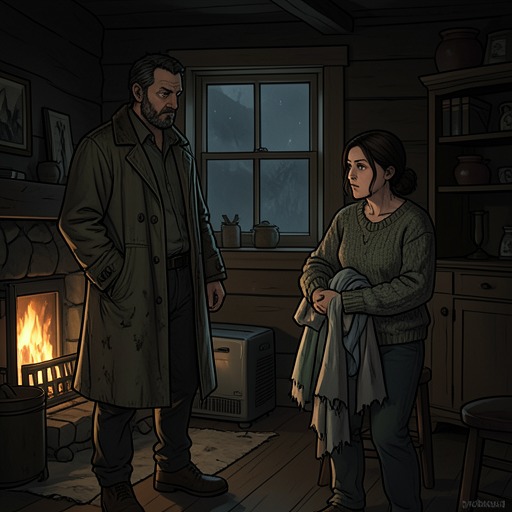
The cottage stands in a clearing at the water’s edge. It is a five-room wooden building over a fieldstone base, with a deck projecting toward the lake and a stone pier extending into the water. Leaves and the damage of several winters have accumulated, but the place itself seems scarcely changed. Its green shingles, moss, pine needles lodged in the roof angles, and wooden gutter preserve the familiar appearance Andy remembers.
That familiarity arrives as more than a soothing recollection. When Andy and Charlie reach the clearing, Andy feels an intense rush of memory, intertwined with a recent dream of a boat, a nightcrawler, and the patches on Granther’s boots. The cottage draws together different times in his life: he remembers learning to bait a hook, sleeping in a narrow bed in a maple-paneled bedroom, and later sharing Granther’s old double bed with his wife. The same rooms thus hold childhood and adulthood, family instruction and married life. The place matters not simply because it is secluded, but because its ordinary features carry the history of a life Andy has lost access to.
The surrounding landscape reinforces that sense of continuity. Across Tashmore Pond, the pines and Bradford Town Landing remain, without the shopping center or amusement park Andy might have feared would alter the shore. He remembers Granther’s teasing remark about trees that could not tell summer from winter. The wind in the trees and the unbuilt far shore make the setting feel set apart from the changing world, while the cottage’s neglected leaves and fallen trees mark the years that have passed in Andy’s absence.
Supplies and the work of shelter
The cottage is useful because it contains what the fugitives need to begin settling in. In the boathouse, Granther’s tools remain neatly arranged. Beneath it Andy finds nearly two cords of split, seasoned wood, much of it wood he had cut himself and covered with canvas. It will not last through the winter, so he plans to cut up the blowdowns around the camp and clear a fallen tree from the road with a bucksaw, making a way for the Willys to pass. The refuge is not ready-made comfort: its resources have to be assessed, extended, and put to work.
Food has survived as well. Andy finds a pantry stocked with canned soup, sardines, beef stew, and vegetables; even a half-case of dog food remains on the root-cellar floor. In the cellar, three steps below the pantry, he uses a match to see by and removes a loose board concealing four mason jars of Granther’s homemade liquor. The concealed cache makes the house feel carefully provisioned, its stores distributed between visible shelves and a hidden recess. Andy’s response to the discovery is a grin, but the detail also underscores the practical uncertainty of their stay: he is counting what the cottage can provide and what must still be done.
A brief sense of safety
The first evening takes shape through small domestic routines. Andy draws the drapes before lighting a kerosene lamp, makes tomato soup, and opens sardines for himself and Charlie. They eat quietly. Charlie finds decks of cards in the drawer of a Welsh dresser, each deck missing a card, and spends the rest of the evening sorting and playing with them while Andy explores the camp. The imperfect cards and the lamp-lit meal are modest comforts, not signs that their danger has passed.
At bedtime, Charlie answers without hesitation that she feels safe. Andy stays with her until she falls asleep, then leaves her door propped open so he can hear if she becomes restless. Her immediate confidence gives the cottage a protective force for that night; Andy accepts her sense of security as sufficient for them both. But the protection is emotional and temporary. The cottage can shelter them from exposure and supply their needs, yet it does not resolve the pursuit that brought them there.
Isolation and the decision to speak
During the winter, Andy crosses the frozen pond on foot. The route is less than a mile across, but the long lake opens into a corridor of snow and ice, bordered by pines beneath a hard blue sky or a featureless sky promising snow. The silence and physical exertion clear his thoughts. Against the remembered ease of teaching and marking papers, the labor of crossing the lake restores a bodily rhythm that helps him confront the problem he has been avoiding.
At Granther’s place, Andy and Charlie are still running. His unease about the old-timers who sit around a stove with pipes and inquisitive eyes makes their vulnerability newly tangible. He thinks through the injustice of his wife’s murder, his daughter’s kidnapping, and their continued pursuit, and recognizes that remaining hidden has not made them free. He had delayed telling their story because he feared what might happen to Charlie if the truth became public, and because he had continued to hope they would eventually be left alone. The cottage, once a refuge from that danger, becomes the setting for his painful decision to stop relying on concealment.
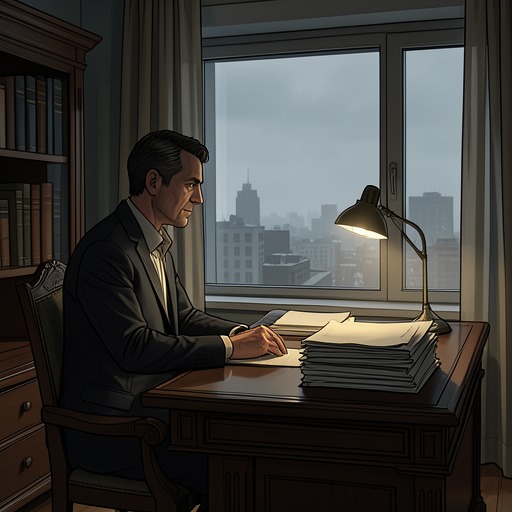
Andy writes six nearly identical letters: two to Ohio’s United States senators, one to the representative for the district containing Harrison, and one each to the New York Times, the Chicago Tribune, and the Toledo Blade. The letters recount events from the experiment at Jason Gearneigh Hall through the enforced isolation at Tashmore Pond. Charlie reads one slowly, taking almost an hour; it is her first time learning the whole story from beginning to end. The cottage thus becomes not only a hiding place but the point from which Andy prepares to expose what has happened. Its quiet and provisions sustain them, but its most consequential role is to make plain the limit of retreat: the family cannot remain safe simply by staying out of sight.