Tashmore Pond
FirestarterTashmore Pond is a lake in Vermont whose secluded shore holds the family camp inherited by Andy McGee. For Andy and Charlie, it becomes both a refuge from pursuit and a landscape shaped by memory: the place where Andy grew up with Granther McGee, and where the Shop eventually finds the fugitives. Its quiet offers a temporary shelter, but its connection to the McGee family also makes it a predictable destination.
Setting and Family History
Although called a pond, Tashmore Pond is described as a lake, with Bradford, New Hampshire, on the far side. The family property lies in wooded, sparsely populated country, about twenty miles from the nearest two-lane road. In summer, camps around the water fill with visitors; by the time Andy and Charlie head there, the season has ended, and Andy doubts that the road is even plowed in winter.
The property has passed through three generations. Granther McGee owned the lakeside place; after his death it went to Andy’s mother, and after her death it passed to Andy. A small sum Granther left in trust covers the back taxes, preventing the town from taking the property. Andy and Vicky Tomlinson McGee had returned there once each summer before Charlie was born, making the camp part of their family history as well as an inherited asset.
Arrival at the Camp
The plan to go to Granther’s comes first from Charlie. Andy is startled by her suggestion because Granther died long before she was born. Just before the idea arises, Andy has been thinking about a dream of fishing in the rain; Charlie says the destination simply came into her mind. Andy recognizes that Granther has also just entered his thoughts through the dream, though he cannot explain the connection between their impulses.
After their journey, Andy and Charlie turn from Route 34 onto a narrow, rutted road marked as private property. The relief he feels at reaching the place is immediate. They drive roughly a mile and a half toward the pond, passing the smaller branch road barred by a heavy steel chain and a rust-spotted no-trespassing sign. Andy gets out with his keyring, whose nearly obliterated leather tab bears his initials and was a Christmas gift from Vicky Tomlinson McGee, given before Charlie’s birth.
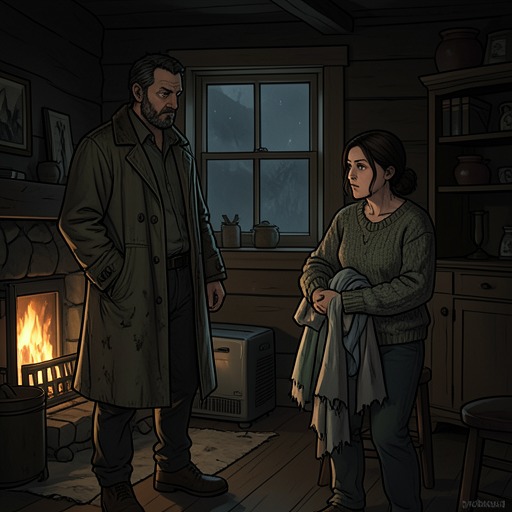
The road opens onto a clearing at the water’s edge. The cottage has five rooms, wood siding over a fieldstone base, a deck facing the lake, and a stone pier extending into the water. Three winters’ worth of fallen branches and leaves mark the time it has stood empty, but Andy finds it otherwise unchanged. Its green shingles, mossy appearance, and pine needles caught in the roof and gutter preserve the familiar character of the place. The familiar structure carries his childhood memories: Granther teaching him to bait a hook, his maple-paneled bedroom, and waking to water lapping against the pier. It also recalls Andy’s adult life there with Vicky Tomlinson McGee.
Winter Refuge and Everyday Life
The camp is remote enough to feel sheltered, but the harsh season makes daily survival a practical concern. Andy considers whether there will be enough oil if they stay through winter; there is enough to begin with, and he plans to cut wood, with Charlie helping to haul it. The arrival scene holds both relief and uncertainty: Andy and Charlie stand quietly by the cottage, while Andy experiences an intense rush of memory, stirred by the place and by details from his recent dream of a boat, a nightcrawler, and patches on Granther’s boots.
During the winter, Bradford provides necessities for their stay. Andy makes the six-mile round trip across the pond on Granther’s skis to shop. He buys heavy pants and wool shirts close to Charlie’s size; with no girls’ underwear available, she has to wear size-eight Jockey shorts, which alternately disgust and amuse her. The journey is physically punishing. Andy gets blisters from the old boots, and moving too quickly can bring on headaches. His fear of leaving Charlie alone, and of suffering a medical crisis on the lake, makes even an errand across the ice feel consequential.
The crossing also gives Andy rare stretches of clear thought. By February, four feet of snow cover the ice. He pauses on the route, which is less than a mile across at that point, and sees the lake as a long white corridor bordered by sugar-dusted pines. The severe winter sky, the occasional crow, and the low sound of the ice stretching frame an expanse that is nearly empty of human activity. The exertion restores a physical sensation Andy had lost while teaching and grading papers, and the silence helps him think through their predicament: they have reached the inherited retreat, but they are still on the run and need a way out of their increasingly constrained position.
How the Shop Finds Them
The camp’s value as a refuge is compromised by the very family history that directs Andy there. Using “last-seen” information and extensive records about more than two hundred relatives and four hundred friends connected to the McGee and Tomlinson families, the Shop’s computer ranks likely destinations. Granther McGee’s camp appears at the top: Andy owns it, the family has vacationed there, and it lies within reasonable striking distance of the Manders farm by back roads.
Less than a week after Andy and Charlie move in, Cap Hollister knows their location. The Shop establishes a loose cordon around the camp and arranges passive surveillance, including photographs taken with concealed telephoto lenses. Agents anticipate that the fugitives will shop in Bradford. The operation is cautious, in part because Cap does not want to risk another firestorm.
The surveillance reaches beyond the immediate camp. On March 10, Andy’s six letters are among the mail collected at the Bradford general store for delivery to the nearest post office in Teller, New Hampshire. The Shop intercepts the postal truck on its return route. By March 27, after more than two weeks without a response, Andy’s unease about the continuing silence has hardened into the suspicion that the letters were diverted—and that the Shop knows where he and Charlie are. His later discovery of snowshoe tracks, six Vantage cigarette butts, and a crumpled Kodak Tri-X package near a spruce tree confirms that someone has been watching the cottage from a position with a direct line of sight. He keeps that discovery from Charlie.
Shelter, Exposure, and Narrative Role
Tashmore Pond gathers together two opposing meanings. For Andy, the cottage is a safe place sustained by family inheritance and childhood memory; for the Shop, the same inheritance makes the McGees’ destination legible and helps turn their hiding place into a target. Andy’s physical return to a place that once held both boyhood and married life cannot restore the security of those earlier years. The camp is secluded, but it is not unknown.
That contrast shapes the location’s role in the pursuit. The lake provides temporary cover, a difficult winter crossing, and a setting in which Andy can think, but the family’s established connection to it enables the Shop to predict their movements. The Shop operation ultimately nets Andy and Charlie at Tashmore Pond. The retreat therefore becomes more than a pause in their flight: it is where the promise of refuge and the danger of being found converge.