Death of Tynnes Falk
FirewallTynnes Falk’s death begins as an apparent medical emergency beside a cash machine and becomes one of the investigation’s most consequential mysteries. Found in Ystad with a head wound and a balance receipt in his hand, the 47-year-old computer consultant is first judged to have died of a heart attack. Later evidence unsettles that conclusion: his doctor and ex-wife insist that something about his death does not fit, while the theft of his body and the removal of objects from his flat make the supposedly closed case part of a wider pattern.
Discovery and Initial Assessment
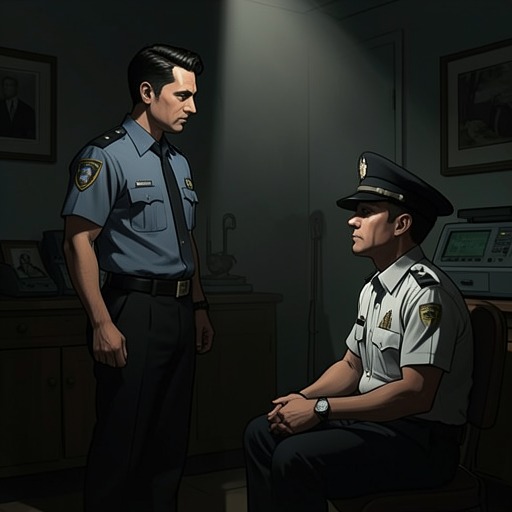
A night patrolman reports shortly after 1 a.m. that a man is lying dead in front of a cash machine outside a department store, beside the Inland Revenue. The doctor who examines him estimates that he has been dead for no more than a couple of hours. He has an ugly wound on his head, but the officers cannot tell whether someone struck him or whether he hit his head in a fall. Nothing else immediately establishes that a crime has occurred.
The scene offers a small but puzzling detail: Falk’s wallet remains with him, money still inside, and the blood-spattered receipt in his hand shows that he checked his account balance at 12:02 a.m. He had not withdrawn cash. The last recorded withdrawal was on the preceding Saturday, and it was not a large sum. The obvious theory of a robber waiting for him to take money therefore has little support. Kurt Wallander wonders whether Falk might have been upset by the balance he saw, but this remains speculation, not an explanation established by evidence.
Falk lived nearby, renting the top-floor flat at 10 Apelbergsgatan. He was divorced and had two children: a 19-year-old son studying in Stockholm and a 17-year-old daughter working as a nanny at an embassy in Paris. He appears to have worked for himself as a computer consultant. Those details give the police an identity and a domestic history, but at first they do not explain why he died in a public place with a receipt rather than cash in his hand.
A Cause of Death in Dispute
The police initially accept the autopsy’s conclusion that Falk died of natural causes: a massive coronary. His head wound, the pathologist says, was caused when his head struck the pavement. With no money taken and no other clear sign of a crime, the investigation is set aside as closed. That conclusion is later challenged by people who knew Falk, though their objections do not immediately change the official finding.
David Enander, Falk’s physician for more than fifteen years, comes to see Wallander after hearing about the death from Falk’s ex-wife. Enander had treated Falk since 1981 and continued to conduct regular check-ups after opening a private practice in 1986. He describes a man who took care of himself, ate well, exercised, and kept regular habits. Most strikingly, Enander says that a complete examination only ten days earlier found Falk’s heart in excellent condition and his stamina comparable to that of a much younger man. He cannot identify what killed Falk, but is certain it was not his heart; he also believes the head wound suggests an attack.
Marianne Falk independently rejects the heart-attack explanation. She says she knew her former husband well, despite their divorce, and that he had been unusually anxious during the preceding year and constantly on his guard. He travelled extensively; sometimes he returned excited, while at other times she saw him visibly worried when meeting him at Sturup airport. She believes he had enemies, although she cannot say who they were or what his work involved. Her account gives Wallander a reason to reconsider Falk’s life, but it supplies no concrete assailant or motive.
The pathologist stands by the autopsy. He tells Wallander that a heart attack can strike even a seemingly healthy person, that the examination established the cause of death, and that the head wound came from the pavement. The conflicting statements therefore produce suspicion without resolving the medical question: Enander and Marianne are convinced the conclusion is wrong, while the forensic finding remains that Falk died of a heart attack. Wallander puts their concerns aside, yet is left with the sense that he may have overlooked something.
The Death Becomes a Clue
The later disappearance of Falk’s body gives the case a new and disturbing dimension. Someone removes it from the morgue and leaves an electrical relay from the Ystad substation in its place. Falk’s flat is also broken into; at least a diary and a framed photograph are taken. These acts transform a death previously treated as incidental into an apparent target of deliberate concealment or communication. They do not prove how Falk died, but they make it increasingly difficult to treat his case as an isolated natural death.
Wallander’s attempt to arrange the events into a timeline places Falk’s death beside the murder of Sonja Hökberg at the substation. He considers the possibility that Hökberg was killed to prevent her from talking and that Falk’s body was removed to hide something. The relay left on the morgue gurney seems to make a connection between Falk and the substation impossible to ignore. Wallander further reasons that the substation’s role in the power-distribution grid, and the blackout that followed Hökberg’s death, may point to sabotage. At this stage, however, he cautions himself against turning an emerging pattern into a proven explanation: the question of what the connection means remains open.
The scene of Falk’s death also acquires an unsettling recurrence. Later, as the police try to locate Robert Modin and anticipate an attack involving an ordinary cash-machine transaction, Wallander recalls that Martinsson has gone to withdraw money. The everyday act of checking a balance or using a cash machine, which marked the circumstances of Falk’s death, becomes a possible trigger in a much larger plot. The later danger does not establish that Falk’s own transaction caused his death; it gives the original scene a new resonance and makes the machine more than incidental scenery.
Significance in the Investigation
Falk’s death is important because it exposes the limits of an apparently straightforward conclusion. A receipt, an untouched wallet, a head wound, and an autopsy initially seem to support a brief, closed account. Enander’s recent examination and Marianne’s testimony introduce a competing picture of a healthy, increasingly anxious man, but neither witness can identify what happened to him. The later theft of his body and the substitution of a relay make the uncertainty consequential: someone has acted as though Falk’s death, or what it concealed, matters.
The case consequently shifts from the question of whether a robber or attacker was waiting at the cash machine to a broader question about the relationship between Falk, the substation, and the acts surrounding the blackout. Its force lies in the contrast between the ordinary transaction and the extraordinary interference that follows. The balance receipt records a routine encounter with a machine; the stolen body and electrical relay turn that ordinary scene into a clue. The evidence does not settle Falk’s cause of death beyond the official autopsy finding, but it makes the closure of his case itself part of the mystery.