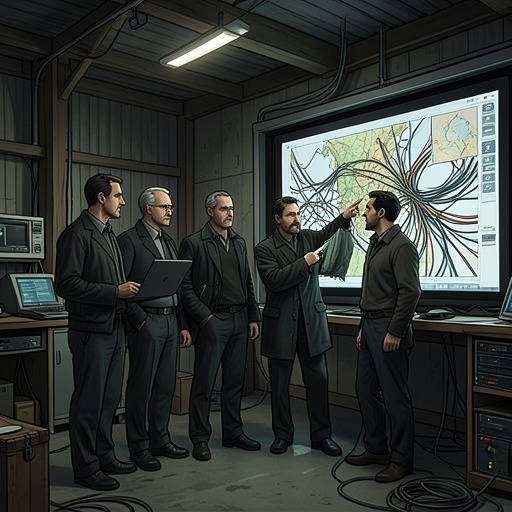
Tynnes Falk and Carter’s plot against the global financial system
FirewallTynnes Falk and Carter’s plot against the global financial system was a long-prepared scheme to turn the electronic connections among major financial institutions into a weapon. Conceived by a financier who had lost faith in reform and a technologist who understood the emerging networked world, the plan depended on more than sophisticated code: it was designed to hide its trigger inside an everyday act. The plot was stopped before it could unleash the crisis its architects intended, but its exposure showed how a routine transaction might be made the hinge of a worldwide attack.
Origins in Luanda
Carter’s route to the conspiracy began with his work at the World Bank. As a young employee, he had believed that the institution could help shift the balance of justice toward poorer countries. His experience in Angola changed that conviction. He came to see the Bank’s policies as protecting the wealthy rather than enabling the country’s independence and reconstruction. Repeated attempts to persuade his superiors—including transatlantic visits and countless memos—met with indifference. A conversation with his longtime mentor Whitfield brought the institutional logic into focus: the Bank’s policy mattered more than whether Carter’s criticism was right. Carter returned to Luanda disillusioned and began to consider a decisive break.
His earlier experience in Vietnam had helped form a different conviction: change required staying close to power. He had killed during his year near An Khe and felt no remorse; the disciplined certainty with which he had approached the war remained part of his understanding of how power worked. In Angola, he first listened and learned, admiring the dignity he saw amid hardship. His later judgment that the existing order should be destroyed arose from that experience and his growing contempt for the corruption and inequality he saw around him; the story presents this as Carter’s own justification, not as a vindication of his actions.
In the mid-1970s, while wrestling with his disillusionment, Carter met Falk at the Metropol in Luanda. Falk was working on a project expected to last three months. Carter kept him in the country by offering another consulting assignment, and the two continued meeting. Carter found in Falk a confidant with whom he believed he shared fundamental political and moral views. Their conversations, sustained over many evenings and regular contact across the following decades, became the setting in which the plan took shape.
A financial network turned into a weapon
The partnership joined two kinds of expertise. Carter knew how financial organizations worked and understood their economic interdependence; Falk could translate an idea into a technical operation. Falk’s accounts of electronic communications convinced Carter that control of those networks could confer extraordinary power. Their strategic vision shifted away from conventional military force: future attacks, they reasoned, could travel through computer systems and communications lines, disrupting markets and telecommunications rather than relying on bombs or nuclear weapons. They agreed to wait for the right moment rather than act hastily.
The intended effect was a cascading crisis in the global financial network. The investigators later identified the network’s major institutions as its vulnerable points: if sufficiently compromised, the systems could set off collapsing stock markets, panic withdrawals and wildly fluctuating currency exchanges. The scale of the danger lay in the connections between institutions. An attack on those points could spread beyond any one bank or country, making a local intrusion the beginning of a worldwide breakdown.
The design also depended on concealment. Robert Modin’s notes led investigators to consider whether an ordinary, repeated action could serve as the trigger for the planned event. Kurt Wallander connected Modin’s idea of an everyday trigger to using a cash machine: inserting a card and receiving cash and a printed receipt could look unremarkable while setting something larger in motion. Wallander and his colleagues did not know which machine or transaction was involved, or precisely what would follow. Later reconstruction established the critical danger: a transaction at 5:31 a.m. on Monday, October 20, using Carter’s Visa card would have set off an electronic avalanche. The attack was therefore not simply a remote assault on computer networks; its mechanism could be concealed in an ordinary act of public life.
Organization and exposure
Carter and Falk built a secretive, tightly controlled organization to support the operation. Its members included Fu Cheng, Elvira Lindfeldt and Jonas Landahl, people drawn into a hierarchy in which Carter and Falk made the decisions. Investigators later concluded that members had been manipulated and kept bound to the group. Kurt Wallander viewed Carter as a calculating and ruthless leader, while his judgment of Falk remained less certain: Falk appeared to have a deep, carefully guarded need for affirmation, and his political path had moved from the extreme right through the radical left before he broke with conventional politics. The partnership was not merely technical cooperation; it joined personal ambition and a shared sense of exceptional purpose to the practical means of sabotage.
Falk’s sudden death disrupted the plan at a moment when Carter believed they were close to acting. Carter had not imagined that one of the two architects might die, and the loss forced him to continue alone. The operation’s name, Jacob’s Marsh, honored a place Falk had described from his childhood: a marsh associated with a man who had drowned himself over unrequited love. Falk had later made the marsh a symbol of life’s chaos and its destructive end. Carter adopted the name as a private gesture of remembrance, giving the planned attack a personal memorial as well as an operational identity.
The investigation began to close in when police examined Falk’s computer. When Martinsson tried to open a protected file, the system appeared to notify someone connected to it; he also established that another user had accessed the computer the previous night. The computer’s security was extensive, and the police could not initially get through its barriers, but the attempted access was enough to draw attention. In Luanda, Carter received a signal that someone had penetrated the first layer of Falk’s defenses in Ystad. He was alarmed, though he tried to persuade himself that the deeper protections remained intact, and concluded that the intrusion had to be dealt with. The breach thus connected the local police inquiry to the wider organization and warned Carter that the plan was at risk of discovery.
Failure, aftermath and significance
The cash-machine hypothesis prompted Wallander to act before he knew the full mechanism. He ordered colleagues to cover Ystad’s machines and sought to stop transactions, accepting that the decision could bring public anger and require approval from senior officials. The investigation later established how close the danger had been: if Wallander or Robert Modin had put Carter’s card into a machine at the decisive time, the attack would have begun. Wallander did not use the card. The intended financial cascade never occurred, although a number of cash machines in Skåne malfunctioned for a day before returning to normal.
The later review of the case found that Carter and Falk had planned beyond the financial assault. After crippling world markets, they intended to strangle important utilities worldwide. Kurt Wallander saw vanity and intoxication with power among the forces driving them; the macabre religious overtones surrounding the two leaders made their imagined authority seem almost divine. Carter’s declared rationale drew on the poverty and social breakdown he witnessed in Luanda, but the scheme did not remedy those conditions: it proposed to destroy systems on which people depended, on a scale that would expose ordinary populations to the consequences.
The plot’s defeat did not erase what its design had demonstrated. Experts tracing Falk’s infiltrations found major financial institutions shockingly vulnerable, and security specialists worked to repair the deficiencies. Wallander connected that vulnerability to a broader change in modern life: technological networks increasingly linked society while also creating new openings for sabotage and terror. In the story, the danger comes from the combination of human decisions, institutional weaknesses and interconnected systems. A cash-machine transaction could be made to carry the force of an international attack, even though the person performing it might understand it as nothing more than a routine withdrawal.