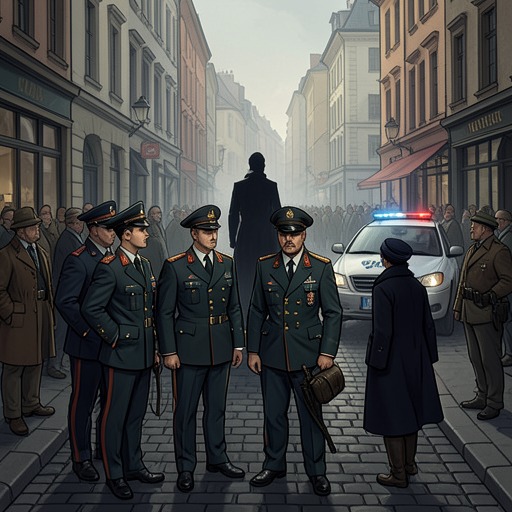
The murder of Elvira Lindfeldt and abduction of Robert Modin
FirewallThe murder of Elvira Lindfeldt and abduction of Robert Modin turn Kurt Wallander’s private hope of companionship into a warning that the investigation has reached beyond its known victims. Wallander finds Elvira shot in her Malmö home and Modin gone; only later does he learn that the two events are bound to the conspiracy against the global financial system. Elvira’s apparent welcome had concealed a role in the plot, and Modin’s disappearance places a young, vulnerable witness in the hands of the people trying to carry it out.
The trail from a letter
Wallander’s alarm begins with two pieces of mail that should not fit together. A dating agency’s notice, delivered to him at the station, thanks him for subscribing and says it will forward responses as they arrive. He first crumples it and throws it away, then retrieves and rereads it. The postmark shows that it was mailed on Thursday. By then, however, he had already received a response from Elvira in an envelope delivered directly to his door, without a postmark. The dating agency’s letter makes the earlier arrival newly suspicious.
Wallander reconstructs a plausible sequence: someone has accessed information about his registration and used it to reach him. He connects this possibility to the computer intrusions already troubling the investigation. The danger, he realizes, is not confined to police files; someone could reach other records, including correspondence with a dating agency. Elvira’s approach to him had not been an innocent response that promised a new relationship. She had obtained his information and manipulated him.
The discovery changes the meaning of the immediate situation as well as the past. Wallander has left Modin at Elvira’s house while the young man goes to collect diskettes in Malmö and continue working. Wallander had trusted her enough to place Modin in her care. Once the letter’s timing falls into place, that arrangement looks less like protection and more like exposure. He orders Hansson to recall the patrol car that took Modin to Malmö, but learns that the officers left him at the house. Wallander understands that Modin may now be in the hands of whoever exploited the same opening in his private life.
The house in Malmö
Wallander and Hansson drive to the house with the police siren on, arriving shortly after ten at night. There are no lights. Wallander asks Hansson to wait in the shadows by the gate, approaches with his gun ready, listens at the front door, and finds it unlocked. Hansson whispers that they should call for reinforcements; Wallander insists that there is no time. He enters cautiously, finds the light switch, and crouches to one side before turning on the light.
The hall is empty. From there Wallander can see Elvira on the sofa. She does not move, and he knows she is dead before he and Hansson step into the room. She has been shot in the neck; blood stains the pale-yellow sofa. They search the house but find no sign of Modin. The absence sharpens the horror of the discovery: Elvira has been killed, and the person Wallander came to protect has vanished.
Wallander concludes that someone had been waiting for Modin at the house and that the man previously encountered in the field had not acted alone. He does not yet know what has happened to the boy, but he distinguishes this crisis from earlier killings: the police now understand more of the case and have a better starting point. That knowledge cannot tell him whether Modin is alive, but it gives the search a direction beyond the immediate crime scene.
Deception, grief, and the investigation
The murder unsettles Wallander through several different injuries at once. He is frightened for Modin, angry at the danger to him, and filled with self-reproach. He also recognizes that his sense of personal loss is not grief for Elvira as the woman he thought he knew. Her death has frightened him; the companionship he imagined was built on deception. He had been thoroughly taken in, and the shame of that realization intensifies his rage even as he moves quickly to respond.
Hansson later recalls how collected Wallander seemed: he assessed the situation and chose what to do with striking speed. Wallander tells Hansson to remain at the house, alert Malmö police, and investigate Elvira’s background, including any connection to Angola and the people she knew in Malmö. Hansson asks who Elvira was, why Modin had been there, and how Wallander knew her. Wallander does not answer. The investigation never establishes her background in a way that resolves the mystery of their relationship, and Hansson does not ask him again directly.
Wallander returns to Ystad, where he believes the heart of the case remains. His private humiliation does not displace the practical urgency: Modin is missing, Elvira’s connections are unknown, and the investigators still need to understand the conspiracy. The scene leaves the personal question deliberately unanswered while turning the discovery of Elvira’s betrayal into a lead about the wider operation.
Modin’s account and the larger plot
The abduction is clarified only when Wallander reaches Modin again. By early morning on Monday, October 20, Modin is alive and beside him at the cash machine that figures in the attackers’ plan. He tells Wallander that the man was already in Elvira’s house when she let him in. The man threatened him, and they locked him in the bathroom. From there Modin heard the man shouting at Elvira in English that she had failed to do her job and had shown weakness; then he heard shots.
When the man unlocked the bathroom, Modin feared he would be killed too. Instead, the gunman declared him a hostage and threatened to kill his parents if he did not obey. Modin says he was shut in a car’s trunk and could hardly breathe. He was ordered to tell Wallander that he had chosen to stay in Malmö to finish working. The lie explains why the patrol officers left him behind, while the threat against his parents explains how his captor controlled him.
Modin also confirms that the threatened attack was to begin at the cash machine: the conspirators intended to knock out the global financial system, using an ordinary place where people withdraw money as the starting point. His account makes the killing and abduction more than an attempt to silence or remove two individuals. Elvira’s death and Modin’s forced disappearance belong to the same operation, whose apparently mundane point of entry is itself part of its design. At 5:51 a.m., with Modin recovered and the gunman dead, Wallander is relieved but exhausted; he still cannot say what, exactly, has ended.