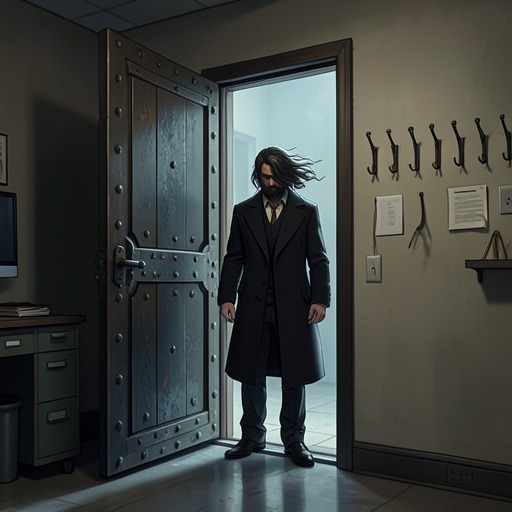
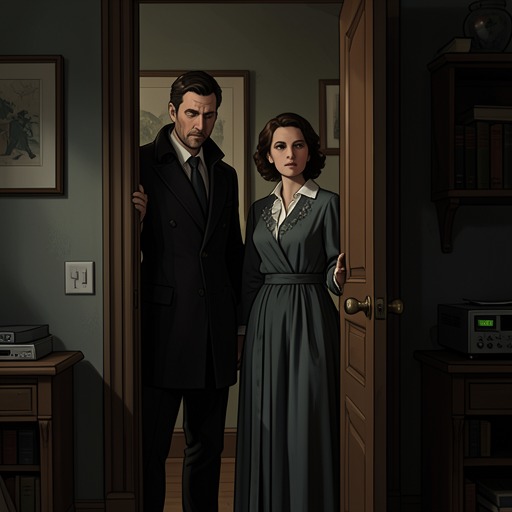
Wallander Slapping Eva Persson
FirewallKurt Wallander Slapping Eva Persson is a brief act of force that becomes a crisis of evidence, professional trust, and public reputation. During an interview about the escaped Sonja Hökberg, Wallander intervenes when Eva Persson attacks her mother, then slaps Persson and knocks her to the floor. A reporter’s photographs capture the fall but not the preceding struggle; the resulting image brings an internal investigation and threatens to overwhelm the murder inquiry the interview was meant to advance.
The Interrogation and the Slap
Wallander is questioning Persson after Sonja Hökberg has escaped from police custody. He wants to learn where Hökberg might have gone. Persson says she has no idea, but identifies Kalle Ryss, a former boyfriend of Hökberg’s, as a possible person to contact. Her mother, also present, says she knew very little about Hökberg and had never liked her. Persson turns on her mother and hits her. The confrontation develops so quickly that Wallander has no time to stop the first blow; when Persson continues, he pulls the two apart.
Wallander then loses control and slaps Persson. She falls to the floor. He leaves the room with his palm stinging, while Lisa Holgersson arrives in the corridor and asks what has happened. Wallander does not explain at that moment. The slap is therefore not simply an act witnessed by colleagues: its immediate context is a family confrontation inside an interrogation, and Wallander’s own failure to report it promptly makes that context harder to establish afterward.
The Photograph and the Public Account
A reporter has reached the doorway unnoticed during the commotion and taken several photographs. The picture later published shows Persson on the floor, but not her attack on her mother or Wallander’s attempt to separate them. Its caption presents the image as a policeman assaulting a teenage girl. The contrast between what the photograph depicts and what Wallander says preceded it becomes central to the dispute: the image is real, but it does not contain the whole event.
The press conference begins late, with Wallander suffering from flu and already under pressure to explain Hökberg’s escape. He tells reporters that two people had confessed to the fatal assault and robbery of taxi driver Johan Lundberg, but that one of the assailants had escaped. He does not name the juvenile. When questions turn to the identities of the assailants and the delay, he continues with the case briefing, then discloses the escape. The photographs taken earlier are not yet part of the public discussion in the room, but they soon redirect attention from the investigation to Wallander’s conduct.
When Lisa Holgersson brings him the newspaper, Wallander recognizes the photograph and recalls that the corridor door may have been slightly open. He is alarmed not only by the headline but by what the picture omits. Holgersson says the incident requires an investigation. Wallander admits that he struck Persson, maintaining that he did so because she was hitting her mother. He is not suspended, but Holgersson wants a full account of what happened.
Conflicting Accounts and Professional Consequences
The version Wallander gives is disputed. Persson tells Ann-Britt Höglund that the slap came without provocation, and Persson’s mother denies that her daughter hit her at all. The photograph reinforces their account for anyone who sees only the published image. Wallander insists that both are lying and asks that the mother be questioned, but he has no independent witness from inside the room to establish the sequence he describes.
The dispute reaches beyond his standing in the department. Persson and her mother decide to press charges for assault, and the prosecutor’s office demands a quick investigation. Wallander is distressed that Holgersson appears to doubt him; he leaves the station, goes home, and withdraws from contact. The next day he returns prepared to address the incident before colleagues and Lennart Viktorsson, Persson’s lawyer. He recounts his explanation, acknowledges that an internal investigation is appropriate, and argues that the police should now return their attention to Lundberg’s murder and Hökberg’s death.
The decision also affects who can pursue the case. Holgersson tells Wallander he will not be allowed to question Persson. He accepts the restriction, even as he continues to maintain that her first confession was truthful and her new account false. The slap thus creates a conflict within the investigation: the officer who insists he can identify Persson’s deception is himself under scrutiny, and his access to her is curtailed.
A Case Still in Dispute
Wallander’s account receives some support from Höglund, who believes Persson’s mother may be using the controversy to divert attention from her daughter’s role and that Hökberg’s death has made it easier to blame the absent woman. This remains an interpretation, not a demonstrated fact. The mother and daughter’s agreement against Wallander and the image in the paper leave him facing two accusers and a powerful visual record, while his account depends on what happened outside the photographer’s frame.
Later forensic findings complicate the broader question of responsibility for Lundberg’s murder without resolving the confrontation in the interview room. The knife bears both Persson’s and Hökberg’s fingerprints, while the hammer bears only Hökberg’s; examination indicates that the hammer was used before the knife. Those findings make it possible that Persson played a part in the attack, but they do not establish whether she struck her mother or whether Wallander’s response was justified. The event remains a sharply bounded uncertainty within a case already shaped by changing testimony: an act Wallander admits, a context he says the photograph conceals, and competing accounts that the available evidence does not settle.