The Skåne blackout
FirewallThe Skåne blackout is the large-scale power failure that gives Wallander’s investigation a new and more dangerous shape: what had looked like scattered crimes may be part of a deliberate attack on the systems modern life depends on. The outage is both a concrete disruption and an interpretive hinge. Wallander sees evidence of planning in the choice of where to strike, but the case does not yet establish who caused the blackout or exactly how it connects to the deaths around it.
The outage and its suspected point of vulnerability
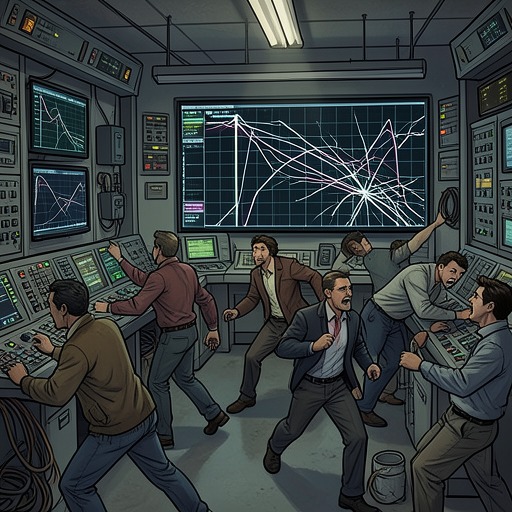
Wallander revisits the blackout while waiting at a cash machine. Ordinary customers take out money, read or discard their printed balance slips, and move on; he has just done the same. The routine makes the machine’s dependence on a functioning power supply newly visible. He recalls that the blackout cut power to most of Skåne and that whoever caused it seemed to know the precise point to hit for the widest effect. The failure was not merely a local interruption: it brought a large part of the region to a halt.
That recollection brings two pieces of evidence into alignment for Wallander. He has seen a blueprint in Tynnes Falk’s secret office, and an electrical relay from the substation was found in the morgue. He takes their conjunction with the blackout as a reason to reject coincidence as an adequate explanation for the events. The link is suggestive, not yet a completed proof: the blueprint’s purpose and the relay’s role still need to be established. Even so, the outage gives each object a possible place in a larger design.
Wallander’s sabotage theory
The blackout changes how Wallander reads Sonja Hökberg’s death. He considers whether she was killed not only to silence her but as a sacrifice intended to make society’s vulnerable points more evident. In his imagined arrangement, Falk’s secret chamber, with Falk’s face treated as an object of worship, becomes part of the same disturbing pattern. This is Wallander’s hypothesis, rather than a confirmed account of the motive or ritual behind the killing. Its force lies in the way the blackout makes him reconsider a death he had been treating as a separate crime.
Back at the station, Wallander rewrites the facts from the perspective that they may belong to a planned act of sabotage. Falk’s involvement in releasing minks now seems capable of foreshadowing something more consequential. But the new pattern does not settle the case. Wallander remains uncertain whether he has found the point that will unlock it, and he repeatedly tests whether the events can be made to fit without forcing them together.
A widening chain of events
The possibility of sabotage also changes the significance of the investigation into the power substation. Martinsson reports that Sydkraft has taken its internal inquiry seriously and expects that officials may face consequences. Yet basic questions remain unanswered: how the break-in occurred, why the gate was broken rather than the inner door, and how Falk obtained the substation blueprint. Wallander worries that the police themselves may not have treated the threat seriously enough.
Martinsson sees a possible progression from releasing minks to cutting power, particularly if a fanatic is involved. Later, as he and Wallander consider further deaths, the blackout becomes one part of a sequence that may also include Falk, Hökberg, and Jonas Landahl. Wallander compares the pattern to dominoes: one event may set others in motion. He cannot make Johan Lundberg’s murder fit that sequence and considers that it may be incidental, or that the events should be separated into different chains. The blackout thus offers a framework for inquiry while also exposing its limits: resemblance and sequence do not, by themselves, prove a common plan.
Consequences and significance
At the cash machine, Wallander extends the danger beyond the lights going out. If control of the power supply can disable a machine used for routine withdrawals, he reasons, the right point of attack could also threaten air traffic, trains, water supplies, and electricity itself. The scene shifts the blackout from a past emergency into an ongoing question about what else could be brought to a standstill. Its central consequence for the investigation is therefore not simply the disruption it caused, but the vulnerability it reveals—and the possibility that someone has learned how to exploit it.
The event’s meaning remains unsettled. The blackout strengthens the sabotage theory, links the substation blueprint and relay to a potentially wider operation, and makes Hökberg’s death appear capable of serving a purpose beyond its immediate circumstances. But Wallander’s repeated doubt matters: Lundberg’s murder may not belong, Landahl’s role is uncertain, and the evidence has not yet identified a perpetrator or demonstrated the full design. The outage becomes both the clearest sign of organized intent and a warning against mistaking a compelling pattern for a solved case.