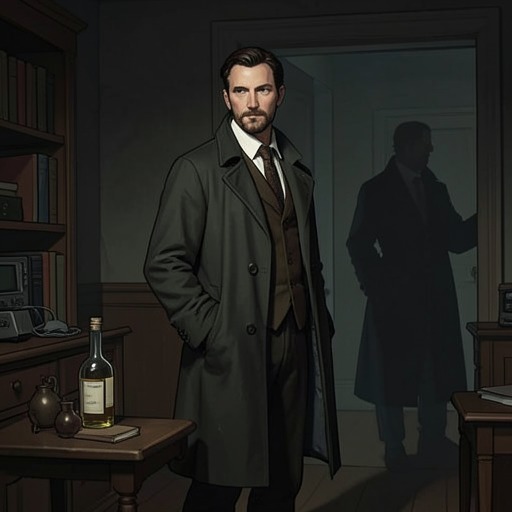
Bill Kraken’s brain fever and recovery
HomunculusBill Kraken’s brain fever and recovery turns a frightening encounter with animated corpses into the unlikely end of Kraken’s week-long mental confusion. After being struck on the head, he says, he had been living in a mist; the sight of the dead men first drove him close to madness, then seemed to restore him. His return to clarity matters not only because it brings him back into the investigation, but because he carries news of a bargain involving the Keeble box and Dorothy Keeble.
The Fever and Its Apparent Cure
Kraken traces his disturbed state to a blow to the head about a week earlier. At the George and Pigmy in Soho, he had been shouting about dead men slouched in walls. A pint mug fell from a shelf and hit him from behind; he describes the impact as waking him, as though he had been out of his mind ever since the earlier beating. Neither liquor nor sobriety had helped: drinking did not improve matters, and being sober was worse.
The corpses produced a reversal. Kraken believes that someone already suffering from brain fever may respond to the sight of the dead men differently from someone who is not: instead of deepening the shock, the encounter can act as a cure. At Narbondo’s laboratory he saw dead men, grave dirt in their hair, stirring in the candlelight and rising toward him. The spectacle nearly drove him mad, but he identifies it, together with the earlier blow from the mug, as the turning point after which his mind cleared.
Physical Recovery and Return
The account is framed by Kraken’s recovery from physical collapse as well as mental confusion. Captain Powers loosens the dirty kerchief around his neck, while Theophilus Godall supports his head and Langdon St. Ives pinches his cheeks open so that the Captain can pour brandy into his mouth. The brandy rouses Kraken; he waves St. Ives away and takes off his own shoes. He then removes his outer clothes one by one and sits in a galvanized tub while Captain Powers pours a bucket of water over his head. Wrapped in shawls, he becomes fit to join the company, and his clothes are sent out to be burned.
Once recovered, Kraken recounts how he left the George and Pigmy and took Captain Powers’s box, without understanding why. He says he then went directly to Wardour Street, determined to do his part because he had seen that Langdon St. Ives and the others did not have the upper hand at Narbondo’s. His return therefore converts a private crisis into timely action: the previously confused man arrives with information that the others need.
Testimony and the Box
Kraken reports that, while concealed in a passage off Narbondo’s laboratory, he overheard Willis Pule offer to surrender his Keeble box in return for Shiloh’s influence in arranging an audience with Dorothy Keeble at Kelso Drake’s house on Wardour Street. Shiloh raged about sin and damnation; after shots were fired, he said he would take the box. Kraken’s account links the box, the attempted approach to Dorothy, and the events at the laboratory in a way that gives the investigators a clearer view of Pule’s bargain.
After Winnifred Keeble describes once believing, while feverish in Jamaica, that the emerald had spoken to her, Kraken adds that he too heard the box speak the previous Thursday night. He insists that he was not suffering from the horrors when it happened. The parallel testimony changes the significance of Nell’s earlier experience: what she had feared was only a product of fever now has an independent witness, although Kraken’s report alone does not establish what the box said or explain how it spoke. Langdon St. Ives recognizes that the testimony casts the situation in a new light, while noting that Dorothy remains in danger.