Sebastian Owlesby’s decline into madness
HomunculusSebastian Owlesby’s decline into madness turns an effort to master death into a record of moral and mental collapse. Through his notebooks, Langdon St. Ives discovers how Owlesby’s experiments, his dealings with Ignacio Narbondo, and his fixation on the homunculus’s apparent power over decay became entangled with murder and his own debasement. The account does not settle whether the change came from scientific ambition, contact with the creature, or both; its force lies in showing Owlesby’s awareness returning just long enough for him to recognize what he has done.
Experiments and the Promise of Arrested Decay
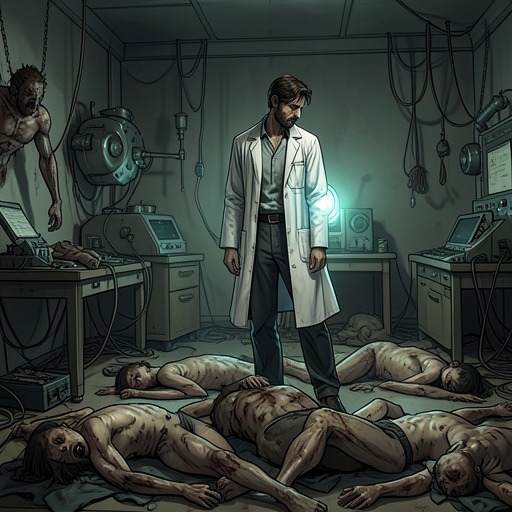
Owlesby’s early research concerned the animation of corpses, a process he had apparently discovered without the homunculus. His ambitions widened when he became convinced that the creature could arrest entropy and, at least superficially, reverse decay. He attributed remarkable powers to it: separating water into ice and steam, animating an old rat, and perhaps making life itself. His notes also describe experiments that he regarded as successful, including producing mice from old rags and restoring an old man from Chingford who was dying of general paresis. Owlesby claimed that the man’s age had been reduced by forty years, though the account comes through his own uncertain understanding and St. Ives’s later reading of it.
The homunculus was not simply an experimental subject. Owlesby believed that possession of it might give him power over death and time, and he communicated with it through a screen fitted into a structure William Keeble had made. The creature’s knowledge and its freedom became terms in an exchange whose details Owlesby could not explain. He also believed it had to remain confined in a box. Keeble later clarified that the creature had first been kept in a bottle: the box existed only after he built it. Owlesby’s account thus links the worsening of his condition not to a single invention but to a developing relationship with something he believed could overturn the limits of mortal life.
Narbondo, Crime, and the Limehouse Episode
Ignacio Narbondo encouraged Owlesby’s work, and Owlesby’s retrospective account portrays that influence as part of his fall rather than an excuse that absolves him. By late May 1861, their experiments had reached the point of requiring the brain of a living person. Owlesby and an unnamed accomplice killed an indigent man in St. James’ Park to obtain it. The notebooks also refer to another murder and a brush with Scotland Yard, while recording the departure of Bill Kraken, who had been involved in the experiments. As the record grows more erratic, research and criminal action become difficult to separate.
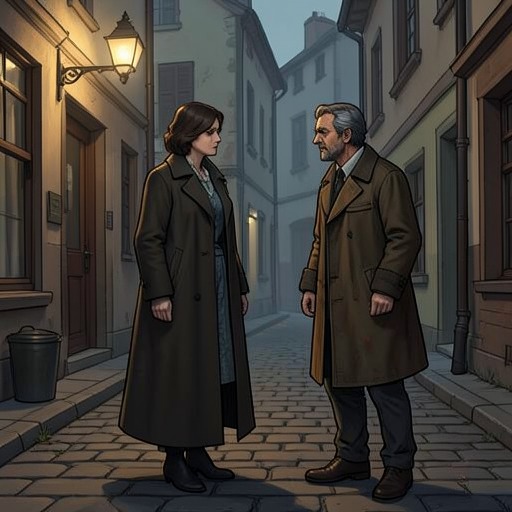
The Limehouse episode exposes Owlesby’s responsibility most plainly. In the account initially read aloud by St. Ives, Owlesby describes a failed attempt to obtain youthful glands and presents Narbondo as the bungler. He later admits that this version concealed his own role. He had pressed Narbondo to secure a gland and, when Narbondo fled, helped set others against him. Owlesby took part in the assault that ended with Narbondo being thrown into the Thames, and hoped he would die. Narbondo survived. Owlesby’s recollection of the episode is therefore not merely a record of horror he witnessed: it is an admission that he had actively helped create it, while trying to shift blame onto his associate.
Symptoms, Remorse, and Recurrence
Owlesby’s notebooks describe severe head pain, relief sought through laudanum, and dreams that return him to the Limehouse events. He interprets his suffering as punishment and imagines his own body undergoing the decay he hopes to defeat. Those descriptions are accompanied by an increasingly unstable sense of responsibility: he recognizes that he drove Narbondo onward, acknowledges that he helped the attack, and regards his own actions as evidence of moral corruption. St. Ives later understands the deterioration as the decay of Owlesby’s soul wearing away the structure of his sanity; this is St. Ives’s interpretation, not a diagnosis Owlesby himself could firmly establish.
When Nell Owlesby found him after Narbondo’s return, Sebastian begged her to kill him. He told her about the Limehouse costerlad and claimed that he would give up the pursuit, insisting to himself that creating life was not worth the price. Yet he also admitted that the promise was false. The homunculus’s supposed powers still held him: he continued to believe that it could arrest entropy and animate the dead, and he could not relinquish the possibility of escaping mortality. His moments of remorse do not produce a lasting break with the work. Instead, they reveal a man able to recognize the danger and wrongfulness of his course while remaining drawn back to it.
Possession, Inheritance, and the Uncertain Cause
Owlesby’s pursuit also shaped his dealings with the people around him. He was jealous of possessing the homunculus and, according to St. Ives, refused to let Narbondo have access to it. He believed the creature’s spacecraft was somewhere in London and hoped to find it, effectively offering the craft in exchange for power over death and time. That ambition connected the private experiments to a larger search, but Owlesby’s notebooks leave uncertain whether his worsening condition arose from greed for scientific power, slow poisoning through contact with the homunculus, or a combination of causes. Even Owlesby did not understand the reasons for his decline clearly.
His plans also involved a separate box and the future of his son, Jack Owlesby. Owlesby withdrew his interests in the West African Gem Company as a large emerald intended for Jack’s inheritance, then persuaded Keeble to make a box for it, almost identical to the one holding the homunculus. The resemblance between the containers gives material form to Owlesby’s divided concerns: the creature he coveted and the inheritance he meant to preserve became associated with matching enclosures. His notebook ends with uncertainty about returning to Limehouse, where Narbondo planned another attempt, and with Owlesby unable to imagine waking the next morning.
The Notebooks and the Limits of Explanation
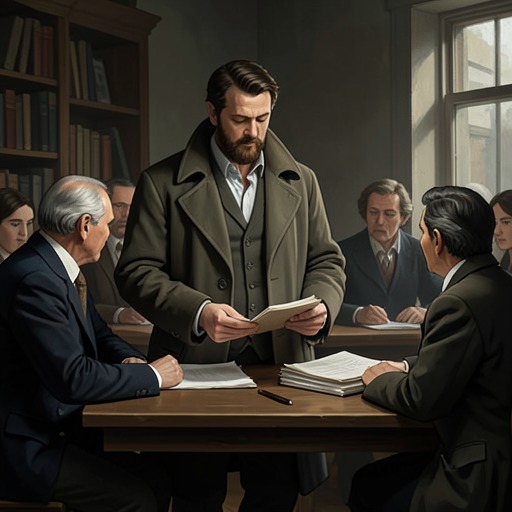
The account reaches St. Ives through roughly one hundred and fifty pages of Owlesby’s lost papers, delivered in a packet posted from London. Their day-by-day record makes his decline visible as a sequence of reversals: confidence in a new power, recognition of wrongdoing, pleas to be stopped, and renewed commitment to the same pursuit. The entries cease a day before Owlesby’s death. A final note in a woman’s hand says that she gave the box to Dr. Birdlip, but does not identify which box. That unresolved distinction between the emerald and the homunculus’s container preserves the consequences of Owlesby’s experiments beyond his own life.
The notebooks do not offer a clean division between scientific discovery and moral corruption. Owlesby’s experiments may have produced effects he considered extraordinary, but his claims are filtered through a mind he knows to be failing; his explanations alternate with admissions that contradict his earlier account. His decline is therefore both a personal tragedy and a source of evidence for the novel’s larger mysteries. The record reveals what Owlesby did, but leaves open what caused his collapse—and whether his belief in the homunculus’s power was insight, delusion, or an unstable mixture of the two.