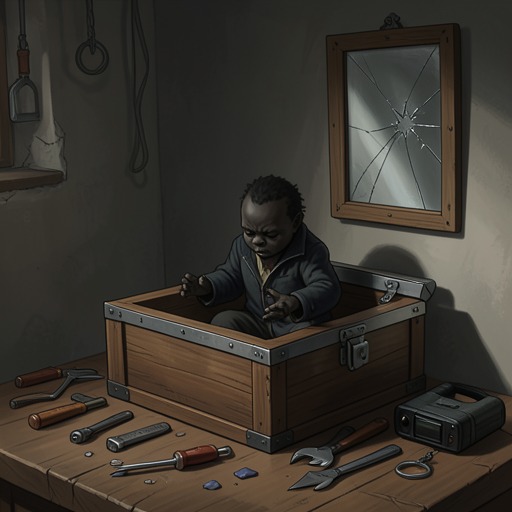
The homunculus’s confinement
HomunculusThe homunculus’s confinement is not a simple imprisonment but the condition that makes the Homunculus’s extraordinary existence manageable—and makes it coveted. Held in a box, it can resist decay and animate dead matter; through Sebastian Owlesby’s experiments, that power becomes entangled with his mental decline, while the box itself passes into a larger struggle involving Nell Owlesby, Dr. Randal Birdlip, and Langdon St. Ives.
The box and its purpose
The Homunculus is kept in a lead-lined cube, an enclosure that Sebastian Owlesby believed could contain a being capable of acting against the ordinary passage of time. Its confinement is not presented as incidental: in Sebastian’s account, the Homunculus must remain in a box. He describes it as prodigiously old, with its reduced size the consequence of its ability to thwart time. The box thus holds a being whose powers exceed ordinary human understanding, while its smallness marks the cost or condition of that existence.
Sebastian’s notes also establish that the box could become an instrument of communication. He fitted a screen into Keeble’s clever structure, allowing him to communicate with the Homunculus. The arrangement did not end the confinement; instead, it made the relationship more intimate and more dangerous. Sebastian believed that he was bargaining with the being, exchanging knowledge for freedom. In his account, the Homunculus could separate tepid water into ice and steam, and animate the carcass of a rat that had been dead for months. The box therefore functioned as a barrier, a container for an extraordinary power, and a narrow channel through which Sebastian pursued it.
What the confinement makes possible
Bill Kraken’s recollection gives the box a second, independent body of evidence. He says he saw the thing inside lift a dead dog from the floor and make it dance on the ceiling. He also recalls that more than one of the bodies he and Tooey Short had brought in later walked away on its own legs. His account connects the Homunculus’s confinement to the broader experiments conducted around it: what was locked away could affect the dead beyond the box, and the consequences were not confined to the laboratory.
Sebastian’s notebooks trace a more personal cost. His experiments, encouraged by Ignacio Narbondo, moved from attempts to reverse decay toward increasingly extreme efforts to animate corpses. Sebastian came to believe that the Homunculus could arrest entropy, at least superficially, and that this possibility justified his work. Yet he recorded his own worsening irrationality and, in moments of clarity, asked Nell to kill him if his madness returned. Near the end of his account, he admits that he had told himself he was finished with the pursuit, but that this resolve was false. The box’s power kept drawing him back even as he recognized the damage the pursuit had done.
A second box and an unresolved secret
Sebastian’s experiments also made confinement an object of concealment and mistaken identity. He withdrew his interest in the West African Gem Company in the form of a great emerald intended as his son Jack Owlesby’s inheritance, then persuaded William Keeble to build a box for it almost identical to the cube containing the Homunculus. The likeness created a consequential uncertainty: when Sebastian’s papers disclosed that Nell had given a box to Dr. Randal Birdlip, St. Ives could not tell whether the emerald or the Homunculus had gone with him in his dirigible. The two boxes had become difficult to distinguish precisely because both carried something valued and vulnerable.
The manuscript ultimately clarifies that Nell gave the Homunculus to Dr. Randal Birdlip. St. Ives understands her actions as more than an escape from Sebastian’s household: she had shot her brother, taken the Homunculus away, and entrusted it to Birdlip to carry perpetually aloft. Earlier, Shiloh’s shrine had placed a portrait of Joanna Southcote beside a sketch of the man he considered his father, and connected the Homunculus’s disappearance to the events set in motion decades before. The being’s confinement therefore has a history extending beyond Sebastian’s experiments, though the papers leave St. Ives initially unsure which box Birdlip possessed.
The threatened fate of the captive
The box’s imperfect seal becomes central to William Keeble’s proposed response. Expecting Dr. Randal Birdlip’s dirigible to return, Keeble suggests meeting it at Hampstead Heath, where he thinks it launched, seizing the box, and dropping it into the Thames from Westminster Bridge. His reasoning is practical: the enclosure is not airtight, and the Homunculus must breathe. Keeble treats that need as a means of killing it, partly to prevent Ignacio Narbondo from gaining possession and partly out of anger over what had happened to Sebastian. The suggestion exposes a sharp contradiction in the group’s position: those who oppose Narbondo’s control of the Homunculus are themselves willing to turn its bodily need into a weapon.
When Bill Kraken later finds the hidden box, he hears a tiny, distant voice that seems to come from within it. The discovery renews the sense that the enclosure is not inert: something is present and attempting to communicate, even though Kraken cannot understand it. His fear turns the box into an apparent source of danger, and he flees with it when Kelso Drake arrives. The episode repeats the pattern surrounding the Homunculus’s confinement: the box conceals its occupant, provokes competing interpretations, and draws people into peril before they know what they have taken.
Narrative significance
The confinement binds together the novel’s scientific and moral conflicts. Sebastian treats the Homunculus as a means to master decay; the Homunculus’s powers appear to validate that ambition, but the experiments instead accompany Sebastian’s collapse and the reanimation of dead bodies. At the same time, the box is never merely a secure container. It must allow the captive to breathe, can be fitted with a means of communication, and is easily confused with another box built to protect an inheritance. Its practical limits make the Homunculus dependent on human custody, while that dependence gives each custodian the power to protect, exploit, or destroy it.
The uncertainty over which box has been carried away also extends the confinement beyond the immediate room: the Homunculus’s location becomes a mystery that shapes St. Ives’s decisions and the group’s anticipation of Birdlip’s return. Nell’s transfer of custody offers temporary protection, not a demonstrated release. The Homunculus remains enclosed and sought after, suspended between the possibility of freedom and the human plans made for its capture.