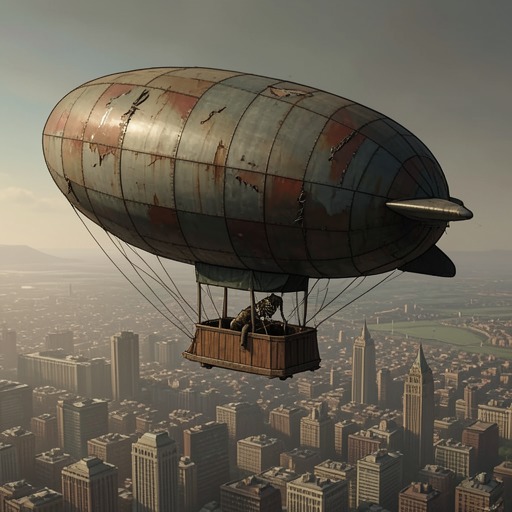
Birdlip’s dirigible engine failure
HomunculusBirdlip’s dirigible engine failure turns an extraordinary, long-running flight into an approaching return. The engine is not described as stopping outright: it is declining, and the dirigible is losing altitude. William Keeble’s account makes that deterioration consequential beyond the loss of a machine, since he believes its design may be drawing it back toward Hampstead, where it was launched.
Signs of Decline
William Keeble assesses the engine while discussing whether its operation could be duplicated at a smaller scale. He cautions that perpetual motion is not a simple or settled scientific matter, distinguishing the ideal of true perpetual motion from the working engine before him. His practical judgment is stark: Birdlip’s engine is running down, and its appearance that spring may be its last.
Keeble bases his concern on the dirigible’s successive passages. Five years before the conversation, it had been flying very low and much farther north than on its 1865 passage. To him, the altered altitude and route suggest decline rather than stable, indefinite flight. The craft’s history of remaining aloft for fifteen years makes the prospect of failure especially striking, but does not cancel the evidence that its power is waning.
A Return Course, Not a Certain Landing
Keeble does not regard the descent as entirely aimless. He suspects the engine contains a homing element, an unintended consequence of its design, and thinks the dirigible is tending toward Hampstead. This is a hypothesis, not a demonstrated property of the mechanism; his account leaves open whether the craft will reach its launch site or merely continue losing height. The possibility of a designed-in tendency toward home gives the failing engine an ambiguous character: its decline is mechanical, but its course appears almost purposeful.
Later reports make the danger immediate. The dirigible has been sighted over the Denmark Strait, high in the stratosphere, turning toward Iceland on a route expected to carry it over Greater London again. Balloon expeditions are being prepared in Reykjavik, and observers anticipate that the craft may descend or land within weeks. The Royal Academy’s mathematicians likewise expect it to touch down within Greater London, though the forecasts allow for very different outcomes: it could fall onto rooftops or drop into the Atlantic and be lost in storms. Neither prediction establishes where it will come down.
Scientific Stakes and Interpretations
The Royal Academy’s interest is sharpened by the prospect that Birdlip’s flight is nearing its end. It invites Langdon St. Ives to help study the dirigible, drawing on his knowledge of Birdlip and his friendship with William Keeble. Its representatives consider Birdlip an investigator of mysteries rather than the engine’s true inventor, and seek Keeble’s cooperation as the person they believe can explain the machinery. St. Ives understands the offer as pressure to secure that knowledge, not simply disinterested inquiry.
The threatened descent also makes the engine’s decline a public-risk question. The Academy fears a destructive landing in Greater London, while its wider attention to the craft is entangled with its wish to control the knowledge behind it. St. Ives, by contrast, sees Birdlip’s course as part of a search for truth that cannot be reduced to calculations of altitude and trajectory. In his reading, the dirigible’s irregular passage has nevertheless led it home. The engine failure therefore carries two meanings at once: it is a measurable technological breakdown, and the approaching end of a flight whose course resists a wholly technical explanation.