Joanna Southcote's first resurrection experiment
HomunculusJoanna Southcote's first resurrection experiment was an early, unsuccessful attempt by Ignacio Narbondo to animate a corpse, carried out under pressure from Shiloh. The body moved briefly, but the trial ended in collapse rather than restored life, exposing both the narrow reach of Narbondo's method and the danger of treating movement as proof of resurrection.
Background and Experimental Method
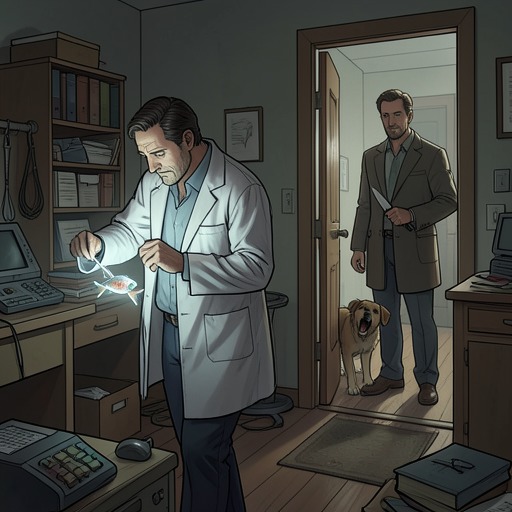
Narbondo's experiments depended on more than a corpse and chemical apparatus. In his laboratory, he maintained aquaria of Carp and watched how the fish responded to food; he singled out a struggling fish, removed a small gland, and preserved it in amber liquid. His handling of the organ and his storage of it alongside other specimens show how carefully the procedure relied on a particular biological material.
The method had a history of failure as well as preparation. Sebastian Owlesby's notes describe an earlier attempt in which a cadaver remained inert despite being filled with fluids; without a Carp and a fresh gland, the body would decompose before the experiment could proceed. Owlesby's account also records that his research with Narbondo had crossed into criminality, and that his pursuit of eternal life was bound up with the creature in the box. These earlier efforts make the first trial not an isolated spectacle but a stage in a continuing and increasingly compromised program.
The Trial in the Laboratory
Shiloh demanded an immediate demonstration, and Narbondo answered by preparing for surgery while Willis Pule assisted. From his rented room across the way, Theophilus Godall watched the proceedings through a window. Narbondo directed yellow mist from a hand-held vaporizer toward the body on the slab, then used material kept in a liquid-filled jar, with Pule's help, to introduce the preparation into the corpse's mouth.
The corpse responded only for a moment. It jerked, stiffened, and slowly raised itself onto the elbow of its handless arm; its head and other arm moved as it turned toward the window. Godall briefly thought its vacant gaze had settled on him, but it turned farther toward Shiloh, whose raised hand and reaction left the event poised between accusation and supplication. The movement did not last: the body fell back onto the slab, and a detached hand dropped to the floor.
Failure and Immediate Aftermath
Narbondo continued to act on the remains after the collapse. As the mist clouded the room, he picked up the fallen hand and, after resisting Shiloh's attempt to take it, placed it beside the bones on the slab. The trial thus ended not with a revived person but with the experimental apparatus, the scattered remains, and a failed effort to control what the procedure had set in motion.
Shiloh's response joined religious expectation to apprehension. Godall had already suspected that Narbondo's work might be intended to produce an army of obedient workers, and he considered the experiment in light of possible dealings between Narbondo and Kelso Drake. That interpretation was Godall's conjecture, not a demonstrated outcome of this trial; what he actually witnessed was a corpse's brief movement and the participants' urgent, unsettled reactions.
Significance
The experiment establishes a sharp distinction between animation and resurrection. Narbondo's equipment and Carp-derived material could provoke movement, but the body's short-lived response offered no evidence that life, awareness, or recovery had returned. The procedure's limited success also depended on a network of human labor, preserved animal material, a vaporizer, and a corpse: none of these elements alone could accomplish what Narbondo sought.
The surrounding narrative connects the experiment to Shiloh's personal stake. Later, when Narbondo prepared another body, Shiloh remembered that the remains before him were his mother, Joanna Southcote, and anxiously asked where her hands were. That later preparation does not turn the first trial into a successful restoration; instead, it clarifies why Shiloh pressed for the experiment and why its uncertain, partial result could not satisfy him.