Limehouse costerlad murder
HomunculusThe Limehouse costerlad murder is the failed attempt by Sebastian Owlesby and Ignacio Narbondo to obtain a gland for their experiments in eternal life. Recounted by Sebastian as a remembered crime, it joins their scientific ambition to a specific act of violence against a child—and shows that Sebastian’s responsibility extended beyond the night of the killing.
Causes and Background
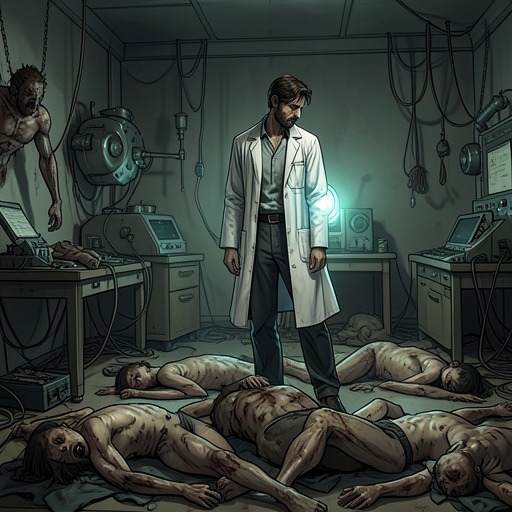
Sebastian describes the murder as part of a search for a fresh gland that could supply their experiments. Their ambition was not merely to preserve a corpse: he believed eternal life was within reach. Yet the practical work had repeatedly failed. A fresh cadaver taken from the gibbet by Short and Bill Kraken remained dead despite being prepared with fluids, and Sebastian feared it would decompose before they could proceed. In his account, the killing in Limehouse belongs to this desperate effort to secure the necessary material, not to an unrelated quarrel with the boy.
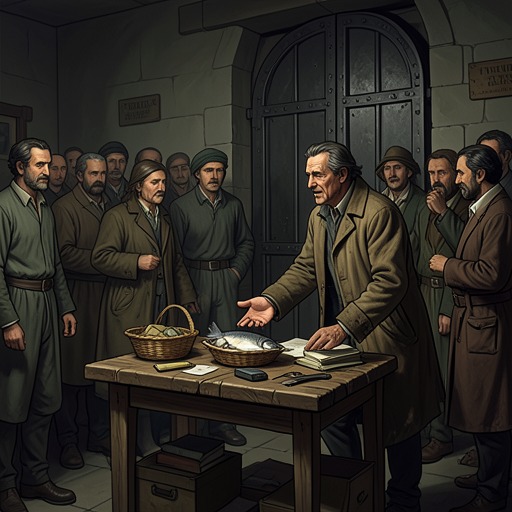
The wider experiments give the search for a gland its disturbing scientific context. Ignacio Narbondo later examines carp in his laboratory and removes a bean-shaped gland from one of the fish, preserving it in a vial. Another carp, weak and struggling at the water’s surface, is treated differently from the fish that feed readily. In a subsequent experiment, Narbondo and Willis Pule bring a live but sluggish carp beside a fresh cadaver. These scenes connect the sought-after gland to the recurring use of carp in attempts to animate the dead, while the Limehouse account reveals the human cost of pursuing that research.
The Night in Limehouse
Sebastian remembers the boy as no more than seven or eight. In fog and poor street lighting, the child carried a pumpkin lantern and a bucket, apparently on an errand to obtain beer for someone else. Sebastian says that he and Narbondo followed behind him. Narbondo had brought a large pair of shears forged at Gleason’s; Sebastian explains that they had concealed the intended use of the tool by claiming it was for tree surgery.
When a gust extinguished the lantern, the boy disappeared briefly into the darkness. Narbondo moved after him, and Sebastian tried to stop his companion, recognizing what the plan meant. But he followed Narbondo rather than withdrawing. They caught the boy as he relit the lantern, and Narbondo killed him. The scene’s small, ordinary details—the errand, the lantern, and the pause to relight it—sharpen the contrast between the child’s vulnerability and the purpose for which the two men had pursued him.
Failure and Flight
The killing did not secure what the experiment required. Sebastian later says that the murder had been for nothing, while the separate cadaver taken from the gibbet continued to decay on the slab. Their need for a carp and a fresh gland remained unresolved; Narbondo intended to go out again to obtain what they needed. The murder therefore produced neither the promised scientific advance nor the eternal life that had helped justify it to Sebastian. It left the experiment stalled and its perpetrators exposed to the consequences of their actions.
Sebastian’s account also connects the Limehouse crime to Narbondo’s subsequent flight. When Narbondo ran along East India Dock Road, Sebastian says he was the one who raised the alarm and set people against him. Narbondo believed the pursuers’ shout came from the police. Sebastian joined in the assault and helped drag him into the river near the Old Stairs. This admission makes the episode more than a confession of complicity in the boy’s death: Sebastian also describes turning against his partner, while continuing to act violently after the original scheme had failed.
Remorse and Narrative Significance
In retrospect, Sebastian presents the murder as a moral turning point that he cannot put behind him. He describes recurring dreams of the night, centered on the extinguished lantern, and interprets his headaches and sense of physical decline as punishment for what he did. He explicitly corrects his earlier attempt to cast himself as someone who had merely been present: he had urged Narbondo onward, wanted the gland, and had taken part in the pursuit. The account thus records both the crime and Sebastian’s belated recognition of his own agency.
The episode also exposes the contradiction at the heart of the search for immortality. Sebastian and Narbondo pursue the preservation or reanimation of life through experiments that depend on treating living beings and corpses as material. The attempted resurrection of a corpse with the aid of a carp, and Godall’s later observation that Narbondo revived what appeared to be a corpse, show that the research continues beyond Limehouse. But the costerlad’s death brings no lasting mastery over death: it yields no usable result, while its memory persists in Sebastian’s account. The failed experiment therefore marks a limit to the men’s claims of scientific control and reveals the violence concealed beneath their pursuit of eternal life.