St. Ives’s flight from London in the alien spacecraft
HomunculusLangdon St. Ives’s flight from London in the alien spacecraft is the moment when his pursuit of an unfamiliar machine turns into an improvised escape and a new journey. In Kelso Drake’s Wardour Street house, St. Ives discovers that the polished object concealed in the great hall is not decorative machinery but a spacecraft. He enters it under pressure, works out several controls without a manual, and lifts away from the city in a craft he can barely steer. The episode joins discovery to peril: the ship’s capabilities become legible only as St. Ives risks using them, and his departure begins in disorder before gaining direction among the evening stars.
Discovery in Drake’s House
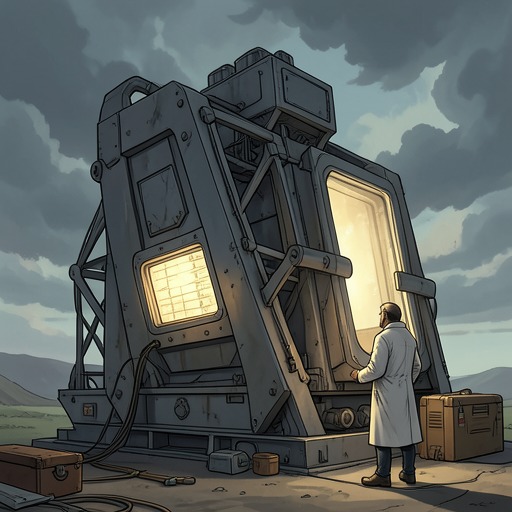
St. Ives reaches the great hall after hearing Drake call for a brougham and learning that Deener has taken another box. Drake himself takes a Keeble box from a mirrored buffet, stuffs it into a leather bag, and leaves. Rather than confront the people concealed elsewhere in the house, St. Ives turns to the machine in the center of the room. Its rounded silver body, fin-like projections, and green-tinted ports recall Langdon St. Ives’s spacecraft. The resemblance is striking, though the two vessels are not identical; St. Ives considers their affinity remarkable given their distant origins, but postpones trying to explain it.
The object has been treated as an eccentric ornament in Drake’s house, its purpose misunderstood amid the furnishings and the assumptions attached to a wealthy owner’s collection. St. Ives instead approaches it as a vehicle whose unfamiliar features may still be understood through comparison with what he knows. That judgment shapes the entire escape: without time for systematic study, he must infer the craft’s workings from its markings and from the responses of its controls.
Entry and Improvised Operation
A crash and furtive voices from upstairs make delay dangerous. St. Ives pulls a cord to open the curtains, admitting afternoon light to the dim hall, then searches the vessel for a way inside. He finds a circular hatch. It opens with a small airy sound, but climbing into the smooth, arched opening proves awkward: his foot slips, his hands cannot grip the polished surface, and he nearly loses his balance. He drags an upholstered chair beside the craft, climbs onto it, and slides through the hatch before closing it behind him.
Inside, he faces an array of dials, gauges, and ivory and ebony buttons. Some instruments sit beneath clock-like glass filled with violet liquid; others bear unfamiliar signs. St. Ives can make educated guesses about a few but has no reliable guide to the rest. He resists the impulse to press controls at random, recognizing that a wrong choice could put him in greater danger, and instead tests the symbols one at a time. A button marked with a sun makes the dials glow through the violet liquid. Another, beside an image suggesting wind, starts a hum and sends air against the back of his neck. St. Ives identifies this as an oxygenator. A further button opens the hatch again, confirming that the controls govern distinct functions, but also briefly exposes him to danger outside.
Ghouls at the Hatch
A Ghoul clambers onto the chair as St. Ives tries to close the hatch. He pushes against it from inside and manages to shut the opening, but more Ghouls gather at the vessel. St. Ives closes the hatch again as they persist in trying to reach the interior. Their arrival transforms the spacecraft from an object he can examine into a refuge he must defend while learning to operate it.
The Ghouls and Zombies move furniture around the craft, and ropes are fastened to the upholstered chair and a piano. St. Ives reads these efforts as evidence that the household knows the machine is a ship and that Drake has taken precautions against its being stolen. His first attempt to activate another button produces no useful movement. A button beside a spiralling arrow, however, makes the spacecraft rotate on its axis, dragging the chair and pulling a rope from a Zombie. St. Ives stops and starts the rotation again, then turns the ship until it faces the window. These tests convert the odd markings into practical knowledge, but they do not yet give him control of a safe departure.
Takeoff and Flight
St. Ives presses a succession of controls. The spacecraft shudders, slides across the floor, and rises abruptly through the window, carrying the chair and briefly a dangling Ghoul with it. The ascent is uncontrolled: the craft rolls, and St. Ives catches fleeting views of St. Paul’s and the Kennington Oval as the city spins past. It shoots south and west, apparently toward the Channel. The spectacle of flight is inseparable from the immediate prospect of disaster; St. Ives is pinned into his seat and fears that the ship will carry him into the sea.
He discovers that the curved levers at the center of the controls govern changes of direction, but even slight movements can send the ship tumbling or plunging. After an initial attempt makes the craft roll again, St. Ives adjusts the other lever and drops toward the water. He then eases it back slowly. The vessel swings into a broad turn, levels, and begins to rise. The episode’s decisive change is not that St. Ives suddenly masters the ship, but that he learns the delicacy of its response: a restrained touch succeeds where frantic correction has failed.
Departure from London
With the craft steadier, St. Ives guides it toward the Dover Strait. The ship climbs through thinning atmosphere as evening deepens, and its motion becomes controlled enough for him to contemplate an arrival before the Royal Academy at great speed. Below him, the danger of the house and the crowding Ghouls recede; ahead, the sky darkens beyond the green-tinted ports, where points of emerald light appear against the purple heavens. The scene closes not with a completed account of the journey, but with St. Ives rising out of the familiar city and into an immense, unfamiliar expanse.
The flight resolves the immediate contest over who can use the spacecraft: St. Ives gets inside Drake’s vessel and makes it airborne before Drake’s household can stop him. Yet the escape is also an experiment conducted under pressure. The illuminated gauges, the oxygen supply, the rotating hull, and the responsive levers reveal a machine that can be operated, while its sudden rolls and plunges keep its full capabilities beyond his command. London’s departure point thus becomes a threshold: St. Ives has escaped the confined danger of Drake’s house, but the craft’s direction and the consequences of its flight remain only partly under his control.