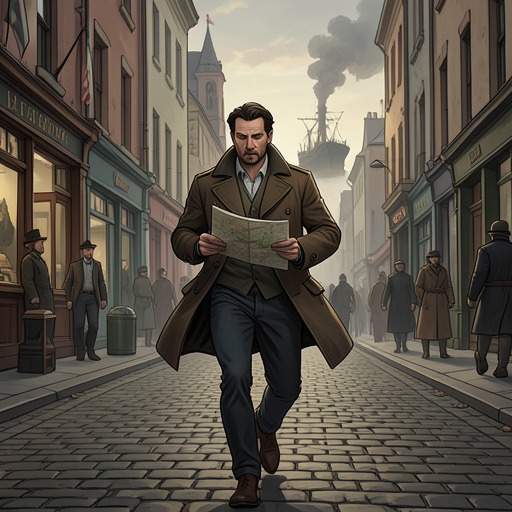
1870 London dirigible sighting
HomunculusThe 1870 London dirigible sighting brought an unfamiliar aircraft across the city before dawn, revealing a craft whose strange construction and skeletal pilot unsettled ordinary witnesses and gave Shiloh a potent sign for his apocalyptic movement. Its passage was brief, but its meaning grew: to Langdon St. Ives it was an urgent scientific mystery, while to the self-proclaimed messiah it became evidence that the end times were approaching.
Route and Eyewitnesses
The sighting began as an oval shadow moving southeast from Iceland across the North Atlantic toward Greater London. Before dawn, the wind was strong over Chelsea. A hunchback driving a dogcart with a tarpaulin-covered load stopped to secure the canvas; nearby, a ragpicker with a pushcart was looking skyward. The craft passed above them, its gondola swinging beneath the dirigible as a rhythmic hum carried through the air. The hunchback hurried away, while the ragpicker remained fixed on the aircraft.
The dirigible continued over London as the city stirred toward morning. It passed above a market and swept briefly over the Victoria Embankment, then headed east toward Billingsgate Market and Petticoat Lane. At Billingsgate, its weathered gondola creaked as it moved over fishmongers and handbarrows. By the time it crossed Petticoat Lane, daylight had diminished some of its mystery, but people still turned to look and point. The varied reactions—from a startled individual’s flight to the market crowds’ passing attention—made the craft at once a public spectacle and an object difficult to interpret.
The Pilot and the Pursuit
The clearest view came when the gondola was outlined against the fading moon. At its wheel stood a rigid figure in a cocked hat. The pilot appeared skeletal, and its wrists were manacled to the wheel, which was itself lashed to a strut between the gondola’s open windows. The sight gave the aircraft’s passage an uncanny dimension: this was no ordinary balloon with a recognizable living aviator at the controls. The craft righted itself and continued east, its humming becoming part of the impression it left on witnesses.
Langdon St. Ives saw the dirigible while in Petticoat Lane, where he had been seeking information from a seller of gyroscopes and abandoned shoes. He had just declined the need to buy a gyroscope, saying that he would rather pay for genuine knowledge. The crowd’s shouts and the sound of the aircraft interrupted that exchange. St. Ives hurried down Middlesex Street, found a hansom cab, and followed the dirigible east along East India Dock Road. He lost sight of it when it rose on an updraft and disappeared into cloud near Gravesend. His pursuit establishes the sighting as more than a passing curiosity: it drew a scientist away from one inquiry and into a direct attempt to learn what the craft was.
Shiloh’s Apocalyptic Reading
Shiloh made the dirigible central to his religious interpretation of events. A later account of his preaching recalls that it had passed in the early morning and that the most recent earlier passage had occurred more than four years before. He remembered it appearing from the west under a dying moon, with its apparently animate pilot looking down from the sky. He treated the craft as confirmation of a prophetic timetable and expected coming changes to disclose the truth of his own birth and the identity of his father.
That belief served both doctrine and organization. Shiloh preached that the end was near, urged people to join the New Church, and presented his movement as a means of salvation. He distributed tracts through followers who also helped circulate counterfeit coins in support of his work. The dirigible did not merely furnish him with a startling image; he used its return as apparent validation for his authority and a reason for Londoners to join his cause. The contrast between the aircraft’s unexplained passage and Shiloh’s certainty about its meaning is central to the episode’s religious significance.
Rumor, Science, and the Omen’s Afterlife
The sighting’s later echoes show how reports of the craft could be recruited into competing explanations. When Dr. Birdlip’s dirigible was expected to return toward London, representatives of the Royal Academy discussed its uncertain purpose and the risks of its descent. At the same time, Shiloh’s followers gathered around him, and his public demonstrations joined religious objects and claims of resurrection to the anticipation of a sign from the sky. In a later episode, news reports about an approaching blimp circulated alongside accounts of the Pratlow Street corpses; public speculation blurred the possibility of an alien threat with fears about the dead rising.
The 1870 sighting therefore established a pattern that outlasted the aircraft’s brief crossing of the city. St. Ives responded by pursuing knowledge, Shiloh by turning the event into prophecy, and other Londoners by passing on fearful or sensational interpretations. The route from Chelsea to the eastern markets made the dirigible visible across distinct parts of the city, but its lasting reach came from those competing accounts. It remained both an unresolved scientific phenomenon and a ready-made omen, each interpretation shaping how people met the prospect of its return.