Pratlow Street corpse outbreak
HomunculusThe Pratlow Street corpse outbreak is the moment Ignacio Narbondo’s clandestine work becomes an uncontrolled public emergency. Corpses that had been the objects of experiments emerge into the street, where Langdon St. Ives and Hasbro encounter them at close quarters. The outbreak also breaks apart the contest over the Keeble box: Bill Kraken escapes with it, while Shiloh leaves by carriage with a separate device. What had been hidden behind laboratory doors now feeds a wider confusion about the dead, an approaching airship, and the end of the world.
Experimental Causes and Background
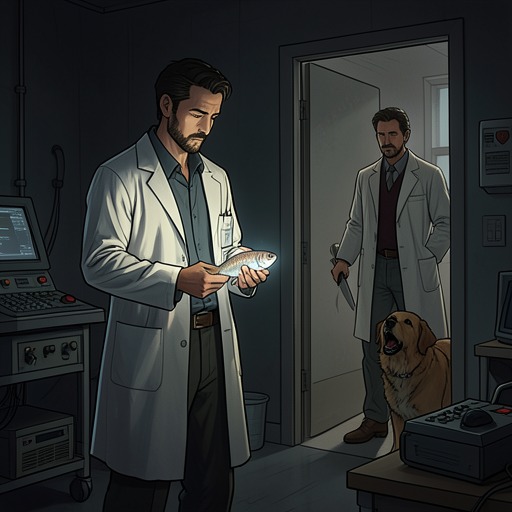
Narbondo’s work depended on an unstable conjunction of dead bodies, chemical apparatus, and carp-derived material. In his laboratory, aquaria held koi, and he watched the fish respond differently to food: five ate the worms he scattered on the water, while a sixth struggled at the surface. He removed a small gland from a carp and preserved it in amber liquid. The episode gives a concrete basis for Bill Kraken’s earlier account that a gland from carp contained an elixir, and for the experiments’ dependence on obtaining fish and fresh glands.
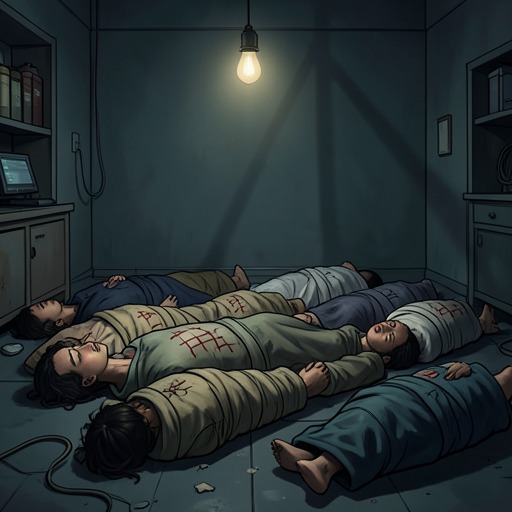
The corpse experiments had already shown how uncertain the method was. Sebastian Owlesby’s recovered papers describe a cadaver that remained dead despite being filled with fluids, and the need to find a carp and fresh gland before it decomposed. The papers also reveal how the work had escalated: Narbondo had urged Owlesby toward increasingly extreme experiments, while Owlesby’s belief that the homunculus could arrest decay coincided with his decline into madness. The outbreak is therefore not an isolated marvel but the consequence of a practice in which technical ambition, criminal acts, and the treatment of human remains had become entangled.
Narbondo’s later preparations preserve that precarious arrangement. During an attempted experiment involving Joanna Southcote’s remains, he brings a sluggish live carp alongside a fresh cadaver and works with the concentrated urgency of someone who understands the procedure but knows it is difficult. Shiloh watches, distressed by the state of the remains and preoccupied with his mother. The scene makes clear that the experiment involves more than a single investigator: fish, preserved substances, corpses, assistants, and contested objects all shape what can happen. Yet their presence does not amount to reliable control.
The Breakout
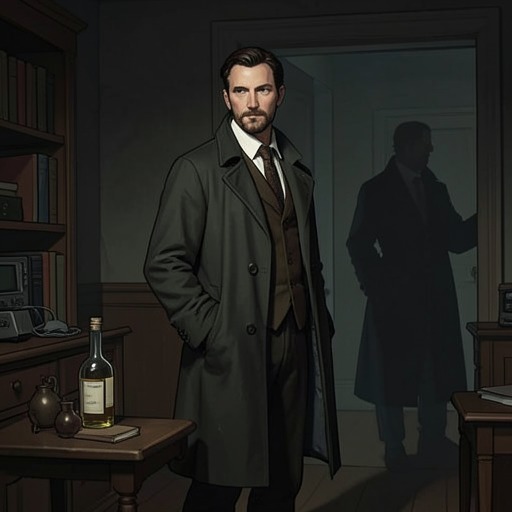
The immediate crisis unfolds through a concealed passage. Bill Kraken, trapped as Willis Pule struggles at the door, finds a hidden panel in the wainscoting and slips into a dark, dusty space. From there he hears a gunshot and the commotion of a struggle. When the panel opens again, Langdon St. Ives and Hasbro see a corpse emerge, followed by another and then a larger collection of animated dead. Their movements are confused and poorly coordinated; they crowd the confined space rather than advancing with any deliberate purpose.
Shiloh appears amid the confusion, accompanied by two men and carrying a Keeble box as well as a bag of bones. St. Ives and Hasbro are briefly trapped between the ghouls and the doorway. St. Ives could try to shut the creatures back inside, but he hears what seems to be Kraken calling from within and abandons the attempt. He instead drags the fallen Pule clear. The choice allows Kraken to escape along with the surging corpses: he leaves among them, carrying the Keeble box. Several of the animated bodies soon falter and collapse, an immediate sign that their activity is temporary and unstable, but their brief movement is enough to defeat containment and scatter everyone present.
Competing Escapes and Loss of Control
The outbreak produces no single victor. St. Ives and Hasbro escape the crush, but they cannot stop Kraken from running into the street with the Keeble box. Shiloh, meanwhile, reaches his brougham with a different box, the aerator box. His companions force a door shut against St. Ives, and the carriage races away. A companion hangs from it briefly before falling into the roadway, while St. Ives is left watching the vehicle carry off the device.
The two boxes mark separate losses of control. Kraken’s flight preserves his possession of the Keeble box amid the disorder; Shiloh’s departure removes the aerator box from St. Ives’s reach. The outbreak thus intersects with a struggle over objects as well as bodies. The moving corpses open a path for escape, obstruct attempts at pursuit, and turn a covert confrontation into a scene in which the participants’ aims diverge sharply. Even the apparent failure of some corpses to remain active does not restore order: the group has already dispersed, and the boxes have been carried away.
Public Meaning and Narrative Significance
The danger soon acquires a second life in public accounts. Newspaper readers encounter reports of both the Pratlow Street corpses and the approaching blimp, while predictions place its landing at Hampstead Heath. Shiloh’s claims that the dead will rise and that the New Church offers salvation give the outbreak a ready-made apocalyptic interpretation. Reports and speculation blur the distinction between the corpse incident and the airship: some people wonder whether the ghouls are aliens, while others entertain Shiloh’s claim that the dead are the silent majority rising from their graves. The reporting does not establish those explanations as true; it shows how quickly uncertain events are joined into a single public threat.
That confusion has been prepared by earlier scenes. The Blood Pudding meeting presents men whom Theophilus Godall believes to be dead, and he has also watched Narbondo revive what seemed to be a corpse. Godall suspects that Kelso Drake may want Narbondo to provide a controllable workforce, though he treats this as a possibility rather than a confirmed plan. Shiloh’s street preaching and his illustrated tract, which links a dirigible with a fiery comet, further connect the corpse crisis to the airship in the public imagination. At the Royal Academy, a crowd already gathers behind Shiloh as the blimp approaches, and officials fear that the cultists may try to destroy the craft or turn it into a temple.
The outbreak’s significance lies in this collision between experimental failure and competing explanations. Narbondo’s material method depends on specific biological substances and precarious procedures; Shiloh recasts resurrection as religious proof; and the newspapers fuse corpses, aliens, and the blimp into a single spectacle. The event makes the dead physically mobile for a short time, but its broader consequence is to set people, devices, and stories moving beyond anyone’s command.