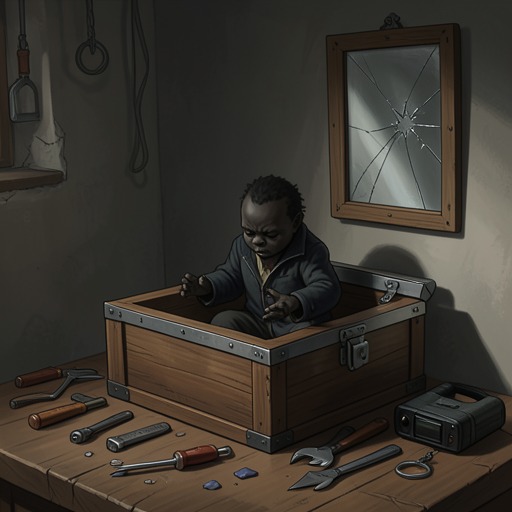
The homunculus is freed and Birdlip sets off from Earth
HomunculusThe Homunculus is freed and Birdlip sets off from Earth when Willis Pule breaks open the Keeble box on Hampstead Heath, releasing the tiny being who had been mistaken for an emerald. The Homunculus immediately seeks out Dr. Randal Birdlip, enters his framework, and takes him aboard the Homunculus’s spacecraft. The scene transforms an object-driven chain of thefts and misunderstandings into a departure beyond the reach of the competing institutions and crowds gathered below.
Causes and Background
The release depends on a confusion that had persisted because two boxes were nearly identical. William Keeble had made a box for Jack Owlesby’s great emerald, which Sebastian Owlesby had withdrawn from the West African Gem Company as his son’s inheritance. Its construction closely matched the lead-lined container holding the Homunculus. When Langdon St. Ives later asked whether the boxes could have been exchanged, an exhausted Keeble confirmed that they could; Nell Owlesby acknowledged that, in her agitated state, she might have mixed them up. She also wondered whether the little man could speak. The possibility that Birdlip had the emerald made the mistake consequential in both material and personal terms: the box carried either a valuable family inheritance or a living prisoner.
The boxes’ similar appearance had already helped propel the hidden object through a sequence of suspicion and pursuit. Captain Powers discovered that the emerald box had vanished from his chest, with no clue in the rain-dark alley to show where it had gone. In an earlier encounter with the hidden box, its holder heard a faint voice from within and feared that it might be a devil speaking inside his own head. Later, St. Ives saw the Keeble box atop the aquarium and picked it up before Ignacio Narbondo could stop him. Its significance was never merely that of a container: what it held determined whether it was treated as treasure, a source of uncanny speech, or an object of scientific and religious attention.
The Break on Hampstead Heath
Birdlip reaches the green in stiff, uneven steps, carrying the Keeble box. Willis Pule rushes at him, but the scene makes clear that recovering the object is no longer Pule’s purpose. His aim has given way to destruction. He seizes the box and smashes it against a stone. The carefully made joinery breaks apart, and the lid flies into the crowd. The violence is brief in the telling; its decisive consequence is that the Homunculus, no longer confined, tumbles out and stands free on the green. Though wearing a hat, he is less than eight inches tall.
The crowd’s attention shifts from the shattered box to the being it concealed. Spectators watch him run through the spring grass toward Birdlip, passing Parsons, with an apparent destination rather than any interest in the assembled onlookers. His small scale sharply contrasts with the public commotion around him: the crowd sees a marvel, while his purposeful movement suggests that the moment matters most to him as an opportunity to act.
Birdlip and the Homunculus
The Homunculus confronts Birdlip, speaks to him, and points toward the heavens. He then climbs onto Birdlip’s framework and works his way into the doctor’s ribcage. The strange transfer gives a practical explanation for the direction of Birdlip’s next action: the doctor is now piloted by the little man. What had appeared to be Birdlip’s extraordinary flight is thus connected to a hidden companion and to the Homunculus’s spacecraft, not simply to the engine that the authorities had hoped to study.
That revelation contrasts with the Royal Academy’s approach. Parsons had told St. Ives that authorities feared cultists might regard a being in a curious box as a god and might seek either to destroy Birdlip’s dirigible or turn it into a temple. He also pressed St. Ives to persuade Keeble to share knowledge of Birdlip’s craft, treating its workings as a scientific resource. St. Ives understood the Academy to be interested chiefly in the engine and to have misunderstood Birdlip’s pursuit. The Heath scene brings those incompatible readings together in public: a crowd cheers without knowing what it is celebrating, while the Homunculus and Birdlip leave the Academy’s claims, the cultists’ presumed designs, and the spectators’ interpretations behind.
Departure and Consequences
With the Homunculus guiding him, Birdlip crosses the grass to the spacecraft. Parsons follows at his heels. Birdlip pauses to look back at London, unties a rope securing one of the spacecraft’s small feet, and climbs through the open hatch. Once the hatch closes, emerald lights appear within the vessel; the ground shudders, and the ship quickly dwindles to a point of fire among the stars. The departure turns the long-held captive’s release into a literal break from Earth, while leaving the crowd with spectacle rather than understanding.
The scene also settles the confusion that had threatened the emerald’s recovery. Langdon St. Ives does not regret losing the ship, convinced that his own voyage was enough and that the future may bring another. Dorothy Keeble has been recovered and stands with Jack, while Captain Powers holds an open Keeble box containing the fist-sized emerald. The ending therefore divides the outcomes cleanly: the Homunculus and Birdlip depart in the spacecraft, while the emerald returns to the human circle to which it belongs. The broken box, once a prison or a presumed treasure chest depending on the mistake, is no longer needed to hold either possibility.