New Church
HomunculusThe New Church is the apocalyptic movement led by Shiloh, who presents himself as the New Messiah and makes the approaching end of the world the basis of a growing London following. Its promises join salvation to the imminent arrival of a mysterious dirigible and the raising of the dead. The movement’s influence depends not only on Shiloh’s claims but on the public circulation of tracts, reports, and spectacles—some deliberately staged, others entangled with events he cannot control.
Beliefs and apocalyptic expectations
Shiloh’s outlook is governed by a personal prophecy as well as a timetable of catastrophe. He believes that a dirigible has appeared in the sky twice, most recently more than four years earlier, and treats its return as a sign that the end is near. He expects the coming upheaval to reveal the truth of his birth and the identity of his natural, or unnatural, father. This expectation reaches back to a meeting twelve years earlier, when Nell Owlesby told him that a tiny creature had existed and had been kept in a box. Shiloh believes that the Homunculus, once possessed by Sebastian Owlesby, was his father. The novel presents this as Shiloh’s conviction, not as an established fact.
The movement’s promise of redemption is bound to Shiloh’s hope of recovering his mother, Joanna Southcote, by restoring her from the grave. He imagines this as a greater achievement than the reanimation of corpses pursued by Ignacio Narbondo. His ambition therefore combines public prophecy with a private, familial longing: the promised last days might vindicate his identity and make possible a restoration that would surpass Narbondo’s work. The surrounding years, however, have not matched the scale of disaster he predicts. The coronation of the Queen as Empress of India and fighting in Turkestan are described as the chief recent public events, a subdued backdrop against which Shiloh insists that world-changing events are close.
Converts and practical activity
The New Church has a visible network of converts who distribute tracts in London. Shiloh calls these followers his lambs and regards their work as service to his cause. He also uses their network for practical purposes: he makes counterfeit half-crowns, clips and smooths the coins, and relies on the faithful to circulate them rather than employing ordinary agents. To Shiloh, the proceeds and the religious work belong to the same undertaking; the coins are to be plated and used to further the work of God. His belief that the time for such work is nearly over gives this mundane operation an apocalyptic deadline.
The converts make the movement noticeable in public places, but visibility does not itself establish the truth of its claims. At Billingsgate Market, one young follower approaches Willis Pule with a tract and presents salvation as available in the ordinary signs of creation, including the sunrise, river, and sea. He identifies himself as a member of the New Church and promises that Shiloh can raise and redeem the dead. Pule, already considering whether it might be advantageous to join Shiloh while maintaining his dealings with Narbondo, rejects the approach in anger. He tears up the tracts and scatters them, but later notices and keeps one bearing an illustration of a dirigible and a falling comet. The image carries the movement’s message beyond the encounter even as Pule rejects its appeal.
Public signs and contested authority
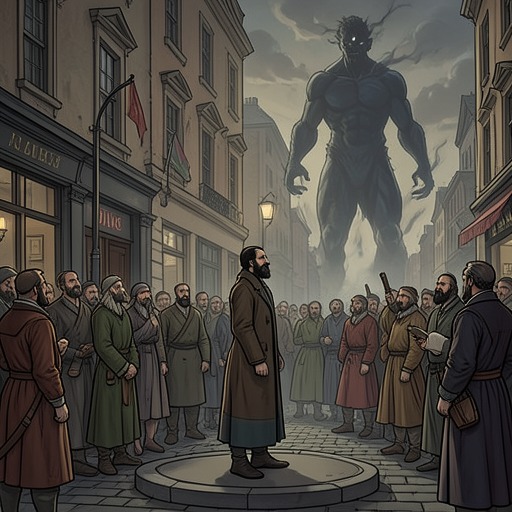
The movement’s public performances expose a gap between its claims and the reactions they produce. In Kensington Gardens, a crowd gathers around Shiloh, who displays a glass cube containing a partly mummified head. The crowd is uncertain what it is meant to witness. Hecklers mock the spectacle, and laughter spreads; the performance initially appears to be losing its hold. Then the head’s jaw begins to move, clacking with enough force to make it bump inside the cube. Shiloh appeals to it as his mother and calls on it to speak. The apparent sign does not deliver a revelation: a voice cries out with an irreverent dismissal, provoking further laughter. The scene leaves the crowd’s response divided between the unsettling animation and the evident failure of Shiloh’s prophetic appeal.
The performance nevertheless benefits from the presence of the converts distributing tracts. Some appear visibly unwell, and their condition lends the gathering a measure of credibility in the eyes of observers: they seem to embody the suffering or transformation associated with the movement. Shiloh’s authority therefore does not rest on a convincing oracle alone. It is reinforced by the gathered faithful and by the difficulty of dismissing their commitment, even when the central spectacle invites ridicule.
Rumor, fear, and the approaching dirigible
The Royal Academy regards the cult around the dirigible as a public danger. Parsons reports rumors linking Shiloh to Dr. Birdlip and says that cultists regard a device in the craft, housed in a curious box, as a sacred god. These claims remain rumors in the scene: Langdon St. Ives assures Parsons that Birdlip is unacquainted with Shiloh. The Academy’s concern is practical as well as ideological, since it fears that the movement may try either to destroy the craft or to make it a temple. Parsons also invokes the spreading crowd outside as evidence that the religious movement has become a matter of public order, while urging St. Ives to secure scientific cooperation from William Keeble.
As the dirigible’s predicted arrival draws nearer, religious expectation blends with sensational news. A newspaper headline announces that the blimp is to land and advertises both a man from Mars and an alien threat. The paper links the approaching craft with the outbreak of animated corpses in Pratlow Street and reports Shiloh’s suggestion that the dead may be rising on a vast scale. These accounts do not establish that the crises share a cause; rather, they show how reports and prophecy turn separate disturbances into a single imagined apocalypse. When Pule, disheveled and carrying loose bandages, is mistaken by frightened passersby for an alien or a ghoul, the public’s categories of threat have become unstable enough to shape how an ordinary person is seen.
Final spectacle and limits
On Hampstead Heath, Shiloh again raises a cube before a gathered crowd, this time as a glowing point descends from the sky. He names the falling star Wormwood, interpreting the sight through the language of apocalypse. The crowd’s attention shifts from the cube to the light. Shiloh is thrown forward, and a running figure seizes the glass container and smashes it before leaving. The followers, including Shiloh, turn their attention to the object in the sky: a glowing, spheroid ship has fallen from the stars.
The ending gives Shiloh’s prophecies a complicated, partial confirmation. The arrival of a strange craft answers the movement’s long-standing expectation of a sign from the heavens, but the decisive event is not produced or controlled by Shiloh’s performance. His revelation of Wormwood accompanies the crowd’s encounter with the ship; it does not establish that the ship is the cause of the promised apocalypse or that Shiloh has mastered what is happening. Across the novel, the New Church gains force by joining belief to visible signs and spreading fear, yet the signs remain open to competing interpretations, and the movement’s authority proves vulnerable to ridicule, uncertainty, and events that exceed its leader’s command.