Perpetual motion
HomunculusPerpetual motion is the promise of motion sustained without end, but in the novel that promise is neither a settled scientific fact nor a harmless abstraction. William Keeble treats it as a difficult, perhaps impossible ideal, while his practical work produces a miniature device that attracts Kelso Drake’s attention. The contrast between an engine that can run down, a patent that can be claimed, and factories imagined as its beneficiaries makes perpetual motion a contested technology: its value depends not only on whether it works, but on who controls it and what kind of power it serves.
The Ideal and Its Qualifications
When Langdon St. Ives asks whether Dr. Randal Birdlip’s engine can be duplicated on a smaller scale, Keeble answers by resisting any simple definition of success. Perpetual motion, he explains, is difficult to pursue and “rather like separating an egg from its shell without altering the shape of either” and suspending the two forms beside each other. He calls true perpetual motion a dream, but then complicates that skepticism with an alchemical story: a sage named Gustatorius supposedly achieved it in 1410 in the Balkans to keep the back lens of a kaleidoscope turning. Keeble admires the idea while discounting the credibility of alchemists, whom he considers frivolous. His account leaves the principle suspended between ingenious possibility and dubious legend.
That uncertainty is important to the invention’s place in the story. Keeble does not simply declare the enterprise fraudulent; he distinguishes the absolute ideal from devices that may approximate it or operate for a long time. St. Ives is interested in a more practical question: whether the engine can be miniaturized for his spacecraft. He points out that Birdlip has been aloft for fifteen years and imagines that, within that span, he could travel to Mars or Saturn and return. The exchange shifts the subject from an abstract claim about endless motion to the engineering problem of making a small, useful machine last long enough for a specific journey.
Scale, Duration, and Decline
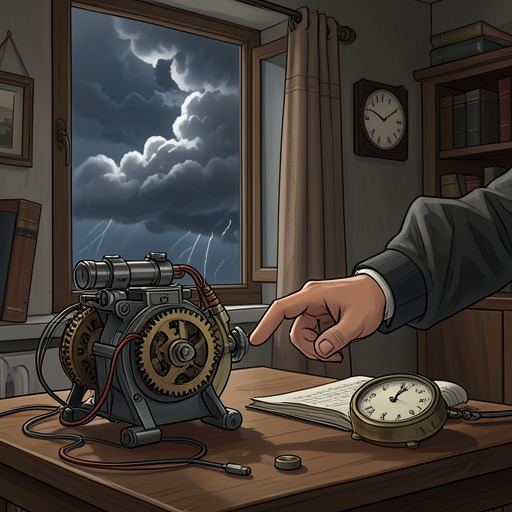
Keeble’s work offers a qualified affirmative answer to St. Ives’s question. He demonstrates a compact device housed in a wooden box, and later says that the work could now be done more quickly, although at fearsome expense. The patent has already become an object of interest to Drake. The machine therefore represents more than an ingenious mechanism: it is a difficult-to-produce invention whose miniature scale may make it useful beyond its original setting, while its cost and ownership remain practical constraints.
Birdlip’s engine supplies the counterexample to any uncomplicated promise of permanence. Keeble believes it is running down and fears that Birdlip’s appearance that spring may be its last. He bases his concern on the dirigible’s earlier passage: five years before, it was low and far north of where it had passed in 1865. From those observations, Keeble infers that the engine is declining. He further suspects that it has a homing tendency and may bring the dirigible toward Hampstead, where it was launched, though he describes that tendency as an unintended product of its design. The engine’s extraordinary duration thus does not amount to endless operation; even its apparent self-sustaining power has a history, a trajectory, and a possible end.
Patents, Theft, and Industrial Ambition
The invention’s commercial and political stakes emerge through a sequence of disputed plans and devices. Keeble says Drake has approached him about the patent, claiming an interest in using perpetual-motion devices to propel entire factories. Keeble admits he does not know how Drake learned of the technology. His uncertainty leaves the route by which the secret spread unresolved, but Drake’s interest is unmistakably larger than the miniature machine itself: he imagines transferring its operation to industrial production.
A break-in at Keeble’s home makes the distinction between the intended prize and the stolen material clear. The intruder leaves behind more valuable possibilities but takes plans for a roof-mounted sausage cooker. Keeble believes the thief had seen him conceal other plans in a cache and could not reach them; when a casement shut and trapped him, he snatched the nearest drawings in panic. The episode is comic in its accidental prize, but it also points back to Drake’s pursuit of the engine. Theophilus Godall suspects Drake was after the perpetual-motion plans and predicts that he might market the device within a month, less for profit than to provoke his opponents. Later, when Drake confronts Keeble and demands the machine instead of the plans, he says his workmen can puzzle it out. Knowledge, patent rights, a working object, and the labor required to reproduce it become competing forms of control.
From Mechanical Motion to Control of Labor
Godall’s suspicions connect Drake’s factory scheme to a darker possibility. He has watched Ignacio Narbondo revive what appeared to be a corpse and believes Drake and Narbondo may have been bargaining over an army of workers that union bosses could not make tractable. This is Godall’s interpretation, not a demonstrated use of Keeble’s engine: the story does not establish that perpetual motion powers such workers. Yet the juxtaposition reveals how Drake’s imagined industrial future is framed. Mechanical power promises to propel factories; reanimated labor promises, in Godall’s conjecture, a workforce beyond ordinary worker organization. Both proposals envision production through forms of power that would reduce dependence on bargaining with living workers.
The novel also places this mechanical ambition beside a separate, more extreme pursuit of permanence. St. Ives describes Narbondo as having become obsessed with animating the dead and with the possibility of perpetuating life or creating it. He says Narbondo hoped to locate the Homunculus’s spacecraft and trade it for power over death and time. These aims are not presented as the same technology as Keeble’s engine. Their proximity instead enlarges the meaning of the pursuit: the desire to defeat limits appears in machines, industrial schemes, and experiments on life, while the evidence repeatedly qualifies the fantasy with cost, decline, uncertain knowledge, and competing claims of ownership.
Significance
Perpetual motion binds inventive possibility to the question of who benefits from invention. For St. Ives, miniaturization could make interplanetary travel practicable; for Keeble, the ideal remains elusive even as a costly device can be built; for Drake, the patent and machine promise industrial reach. Godall’s suspicions add the prospect of labor control, while Birdlip’s failing engine undercuts any assumption that long operation means permanence. The concept’s force lies in that tension: the machine seems to promise an escape from limits, yet its operation remains vulnerable to time, expense, and human appropriation.