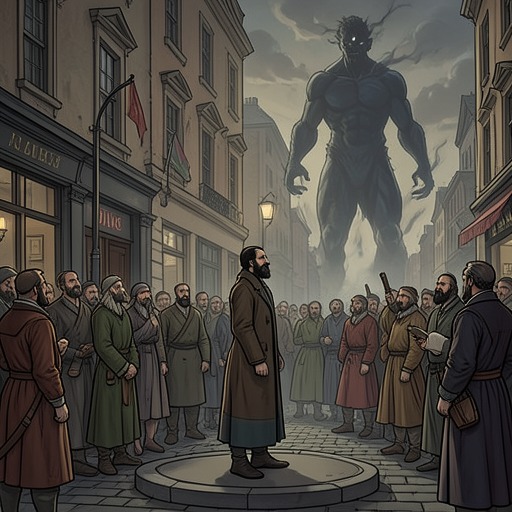
Shiloh’s Apocalyptic Gospel
HomunculusShiloh’s Apocalyptic Gospel is a London religious movement that binds together the coming of Dr. Birdlip’s blimp, the return of the dead, and Shiloh’s claim to messianic authority. It operates through a network of faithful who distribute tracts and counterfeit coins, and through public spectacles that present disputed or unexplained events as signs of the approaching end. As the blimp nears London, the gospel offers a single prophetic explanation for rumors of corpses, alien visitors, and social upheaval, drawing crowds toward the very events it foretells.
Prophecy, origin, and promised redemption
Shiloh’s account of his own origins gives the movement’s prophecy a personal stake. Twelve years before the events in London, Nell Owlesby told him that a tiny creature had existed in a box and explained what had become of it. She later recanted and disappeared. Shiloh nevertheless became convinced that the Homunculus, possessed by Sebastian Owlesby, had been his father. The revelation underpins his conviction that his birth was extraordinary and that the coming crisis will disclose his true parentage. The gospel therefore promises not only a transformation of the world but also confirmation of Shiloh’s own identity.
The approaching blimp is central to his chronology. Shiloh believes it has appeared before, including a sighting more than four years earlier, and has fixed its return within his expectation of the apocalypse. His message joins that aerial sign to the resurrection of the dead: he presents himself as the New Messiah through whom people can be raised and redeemed. The promise gives the blimp a religious meaning before it arrives, while the prospect of resurrection makes the predicted catastrophe a source of hope as well as fear.
Shiloh’s concern for Joanna Southcote, his mother, makes resurrection more than a general doctrine. He wonders whether she might be restored from her grave in Hammersmith Cemetery and considers that prospect more valuable than the many animated corpses associated with Ignacio Narbondo. Those corpses may serve the movement as converts, but Shiloh recognizes that they do not think or choose. His imagined restoration of his mother would carry a different significance: it would answer a private longing within the public promise of renewed life.
Followers, tracts, and material practice
The gospel is organized through action as well as proclamation. Shiloh does not rely on agents to sell the counterfeit half crowns he prepares. Instead, he has his faithful distribute them, accepting greater profit and risk as part of what he regards as religious work. Coins and tracts thus travel through the same network: one helps sustain the movement materially, while the other announces its impending revelation. Shiloh treats the counterfeit work as temporary, something that will end when the predicted transformation arrives.
The tracts connect the approaching blimp with an image of a comet arcing toward the Earth and a warning of imminent change. At Billingsgate Market, Willis Pule encounters one after angrily scattering the tracts carried by a young evangelist. The drawing and its apocalyptic caption do not explain what, precisely, is about to happen. That uncertainty does not prevent the image from circulating; Pule keeps the tract, and the blimp becomes part of the public conversation. The episode shows how the movement’s broad predictions can spread even when their wording leaves their meaning unclear.
The faithful also supply visible evidence of collective commitment. At Kensington Gardens, a large crowd gathers behind Shiloh, while supporters distribute tracts. Their presence helps make his performance appear credible to onlookers, even as the spectacle attracts mockery and impatience. Later, crowds and followers gather again as the blimp approaches Hampstead Heath. Across these appearances, the movement’s authority depends not only on what Shiloh says but on the repeated public sight of people acting as though his predictions matter.
Resurrection and public performance
Shiloh’s message is explicitly a promise that the dead can be raised. He presents conversion as a means of saving the soul and invokes his own power to lift people from misery. His preaching reaches people outside the settled ranks of his followers: on the embankment, he approaches Pule with tracts and a promise of salvation. Pule rejects the appeal and destroys the leaflets, making the encounter a small-scale example of the resistance Shiloh’s claims can provoke.
At Kensington Gardens, Shiloh stages a more consequential display. He holds up a transparent glass cube containing the partially mummified head of Joanna Southcote. The crowd watches, but the purpose of the exhibition is not immediately clear to those assembled. Some onlookers ridicule the spectacle, while the presence of tract-distributing followers lends it an appearance of religious conviction. The display makes a relic serve as a promise of resurrection without demonstrating that resurrection has occurred. When Theophilus Godall later sees Shiloh at Hampstead, the head remains in its cube, toppled to one side and silent.
The movement’s interpretation of resurrection is also entangled with the green vapor produced by the Keeble box. After the device has been used, Shiloh understands its effects as evidence of fertility and renewal, and interprets his own changed appearance and unusual voice through the language of spiritual rebirth. At Hampstead, he turns the device into part of another public religious act, cranking it to release green vapor before the crowd. Godall, disguised as a corpse, presents himself as responsive; Shiloh calls him his son and imagines that the dead will be able to testify before a holy tribunal. The episode shows how Shiloh folds an ambiguous mechanical effect and a staged appearance into his expectation of miraculous return.
The blimp, the crowd, and the gospel’s climax
As reports of the Pratlow Street corpse outbreak reach the public, Shiloh’s prophecy offers a framework for reading events that otherwise appear disconnected. Newspaper accounts place the corpses alongside the approaching blimp, and public speculation entertains both alien explanations and the possibility that the dead are rising in great numbers. Shiloh’s teaching encourages that convergence: the blimp, the animated dead, and the end of the world become parts of one anticipated revelation. The crowds moving toward Hampstead are therefore drawn by more than curiosity about an airship; they have also been stirred by the apocalyptic account circulating through London.
On Hampstead Heath, Shiloh continues preaching among the gathered multitude, with followers supporting him and the glass cube in his hands. The Royal Academy is present to observe the expected arrival, while the crowd’s singing, drinking, and excitement make the gathering an unruly public event rather than a controlled religious ceremony. Shiloh raises the cube as a sacred object, and when a small light falls from the sky and brightens, he identifies it with the apocalyptic star Wormwood. His declaration turns the blimp’s arrival into apparent confirmation of his prophecy at the very moment the scientists and spectators are trying to understand what they see.
The moment does not leave Shiloh in control of the spectacle. He is knocked forward, and the cube is taken by a running figure, who reaches the assembled scientists and smashes it before leaving. The object is lost just as the glowing ship descends, and Shiloh’s followers turn their attention toward the falling vessel. The gospel’s climax thus joins prophecy to a real arrival but denies Shiloh command over the event: his sacred object is destroyed, and the blimp, rather than the staged relic, becomes the crowd’s immediate focus. The movement’s force lies in how it organizes belief and public attention around uncertain signs, not in any final proof that its promises have been fulfilled.