Immortality and arrested decay
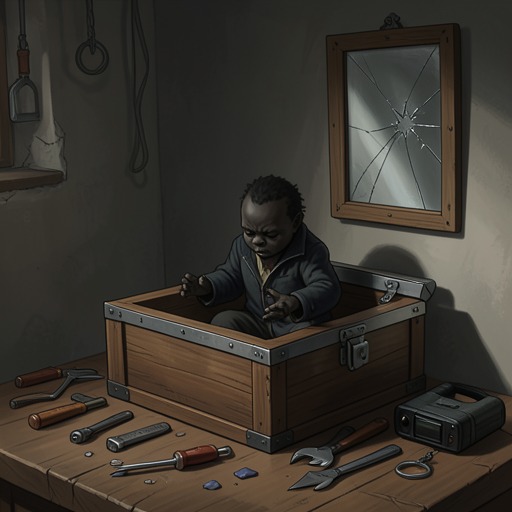
HomunculusImmortality and arrested decay are the powers Sebastian Owlesby believes the Homunculus can offer: resistance to entropy, apparent reversal of decay, and potentially indefinite life. The concept drives Owlesby’s experiments and his increasingly desperate pursuit of control over death, while the evidence leaves both the mechanism and the cause of his decline uncertain. Its promise is inseparable from confinement: the Homunculus must remain in a box, even as Owlesby seeks to bargain with it for knowledge and power.
Meaning and Limits
Owlesby is convinced that the Homunculus can arrest entropy and at least superficially reverse decay. That qualification matters: the evidence presents arrested decay as a claim about observable effects, not as proof that anyone has achieved literal immortality. Owlesby’s ambitions extend from preserving life to creating it, but the distinction between those goals is not resolved. Langdon St. Ives understands the creature’s apparent power as the basis of Owlesby’s fixation, while also recognizing how little Owlesby himself understands about what is happening to him.
The Homunculus’s small, confined state is itself described as the consequence of its resistance to time. Owlesby regards the creature as prodigiously old and attributes its diminutive condition to the way it has thwarted time. This account links extraordinary longevity to physical limitation: the being that seems to escape ordinary decay cannot simply live or move without constraint. The need to keep it in a box further complicates any easy equation between immortality and freedom. Its power is potent enough to transform Owlesby’s ambitions, yet access to it depends on an enclosure and on a continuing, uneasy relationship with its occupant.
Experiments and Proposed Mechanisms
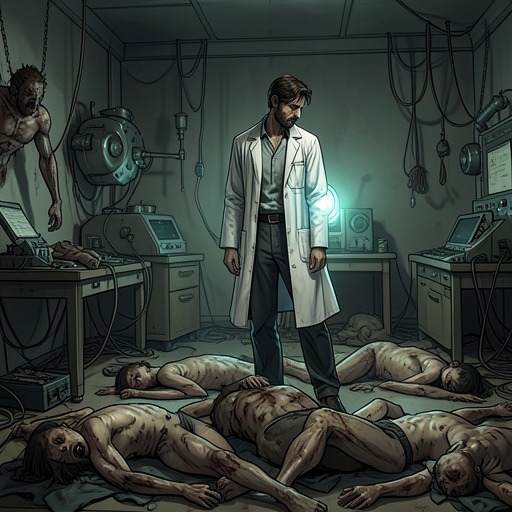
The notebooks connect the idea of arrested decay to several distinct experiments. Owlesby records that the Homunculus can separate tepid water into ice and steam, an ability that suggests control over processes otherwise taken for granted. He also describes it animating the remains of a rat that had been dead for months, making the creature move like a marionette. These demonstrations underpin his belief that it can intervene in the passage from life to death, though they do not establish that the reanimated animal has recovered its former life.
Other experiments are attributed to Owlesby’s own work. Langdon St. Ives notes a reported success in producing mice from old rags and an experiment in which Owlesby revived a man from Chingford who was dying of general paresis. According to the account, the man’s age was reduced by forty years. These claims make the research seem to reach beyond the animation of corpses toward the restoration or creation of life, but their methods are described as alchemical and remain outside St. Ives’s field. The notebooks therefore offer striking results without supplying a dependable scientific explanation or establishing how much of the effect belongs to Owlesby, the Homunculus, or their interaction.
A further distinction emerges in St. Ives’s account of Owlesby’s earlier work: Owlesby had apparently discovered how to animate the dead without the Homunculus. The creature’s contribution, as St. Ives understands it, was the possibility of perpetuating life indefinitely, or perhaps creating life itself. The evidence thus does not make the Homunculus the source of every reanimation. Instead, it marks a change in scale and ambition: from making the dead move to imagining that decay and mortality might be overcome.
Possession, Exchange, and Confinement
Owlesby’s research becomes a struggle over access to the Homunculus. He is described as jealous of possessing it and unwilling to let Ignacio Narbondo have it. At the same time, Owlesby fits William Keeble’s structure with a screen through which he can communicate with the creature. He fears that this arrangement has contributed to his own decay and admits that he is bargaining with the Homunculus, offering knowledge in exchange for freedom. The terms are uncertain, but the exchange makes the research more than an experiment: Owlesby is trying to control a power whose cooperation he cannot guarantee.
The enclosure around the Homunculus is central to that imbalance. It must be kept in a box, yet Owlesby imagines that it could leave if it found its spacecraft and a sufficiently capable pilot. He believes that recovering the craft could let him offer it to the Homunculus in return for power over death and time. The proposed bargain exposes the contradiction at the center of his project: he wants access to the creature’s extraordinary capabilities, but the creature’s confinement is what makes that access possible. The box is therefore both a practical condition of contact and a visible limit on Owlesby’s claim to mastery.
The notebooks also describe a separate box made for a great emerald, part of Jack Owlesby’s inheritance. Sebastian withdrew his interests in the West African Gem Company in the form of that emerald and persuaded Keeble to build a container almost identical to the lead-lined cube holding the Homunculus. The two boxes should not be confused: one houses the creature, while the other protects the emerald. Their resemblance nevertheless places the secret of life beside an object of inherited wealth, turning possession and safekeeping into recurring material forms in Owlesby’s story.
Moral Cost and Unresolved Cause
Owlesby’s pursuit exacts a cost that he cannot interpret with confidence. His notebooks document a progressive decline into madness, and he describes pain, frightening dreams, and a sense of personal decay. He believes that the suffering may be his due and links it to his own actions, but his explanations do not settle whether his condition results from scientific greed, contact with the Homunculus, or some combination of causes. Langdon St. Ives offers a moral interpretation: he becomes convinced that Owlesby’s slide into wrongdoing has corroded his sanity. That judgment is St. Ives’s conclusion, not a demonstrated mechanism of the creature’s power.
The idea of preserving life is consequently shadowed by the damage done in its pursuit. Owlesby’s moments of rationality lead him to ask Nell to kill him if he falls into madness again; even so, he continues to hold onto the promise of what the Homunculus can do. His recorded desire to abandon the pursuit conflicts with his continued bargaining and plans. That contradiction makes the promise of immortality less a solution to death than a source of escalating dependence: the prospect of mastering time cannot free Owlesby from fear, uncertainty, or the consequences of his choices.
Nell’s removal of the Homunculus from Owlesby’s possession ends his immediate control of the supposed secret of life and transfers its custody to Birdlip. Langdon St. Ives interprets this loss as infuriating to Narbondo, who had also wanted access to the creature. The transfer does not resolve whether immortality is attainable or explain what caused Owlesby’s decline. Instead, it leaves the power’s promise in circulation, separated from the researcher who tried to possess it and still bound to the conditions of confinement, exchange, and uncertain knowledge.