Corpse animation
HomunculusCorpse animation is the attempt to make dead bodies move again, a practice that joins Sebastian Owlesby’s increasingly destructive experiments to Ignacio Narbondo’s ongoing work with carp and their glands. The method promises activity after death, not a demonstrated return to ordinary life: the reanimated figures encountered in the story are disoriented, limited, and dangerous. Its materials also give the process a material life of its own. Bodies, fish, extracted glands, fluids, and containers shape what the experiment can do, while human ambition supplies its increasingly reckless direction.
Proposed mechanism and materials
The accounts connect reanimation to an elixir-like substance found in carp glands. Bill Kraken recalls driving a wagon during a midsummer-night theft of about half a dozen carp from the aquarium. Sebastian Owlesby cut them up on Baker Street, and the fish were given to a beggar woman on Old Pye, who sold them at Billingsgate Market. Kraken describes the gland as containing an elixir, and his recollection makes the fish a crucial ingredient in the hidden enterprise rather than incidental cargo. He also distinguishes this episode from what he considers the worse crimes, which he associates chiefly with Narbondo.
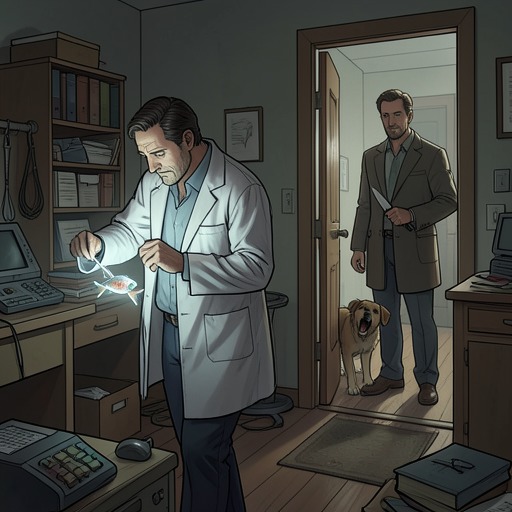
Narbondo’s laboratory supplies a more immediate view of the proposed method. He keeps large aquaria stocked with koi and tests them by feeding them worms. When one fish behaves differently from the others and struggles at the surface, he removes it for dissection. He extracts a small gland from its organs, places it in amber fluid, and preserves it with other specimens. The sequence suggests careful attention to the fish’s condition and to the gland as a collected substance. The experiment depends not simply on possessing a carp, but on obtaining the right material from it.
The process also involves preparing a corpse. Narbondo considers whether a body that has been dead for two weeks could serve his purpose, and judges that animating it might have little practical value beyond its possible use in Shiloh the New Messiah’s religious performances. In another case, he identifies a dead man named Stephanus Biddle and says he intends to enliven him so that he can distribute religious tracts. These are Narbondo’s plans, not evidence that Biddle completes the task; they show how readily he treats reanimation as a means to an end, whether spectacle or labor.
Sebastian Owlesby’s experiments
Sebastian Owlesby’s surviving notebooks reveal how reanimation became part of a prolonged moral and psychological decline. His notes describe attempts to animate corpses and record the practical obstacle of finding both a fresh body and a fresh carp gland before the body deteriorates. In one entry, a cadaver obtained from a gibbet remains inactive despite being filled with fluids. Owlesby recognizes that his work is becoming a road toward murder and horror, yet also admits that he has already gone too far to imagine returning to his former position.
The notebooks trace that change beyond laboratory procedure. Owlesby writes of experimenting under Narbondo’s influence and of a late-May 1861 episode in which the work called for brain matter from a living man. He and an unnamed accomplice took it from a sleeping indigent in St. James’ Park. The account makes clear that the search for an effective process had crossed from handling the dead into violence against the living. Later, Langdon St. Ives judges that Owlesby’s narrative concealed part of what happened in Limehouse, and that what he subsequently admitted was more disturbing still. The notebooks therefore present reanimation not as a single discovery but as the center of an escalating chain of decisions and concealments.
Owlesby also believed the Homunculus could arrest entropy and reverse decay, at least superficially. That belief needs to be distinguished from the corpse experiments themselves: St. Ives concludes that the creature was not required to animate bodies, even though Owlesby and William Keeble had both associated it with the secret of perpetual life. The distinction sharpens the tragedy of Owlesby’s research. He treated animation and the overcoming of decay as related promises, but the evidence separates a practical method for making corpses active from his larger hope of defeating deterioration. His notebooks connect that hope to the loss of his sanity and to his request that his sister Nell kill him if he again fell into madness.
Narbondo’s use of reanimation
Narbondo’s conduct makes the technique at once experimental and transactional. He considers a corpse’s likely usefulness, gathers the carp material, and prepares a dead man whom he expects to put to work. His proposed use of Stephanus Biddle as a tract distributor turns reanimation into an instrument of Shiloh the New Messiah’s public religious campaign. The contrast between Shiloh’s language of redemption and Narbondo’s practical treatment of the dead exposes the uneasy alliance between them: the same body can be presented as a religious sign and handled as experimental material.
The process also becomes entangled with criminal and commercial interests. Theophilus Godall reports seeing Narbondo revive what was almost certainly a corpse, and he interprets the dead men at The Blood Pudding as evidence of the practice. Their behavior is markedly impaired: one has difficulty finding his way and walks into a wall. Godall speculates that Kelso Drake may want an army of workers who cannot be controlled by union leaders, or may hope to buy the means of overcoming decay. These are possibilities he considers, not confirmed motives. His account nevertheless shows how reanimation could become a political and economic threat once the dead were imagined as a labor force.
A later scene involving Narbondo, Willis Pule, and Shiloh the New Messiah shows the laboratory procedure being prepared around another corpse and a sluggish carp. Narbondo works with urgency, while Shiloh’s attention shifts anxiously to the remains of his mother, Joanna Southcote. His fear that her hands are missing interrupts the experiment’s detached appearance and recalls the human claims that the laboratory’s objects and bodies cannot fully erase. The scene records the preparations and their stakes without making the procedure a simple, reliable recipe.
Results and consequences
The animated dead are not presented as restored people. In the account at The Blood Pudding, the figures appear dead to Godall and move with poor coordination; later, a group of shambling corpses presses into a confined passage as Langdon St. Ives and Hasbro try to escape. Their movements are repetitive and uncontrolled, and the scene turns the presumed achievement of the experiment into a physical obstacle and a public crisis. The bodies can move, but their activity offers no evidence of renewed judgment, identity, or ordinary human life.
This gap between motion and restoration defines the concept’s force in the story. Carp glands and laboratory fluids promise a technical answer to death, yet the visible result is impaired movement that can be exploited, misread as a miracle, or unleashed beyond the experimenter’s control. Reanimation’s consequences therefore extend past the laboratory: it supplies Shiloh with the possibility of religious spectacle, gives Drake a conjectured route to obedient labor, and creates a danger that traps people who encounter the animated bodies. The process is less a clean victory over mortality than an unstable network of bodies, materials, and ambitions whose effects exceed any one participant’s plan.