Shiloh's apocalyptic messianism
HomunculusShiloh’s apocalyptic messianism is a London street religion that makes the passing dirigible a sign of approaching catastrophe and promises that Shiloh, the self-proclaimed New Messiah, can redeem the dead. Its prophecies are not merely private convictions: they organize a network of followers, give practical purpose to Shiloh’s work, and provide a framework through which the public interprets the novel’s increasingly strange events. At its center is a personal claim about the Homunculus, whom Shiloh regards as his father, and a hope that the dead Joanna Southcote, his mother, might be restored.
Prophecy and the Dirigible
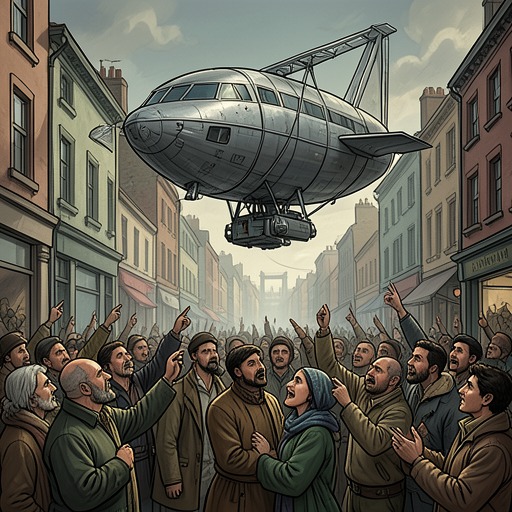
The movement’s defining sign is an airship Shiloh believes heralds the end of the world. During an early-morning passage over a crowded London market, a dirigible crossed the sky beneath the fading moon. Its gondola carried a rigid, skeletal pilot, a startling sight that briefly drew thousands of faces upward. Shiloh, preaching nearby in sackcloth and ashes, took the appearance as an omen and a confirmation of coming doom. His preaching gained immediate practical force: by sunrise he had made a dozen converts.
Years later, the sighting remains the structure around which he arranges his expectations. He recalls that the dirigible had passed twice in the early morning and that its last appearance, more than four years earlier, came from the west beneath a dying moon. He has fixed its return to a particular day and treats that prediction as more than a forecast: the approaching crisis, he expects, will reveal the truth of his birth and the identity of his natural or unnatural father. The airship therefore links public spectacle to private identity. Its return promises both a world-changing event and an answer to the history Shiloh has built his faith around.
Origins and Family Claims
Shiloh’s beliefs grow from a disclosure he says he received twelve years earlier from Nell Owlesby. In a moment of spiritual remorse, she told him about the tiny creature in a box and what had become of it. She later withdrew her account and disappeared into the Leeward Islands. Shiloh has spent the intervening years waiting to learn whether she deceived him. He nevertheless identifies the Homunculus, once possessed by Sebastian Owlesby, as his father and understands himself as carrying out that father’s work.
This conviction is joined to a grievance about his mother, Joanna Southcote. Shiloh resents those who had rejected her claim that she carried a messiah and regarded her condition as illness. They have long since died, leaving him unable to confront them; his religious labor becomes, in his own understanding, a continuation of the mission they denied. In his room, he keeps a small shrine containing a silver crucifix, a miniature portrait of Joanna, and a sketch of the man he believes to be his father. The sketch was made by James Clerk Maxwell, who had possessed the creature without understanding its nature. Shiloh’s account reaches further back still: the creature had been sold to Joanna by a dying Abyssinian eighty-two years earlier. These objects and recollections make his theology a family history as much as a public creed, although its central paternity claim remains Shiloh’s belief rather than an established fact.
Religious Work and Resurrection
Shiloh combines preaching with practical, clandestine work. In a lodging house on Buckeridge Street, he spends the evening clipping the gates from counterfeit half-crowns and smoothing their edges. He intends his followers, whom he regards as his lambs, to distribute the coins for profit and peril in support of his cause. He hides the unfinished coins beneath a false bottom in the shrine, takes away a bag of plated coins, and leaves for Soho. Religious tracts cover the coins while they are being prepared, binding the movement’s material activity to its apocalyptic message.
His promises center on salvation from death. When Willis Pule encounters a young preacher distributing tracts, the man urges conversion by describing Shiloh as the way to save the soul and as one who raises people from the grave. The preacher also attempts to present a healing gesture as a personal appeal, but Pule reacts angrily, scattering the tracts and leaving one behind. Its illustration joins a dirigible to a comet descending toward a flat earth and announces that the decisive time is at hand. The episode shows how the movement’s message circulates in simplified images and street preaching, but also how readily it meets disbelief and hostility.
Shiloh’s interest in resurrection is not limited to recruitment. He wonders whether Ignacio Narbondo might restore Joanna, whose body lies in Hammersmith Cemetery. For Shiloh, the possibility of regaining her is worth more than a multitude of Narbondo’s animated corpses. Yet he also recognizes that the reanimated dead can serve his movement as obedient, undemanding workers. The contrast exposes a tension within his religious project: resurrection is at once a hope for a mother’s return and a resource for organizing followers. His longing for Joanna is personal, while his assessment of the animated dead is instrumental.
Public Spectacle and Uncertainty
The movement grows visible in London through tracts, street preaching, gatherings, and the reported activity of its followers. When a crowd moves out of Kensington Gardens toward the Royal Academy, Shiloh leads it, and the people shout together as they press into the streets. To Parsons, the gathering is evidence that the evangelist’s apocalyptic message has stirred a vast and disruptive exodus. The Academy also hears rumors that cultists have fixed their attention on Dr. Birdlip’s dirigible and may want either to destroy it or turn it into a temple. These are reported suspicions, not a settled account of the movement’s plans, but they show how Shiloh’s religious following becomes entangled with scientific fears about the airship.
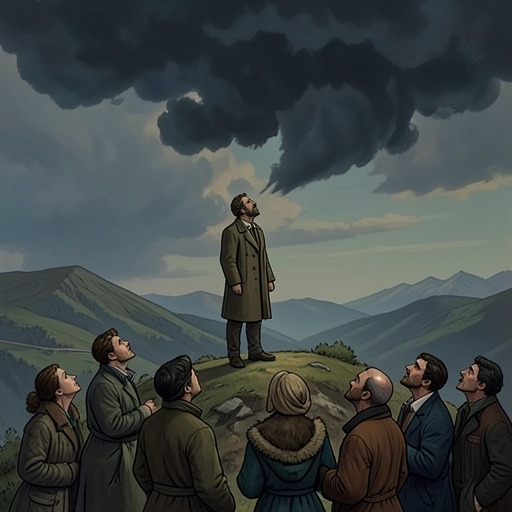
Shiloh’s public performances make sacred meaning out of objects and coincidences. Before a crowd, he raises a glass cube containing a partially mummified head. Later, at night on Hampstead Heath, he holds a cube aloft while the crowd gathers around him and a small light descends from the sky. As the object brightens, Shiloh calls it Wormwood, giving the approaching phenomenon a place in his apocalyptic scheme. The performance brings together the movement’s signature elements: a displayed relic, a gathered congregation, a heavenly sign, and a named prophecy.
But the spectacle does not remain under his control. As attention turns toward the falling object in the sky, Willis Pule rushes through the crowd, seizes the cube from Shiloh, and hurls it to the ground before leaving. The crowd and Shiloh’s followers then turn their attention to the glowing spheroid ship descending toward the Heath. The scene leaves the prophecy’s public force intact while interrupting Shiloh’s attempt to direct its interpretation. Across the novel, his messianism supplies an explanation for the dirigible, resurrection, and apparent omens; at the same time, the gaps between his certainty, the uncertain evidence, and events he cannot command make the movement’s authority precarious.