Shiloh's skull revelation performance in Kensington Gardens
HomunculusShiloh’s skull revelation performance in Kensington Gardens made a glass-encased head the center of a public contest between prophecy, popular spectacle, and doubt. Before a crowd gathered around the evangelist, the head’s jaw moved and a voice seemed to issue from it; yet the performance faltered under ridicule, and Shiloh left with the object as the crowd pressed in. The episode neither settles whether the head speaks by supernatural means nor reduces the display to an ordinary trick: its animation bears the mark of Ignacio Narbondo’s work, while its failure leaves Shiloh’s claims exposed to public scrutiny.
Apocalyptic preaching and the promised sign
Shiloh’s performance drew force from a religious program already organized around an approaching catastrophe. He preached that the end was near and that the New Church offered salvation, presenting himself as the New Messiah who could raise and redeem the dead. His message promised more than survival: Shiloh expected the coming changes to disclose his own extraordinary birth and the identity of his father. He believed that the tiny homunculus once kept in a box was his father, a conviction that helped make resurrection and the return of the dead central to his religious imagination.
That expectation also had a practical side. Shiloh’s followers distributed tracts and counterfeit coins on his behalf. He avoided using agents to sell the coins, instead passing them through the faithful, whom he regarded as helping his divine work. In a separate encounter, one of his young adherents tried to persuade Willis Pule that conversion could save his immortal soul, describing Shiloh as a healer of the dead. Such recruitment helps explain why Shiloh’s appearance before a multitude was more than a private display: it was a public claim to authority, staged before potential believers and skeptics alike.
The skull carried a particularly intimate promise. Shiloh longed for the possibility that his mother, Joanna Southcote, could be resurrected, and believed that restoring her would surpass the value of Narbondo’s animated corpses. In the later performance he addressed the displayed head as Mother and urged it to disclose what it heard and saw. The scene thus placed his personal hope within his public prophecy: the promised sign was at once an attempted revelation and a possible answer to his wish for his mother’s return.
The crowd and the speaking head
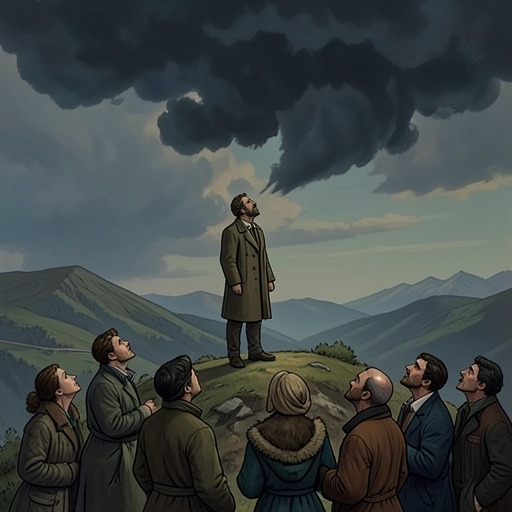
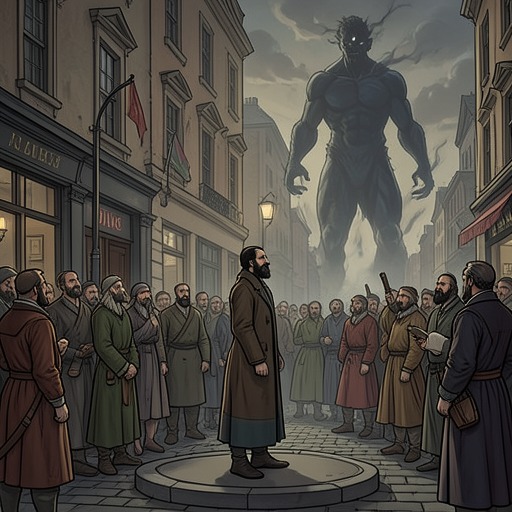
Langdon St. Ives encountered the spectacle after leaving a meeting with Parsons. The fog had cleared, and a crowd filled the street: people climbed trees, perched on shoulders, and gathered on carriages to hear the evangelist. A narrow passage opened through the mass, allowing St. Ives to approach. Shiloh stood on a crate, holding up a transparent container. From the front, St. Ives could see a partially mummified head, dusty and brown, inside a glass cube. The scene’s public scale made the object a promised wonder, but the spectators were not uniformly reverent; some were plainly waiting to be entertained.
The head’s jaw began to clack, and it bounced in its container as its stringy hair moved with it. Shiloh called on Mother to speak and lift the veil from the future. A hoarse voice answered, but the crowd’s expectation was interrupted by a heckler’s joke. Shiloh waited for quiet and tried again. The head produced a wavering utterance, then the crowd shouted back at it; the exchange broke the solemnity Shiloh was trying to create. When the head fell silent, a woman in the crowd blamed the hecklers, while another bystander demanded quiet. The audience was not a single body of believers but a noisy public whose laughter could disrupt the ritual as effectively as faith could sustain it.
St. Ives considered how the voice could come from an object without flesh on its neck, wondering whether wind might vibrate the bones in its chin. That rational possibility did not resolve the matter. The head spoke again, but its teeth seemed to fail before the voice had finished, leaving a fragment about dreadful things in the sea. Each attempt sounded weaker; Shiloh peered into the cube and shook it slightly, as if trying to keep the mechanism—or whatever animated it—going. The head gave a final series of short chatters, toppled onto its side, and stopped.
Failure, suspicion, and retreat
The crowd had expected revelations and instead surged forward to inspect the failed exhibit. Acorns fell from a tree as Shiloh, visibly puzzled and disappointed, tried to preach over the confusion. His supporters linked arms to hold back the onlookers, but the barrier gave way. Shiloh withdrew up the street with his followers, and a brougham arrived, took him and three allies away, and carried off the chattering head. The retreat preserved the object but could not restore the performance’s authority: the crowd had seen the promised oracle falter in public.
The failure does not establish that the whole display was a fraud. St. Ives judges that whatever Shiloh had attempted was not entirely fake, and that it bore the unmistakable stamp of Ignacio Narbondo. The distinction matters. Shiloh’s religious interpretation, the apparent animation, and St. Ives’s suspicion of a scientific or mechanical source remain in tension. The performance makes the head’s activity visible without making its cause transparent. Its public collapse therefore weakens Shiloh’s control over the crowd while leaving the underlying phenomenon unresolved.
The box beneath the falling star
A later gathering extends the performance’s consequences. At night on the Heath, Shiloh again raised a cube before his followers, although the darkness and scattered fires kept the object indistinct to Parsons. The crowd answered the evangelist; then a scream and pointing hands redirected attention to a tiny light descending from the sky. As it grew brighter, Shiloh named the star Wormwood. The language of apocalypse now accompanied a visible celestial event, shifting the crowd’s attention from the promised revelation in the cube to the object falling toward the Heath.
In the upheaval, a running figure in a broad-brimmed hat seized the cube from the evangelist’s hands and raced toward Parsons and the assembled Royal Academy. The glass container rattled; the man stared at it in apparent dismay, then threw it down and left. Shiloh and his followers, meanwhile, watched the glowing spheroid ship fall from the sky. The seizure and destruction of the container were not simply the end of the earlier street performance: they left Shiloh without the object at the moment his apocalyptic prophecy seemed to acquire an extraordinary public sign. The episode binds the fragile, disputed animation of the head to the novel’s larger arrival-from-the-stars mystery, while refusing to explain either the head’s power or the fleeing figure’s reaction.