The accidental launch and crash of St. Ives's spacecraft
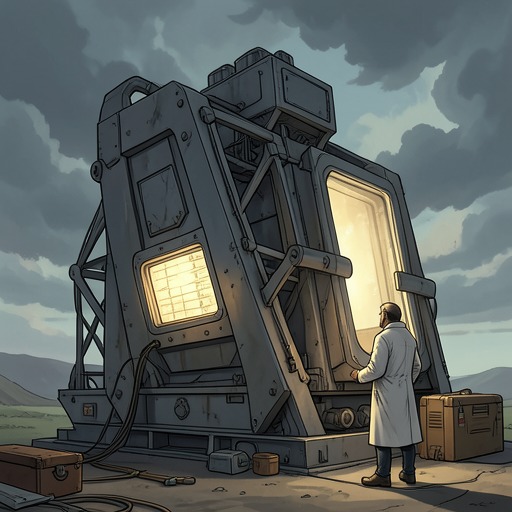
HomunculusThe accidental launch and crash of Langdon St. Ives’s spacecraft begins as a burglary and an act of intended sabotage, but turns on Billy Deener’s interference with the machinery in the silo. Seeking a box for Kelso Drake, Deener sets off the rocket without understanding the controls. The rocket breaks through the silo roof and falters; the spacecraft separates, flies beyond the observers’ reach, and crashes through Lord Kelvin’s barn. The episode converts a hidden, carefully made machine into public wreckage, while leaving the identity and custody of the box uncertain.
Background and Stakes
Deener entered the silo with a purpose supplied by his criminal work for Kelso Drake: he wanted the box and expected to damage Langdon St. Ives’s property along the way. He regarded the spacecraft as something worth meddling with and intended to disrupt the work of Langdon St. Ives and his associates. The silo concealed a rocket with a spacecraft perched above it, a project whose value Deener neither respected nor understood. The danger arose from the gulf between his destructive intent and the operation of the machine he was about to handle.
The box made the intrusion more than a simple attempt to damage the craft. Earlier, Sebastian Owlesby had withdrawn his interest in the West African Gem Company as a great emerald, intended as his son Jack’s inheritance, and had asked William Keeble to make a box for it. That box was almost identical to the lead-lined cube used to hold the Homunculus. Deener’s assignment to acquire a box therefore touched a chain of objects already subject to mistaken identity and competing claims. The launch did not resolve which box was involved; instead, the crisis at the silo unfolded alongside that uncertainty.
Deener’s Intrusion and the Trigger
At the top of the silo, Deener opened the spacecraft’s hatch and investigated the box mounted beside it. Its carved surfaces included a grinning hippopotamus, which provoked him to raise his hammer, but he stopped short of smashing it. He used a prybar and hammer to loosen it from its place, then carried it out onto the landing. The box resisted easy interpretation: its six sides appeared alike apart from their carvings, and shaking it produced no rattle. Deener found no latch. Unable to make sense of it, he left it outside and returned to the rocket.
His frustration shifted from the box to the surrounding equipment. He cut and trampled plants in the silo, then reached a bank of levers on the rocket’s smooth side. Rather than identifying their functions, he wrenched them in succession. One lever broke off in his hand; he threw it against the silo wall. The narrative presents this rough handling as the immediate cause of the launch, not as a considered attempt to fly the craft. Deener had meant to take the box and damage the operation, but his actions activated machinery with consequences far beyond his plan.
Launch, Separation, and Crash
A blast threw Deener into the grass and illuminated the scene. The silo’s domed roof burst outward, scattering shingles and fragments of wood as the rocket rose through the opening, trailing sparks. Its progress was unsteady: it seemed almost stationary, and its nose threatened to tip toward the ground. From beyond the willows, Langdon St. Ives and his companions watched the eruption and understood that the rocket was not making a successful ascent.
Just before the rocket dipped and fell lifeless onto the meadow, the spacecraft sprang away from its top. The distinction between the two machines matters: the rocket’s flight failed, but the spacecraft continued on its own, its gaslamps lit and its hatch thrown open. It arched over the observers and vanished beyond the trees. Langdon St. Ives could see neither the craft nor the point where it came down. An old man later described seeing it pass over the trees and strike Lord Kelvin’s barn, breaking through the roof and leaving the building in ruins. His animated account supplied the destination that the immediate scene had withheld; the crash had carried the craft out of the characters’ sight and into the landscape beyond them.
Consequences and Significance
The destruction was both practical and reputational. Langdon St. Ives recognized that the spacecraft, the product of years of work, had been reduced to wreckage, and he blamed himself for leaving the silo door unsecured. The loss followed directly from a failure of access control: a machine hidden from ordinary view could still be reached by an intruder, and its controls were vulnerable to someone acting without knowledge of them. The scene makes the scale of the danger visible through the contrast between Deener’s small, opportunistic objective and the consequences of a single lever being pulled.
The box’s role also remains unsettled after the launch. Much later, when William Keeble was conscious enough to answer questions, he confirmed that the emerald box and the Homunculus box were nearly identical apart from their distinctive carving and paintwork. Nell Owlesby acknowledged that she might have confused them, and considered that Dr. Birdlip could have the emerald. At the end, an open Keeble box contains the great emerald, while Dorothy Keeble has been recovered and is with Jack. These later details frame the silo episode as part of a larger sequence of mistaken custody and uncertain identification; they do not establish that the box Deener handled contained the Homunculus or the emerald.
The spacecraft’s loss does not close Langdon St. Ives’s interest in travel or the unknown. He does not regret losing the ship, because he has had his voyage and believes the future holds the promise of more. The crash thus ends the machine’s journey, not the larger imaginative horizon it had embodied. Its abrupt separation from the failing rocket gives the episode a double outcome: an ambitious vehicle is lost, while the events it set in motion continue to connect the theft, the box, and the characters who must determine what was taken.