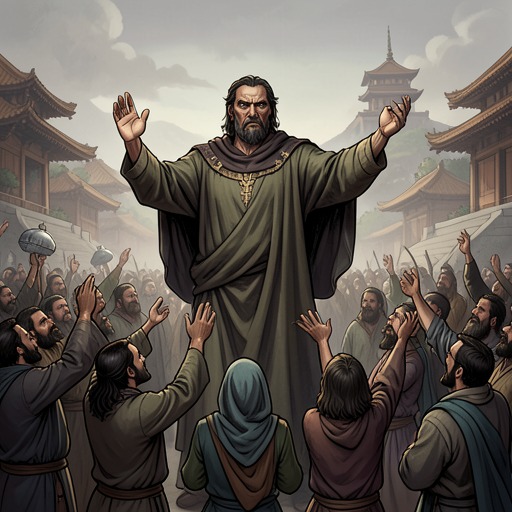
Crucifixion of Jesus
JudasThe Crucifixion of Jesus is both a historical and theological hinge in the novel and the devastating consequence of Judas’s intervention. The scene is rendered not as a triumphant passage toward resurrection but as a death witnessed by a man who helped arrange it because he loved Jesus and believed that the crucifixion would compel a final miracle. The two men’s deaths are joined in Judas’s understanding, while the later history of Jewish writing about Jesus reveals how difficult it has been to confront the event without distortion, invective, or silence.
Background and Interpretive History
The novel approaches the crucifixion through competing accounts of Jesus and through the silences surrounding him. Flavius Josephus, also called Yosef Ben Matitiahu, appears as the earliest Jewish source to mention Jesus. One version of his account, in Antiquities of the Jews, describes Jesus in language that sounds Christian, including his messiahship and reported resurrection; the novel notes the view of Gustav Yom-Tov Eisenschloss that the passage was likely rewritten and inserted by later Christian hands. A version preserved by Agapius instead presents Josephus as reporting the beliefs of Jesus’s followers without affirming the resurrection as fact. In either form, the treatment is brief: Josephus gives the episode fewer than a dozen lines, a small space for a life, teaching, death, and the religion that followed.
Later Jewish references are likewise sparse and uncertain. Rabbinic allusions may concern Jesus, or may refer to other people; the Tosefta mentions Ben Stada and a healer associated with the name Yeshu Ben Pandera, but the identifications remain conjectural. The Babylonian Talmud contains three explicitly derogatory passages about Jesus, yet they were removed from almost all printed versions because Jews feared what Christian neighbors might do if they read them. The novel makes this historical reticence part of its subject: the record is not simply a contest of claims, but also a record shaped by the danger of speaking.
Medieval polemic gives the crucifixion a harsher, more openly disputatious frame. An anonymous Jewish author’s Arabic work, later translated and adapted as The Book of Nestor the Priest, seeks to refute the Gospels, the Trinity, and Jesus’s divinity. Its argument is internally divided: it presents Jesus as a pious Jew who did not intend to found a new religion, while also repeating degrading claims about his birth and ridiculing his death. At its close, Nestor invokes the scriptural curse on a person who is hanged. Shmuel notices the contradiction between calling Jesus a righteous Jew and subjecting him to abuse, and draws attention to the text’s use of the crucifixion as an occasion for mockery rather than spiritual or moral engagement.
The Crucifixion as Witnessed
The central scene is told through Judas’s experience at the crucifixion. After leaving Jerusalem, he sits alone in a roadside tavern before Shabbat and Passover, unable to eat or drink. A pregnant young woman who has served him has no apparent support, and Judas’s awareness of her vulnerability does not quiet the remembered cries from the execution. The event remains with him as an experience from which he has escaped physically but not inwardly.
At the execution, the crowd gradually disperses as the day grows late and the approaching Sabbath and Passover draw people home. Women remain near the central cross, gathered close without quite embracing. One comforts the older woman; the younger watches the condemned man and weeps without turning away. Judas, standing apart, feels drawn toward them but stops by the broken timbers of an older cross. He believes that a miracle is about to occur and imagines the arrival of a kingdom not of this world. The expectation is not fulfilled in the scene: Jesus dies, while the other two condemned men continue to live for a time.
The distinction between what Judas hopes for and what he witnesses determines the scene’s force. Jesus’s last cry, as Judas understands it, is not a declaration of victory but an appeal to God in abandonment. Judas concludes that the deaths of both men have ended together. He leaves before the bodies are taken down. On the road, he gives a piece of cheese to a stray dog that has followed him, then tries to send it away at the entrance to the tavern. The dog returns and lies at his feet. This small act of care follows the public spectacle of suffering without undoing it; the scene closes not on a miracle but on Judas’s departure and the animal’s quiet company.
Judas’s Role and the Broken Promise of Redemption
The event’s decisive reversal is disclosed in Judas’s later account of how it came about. He says that nobody in Jerusalem had initially seen a reason to crucify Jesus: to the priests, Jesus seemed another eccentric Galilean preacher, and to the Romans, another marginal religious figure. Judas went repeatedly before the Sanhedrin and pressed his case, arguing that Jesus was unlike other prophets and describing miracles he claimed to have witnessed. He also persuaded Roman authorities to view Jesus as a possible source of revolt. Their agreement, in Judas’s telling, came less from conviction than indifference. Judas therefore understands himself not as a bystander to an inevitable sentence, but as the person who helped make it happen.
His responsibility is bound to love and belief. Judas says he loved Jesus as a brother, a teacher, and a wonder-worker, but that these descriptions were not enough: he loved him as God, and loved him more than he loved God. He saw Jesus as compassionate and merciful, in contrast to the jealous and punitive deity he rejected. Convinced that death could not reach Jesus, Judas believed the journey to Jerusalem would bring the greatest miracle, end death, and inaugurate a world governed by love. He also says that he pushed Jesus toward promises of redemption, immortality, and a new order, while Jesus himself had meant to continue healing the sick, feeding the hungry, and planting love and compassion in human hearts. The crucifixion is thus the tragic result of a mismatch: Judas’s immense expectation turns the person he loves into the instrument of a final, universal deliverance.
The scene’s failed expectation also reframes the familiar story of betrayal. Shmuel writes that Jewish authors across generations have almost never discussed Judas, even when they wrote polemics against Christianity or disputed the crucifixion and resurrection. In his reading, their silence reflects shame and fear of a figure burdened with generations of hatred and contempt. He contrasts that silence with images of Judas in famous Last Supper paintings, where he is made grotesque and morally legible through his appearance. The novel’s account shifts attention from the inherited emblem of the traitor to Judas’s own testimony: his agency is real, but so are his love, his belief, and the disastrous certainty with which he acts.
Jewish Critique, Political Faith, and the Limits of Salvation
The novel distinguishes criticism of Jesus from contempt for him. Gershom Wald condemns the vulgar abuse in The Book of Nestor the Priest, arguing that serious disagreement requires a higher standard than invective. He identifies universal love as a genuine subject for dispute, questioning whether anyone can love everyone without exception and whether Jesus’s own actions and sayings sit easily beside that command. The point is not to settle the theological questions, but to show how argument can engage a teaching rather than reduce its bearer to an object of insult. Shmuel likewise notes that Jewish polemic often concentrates on supernatural claims about Jesus’s birth, life, and death while avoiding his spiritual and moral message—and, strikingly, says nothing about Judas, without whom the crucifixion might not have occurred.
That dispute over religious redemption resonates with the novel’s modern political arguments. Wald distrusts movements that promise to save the world: Judaism, Christianity, Islam, and modern revolutions may preach goodness, he says, yet become instruments of coercion and bloodshed when they gain power. Shaltiel Abravanel’s opposition to establishing a Jewish state through partition and war rests on a different political vision, while Wald ultimately defends David Ben-Gurion’s realism: he believes that Jewish survival required self-reliance and that the Arabs would not willingly share territory or power. The disagreement is sharpened by the death of Wald’s only son, Mija, in the fighting. Wald recalls the way collective exhortations to take up arms helped send Mija to war, and imagines the question Shaltiel never asked him: whether it had been worth it.
In this context, Judas’s failed hope is more than a private religious disappointment. His belief that one death could abolish death and establish universal love echoes the larger temptation to make sacrifice the passage to a redeemed world. The novel places that expectation beside Wald’s refusal to believe in worldly redemption and the competing claims made in the name of national survival. The crucifixion remains open to argument and reinterpretation, but its narrative weight lies in its cost: Judas’s attempt to force a miracle produces a death he cannot repair, and the history built around that death carries both the hope of salvation and the danger of turning hope into a justification for suffering.