Exposure and criticism of Stalin-era Soviet terror
JudasExposure and criticism of Stalin-era Soviet terror becomes a decisive test for Shmuel Ash and the socialist circle he attends: the recognition of Stalin’s crimes does not settle whether socialism itself remains a viable hope, but opens that question into a crisis over the foundations of revolutionary authority. The resulting split estranges Shmuel from friends and gives political disillusionment a direct place in his private loneliness.
The Circle and Its Dispute
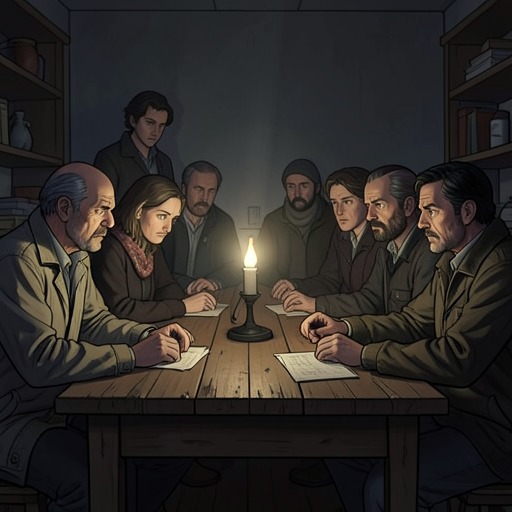
The group met every Wednesday evening at eight in a low-ceilinged, soot-darkened café in the back lanes of the Yegia Kapaim neighborhood. Artisans, plumbers, electricians, painters, and printers also gathered there to play backgammon, lending the place a working-class character that the socialist circle valued. The members and the workers did not ordinarily share a table, but conversation sometimes crossed the gap: a player might call over a comment, or a group member might approach to ask the backgammon players for a light. The setting gives the circle’s politics a material, if limited, proximity to the laboring people on whose behalf it spoke. The immediate dispute followed the exposure of Stalin’s terror and the condemnation of his regime at the twentieth session of the Soviet Communist Party’s assembly. After repeated objections, nearly all the members accepted that judgment. A stubborn minority, however, insisted that the reckoning could not stop at Stalin’s personal rule: the group must also reconsider its commitment to Stalin and its attitude toward the very foundations of the dictatorship of the proletariat as Lenin had conceived it. Two members went further, invoking the ideas of the young Marx to challenge the armored doctrine of the mature Marx. The controversy was thus not simply over a disgraced leader; it reached into the political tradition that had authorized the group’s hopes.
The Split and Shmuel’s Loss of Community
Shmuel tried to stop the group from wearing itself down in argument, but four of its six members declared a break and announced the formation of an independent cell. Both women in the group were among the four dissenters; their departure mattered to Shmuel beyond the abstract reorganization of a political circle. The collective that had offered him an intellectual and social home was divided, and its fracture could not be repaired by his effort to contain the disagreement. Later, speaking with Gershom Wald, Shmuel explained that his friends had moved away from him—or, more precisely, that he had moved away from them—after the Stalin crisis shook the socialist movement and the controversy erupted among them. Rather than discuss love and loneliness, he described the circle’s weekly meetings and its dissolution, then turned to Lenin’s legacy and Stalin’s treatment of it. The political rupture had become a way to speak about personal isolation, even as Shmuel used political argument to evade Wald’s questions about his emotional life.
The Problem of Discredited Ideals
Shmuel’s defense of continuing hope takes the form of two comparisons. He asks whether the corruption and deviation of the Soviet party require the abandonment of a vast idea and of the hope for social justice; by the same reasoning, he asks whether the Inquisition’s claim to act in Jesus’s name should make Jesus himself a figure to be judged negatively. The analogy separates an ideal from the institution that claims to embody it, without denying the damage done by that institution. The question remains difficult precisely because the Soviet case has made the difference between revolutionary promise and political practice impossible to ignore. Wald answers with a different pressure. He portrays Shmuel as a courageous soldier in the effort to put the world right, but sets that idealism against a future purified by revolution, in which people like Wald—disabled, dependent, and unwillingly made objects of jokes—would supposedly have no right to exist. He also imagines Atalia as dispensable to such a world: a solitary widow who does not join the work of remaking society and instead does good and bad, breaking the hearts of the naïve. His challenge exposes the human cost hidden inside Shmuel’s language of a transformed world. Political purification may promise equality while rendering the imperfect, the dependent, and the emotionally complicated intolerable.
Political Rupture and the Meaning of Treason
The novel places the circle’s ideological fracture beside the fate of Shaltiel Abravanel, whose opposition to the political course chosen by Ben-Gurion and others was framed as treachery. A contemporary newspaper report attributed to Abravanel the warning that this course would lead to a bloody war between Jews and Arabs, while a historic compromise was still possible. The account of Stalin-era terror and the circle’s schism therefore sits within a broader pattern: dissent can be condemned as betrayal when a movement treats unity and discipline as conditions of survival. Shmuel later argues that the readiness to change can itself earn the name of traitor from those who fear change. By invoking examples of people stigmatized for challenging prevailing loyalties, he recasts the label as a possible mark of courageous dissent rather than proof of disloyalty. The socialist circle’s split gives that idea an intimate basis: Shmuel’s political friends did not merely disagree over an historical verdict; they separated over what that verdict demanded of their shared commitments. Their rupture leaves open the question that animates the episode—whether the betrayal lies in abandoning an ideal after its corruption, or in preserving an ideal by refusing to confront what has been done in its name.